The short version
- All of these pedals do one trick: a slow low-frequency oscillator (LFO) wobbles something. What it wobbles is the whole difference. More on the LFO.
- Tremolo wobbles the volume. Vibrato wobbles the pitch. Details and the naming mix-up.
- Chorus mixes your signal with a copy delayed by roughly 5 to 50 milliseconds, with that delay wobbling. Chorus.
- Flanger does the same with a shorter delay (Wikipedia says under about 20 ms) and usually feeds some of the result back, which gives the jet-plane sweep. Flanger.
- Phaser uses no delay at all. It shifts the phase of different frequencies with a chain of all-pass filters, then mixes that with the dry signal, which cancels a few moving bands. Phaser.
- Chorus and flanger pedals in the analog era are built around a bucket-brigade delay chip. Phasers are built from filters and a transistor or two acting as variable resistors.
- We have bought and sold plenty of these pedals. They are listed below, and the blog post tells the story of how they turned up.
The LFO: the slow wobble that does the work
Every effect on this page uses a low-frequency oscillator, a control signal too slow to hear as a note that steers something that you can hear. According to ElectroSmash’s analysis of the Boss CE-2, chorus LFOs run at up to about 20 Hz, and the two common shapes are sine and triangle. A sine wave changes pitch smoothly all the time, while a triangle gives two alternating pitches with a sudden change between them. The CE-2 uses a triangle. ElectroSmash’s analysis of the MXR Phase 90 says its triangular LFO runs from tenths of a hertz up to a few hertz, set by its one knob.
Two controls turn up on nearly every modulation pedal because of this: Rate (also Speed), which is the LFO’s frequency, and Depth (also Width), which is how far the LFO swings the effect. The controls section covers the rest.
Tremolo and vibrato: volume versus pitch
Wikipedia defines vibrato as a periodic variation in the pitch of a note, and tremolo (in the amplitude sense) as a variation of volume. A true electric-guitar tremolo, it says, is normally made by a simple amplitude-modulation circuit: the LFO simply turns the volume up and down.
The confusion is a long-running one. The lever on a Stratocaster-style bridge, which bends pitch, is commonly called the “tremolo arm”. Wikipedia calls that a misuse of the term, since it changes pitch and not volume, and notes that people still call the bridge system a “tremolo” anyway. The word has been wrong for long enough that it is now correct by seniority. Wikipedia also notes that the two terms are sometimes used interchangeably in general use, so when a pedal says “vibrato” or “tremolo”, it is worth checking which one it does.
An electronic vibrato is a close relative of chorus. Wikipedia says vibrato can be reproduced “electronically as an audio effect close to chorus”, and ElectroSmash notes that the Boss CE-1 had a vibrato mode that its smaller successor, the CE-2, left out. My reading of that, rather than a sourced statement: a vibrato is what you get if you take a chorus circuit and listen only to the delayed, modulated copy. While the delay time is changing, that copy is slightly sharp or flat compared with the input, and that is the pitch wobble. Our Behringer UV300 Ultra Vibrato was listed as an analog pedal in the Boss style.
Chorus: two players that are nearly in tune
Wikipedia describes the chorus sound as what you hear when sources with nearly the same pitch converge, such as a choir or a string section, with a shimmer that comes from beating. A chorus pedal fakes a second player by making a delayed, slightly detuned copy of your signal and mixing it with the original.
- Architecture. ElectroSmash describes chorus as a delay-based effect: the output is the original plus the input run through a delay, and the delay time is modulated by an LFO. Typical delay times are around 5 to 50 ms.
- History. ElectroSmash traces the chorus or “celeste” effect to Hammond organs from the 1940s, and early stompboxes such as the Vibra-Chorus and Uni-Vibe from Shin-Ei in the 1960s. The Roland/Boss CE-1 Chorus Ensemble (1976), which was taken from the circuit in the Roland JC-120 amp, is described there as the “Mother of Chorus”. The compact CE-2 followed in 1979 with mono output and no vibrato mode, no level or intensity controls, and an input impedance and mid boost better suited to guitars (the CE-1 had a 50 kΩ input intended for keyboards).
- What is in a CE-2. A 1024-stage MN3007 bucket-brigade chip, an MN3101 clock driver, a pair of op-amps in the signal path, a separate op-amp for the LFO, and just two controls: Rate and Depth. ElectroSmash lists three production versions: black label made in Japan (1979 to 1984), green label made in Japan (1984 to 1988) and green label made in Taiwan (1988 to 1991). For dating a Boss pedal in general, see our Boss dating guide.
- Stereo. ElectroSmash notes one approach to a stereo chorus: two independent delays sharing the same LFO but modulated 180 degrees out of phase, giving a double wet output. Our catalogues include several pedals sold as stereo choruses, such as the MXR M-134 and the DOD FX60 and FX65B. For the DOD series, see the DOD FX-series field guide.
Bucket-brigade delays: how an analog chorus gets its delay
A bucket-brigade device (BBD) is a long chain of capacitors, each passing its stored charge to the next at a rate set by an external clock, like a line of people passing buckets. ElectroSmash’s page on the MN3007 and bucket-brigade devices says the chip was invented by F. Sangster and K. Teer at Philips Research Labs in 1968 to 1969, that Roland/Boss was the first customer for the Matsushita-licensed version, and that it went into the JC-120 amp, the CE-1 and the CE-2. The output is discrete in time (because of the clock) but analog in amplitude (because the stored charge is a voltage).
- The numbers. The MN3007 has 1024 stages and gives a delay of 5.12 to 51.2 ms for clock frequencies from 100 kHz down to 10 kHz. Signal-to-noise is typically 80 dB, distortion 0.5 percent typical, and it wants a negative supply of 10 to 15 volts. The MN3207 is the NMOS version, with a single positive supply but a lower signal-to-noise figure of 73 dB.
- The arithmetic. Those figures fit delay = stages / (2 × clock frequency): 1024 / (2 × 100,000) = 5.12 ms, and 1024 / (2 × 10,000) = 51.2 ms. That is my calculation, not a quotation, but it matches the datasheet range. Slow the clock down and the delay gets longer.
- Clock limits. ElectroSmash says the chip is guaranteed up to about 100 to 200 kHz, because the input capacitance of the clock pins degrades the clock pulses above that.
- Filters before and after. Because the signal is sampled, a pedal needs pre- and de-emphasis filters and anti-aliasing and reconstruction filters around the chip, which is a lot of the CE-2’s circuitry. My reading: that filtering is a large part of why analog chorus and flanger pedals sound a little dark compared with the dry signal.
- Who else used it. ElectroSmash lists the Boss DM-1 delay, Electro-Harmonix Small Clone and Memory Man, Maxon AD-999 and MXR Analog Delay among MN3007 users. Some designers used other clock circuits, and it names the CD4047 in the Small Clone and the A/DA Flanger, and the 4013 in the Electric Mistress.
Flanger: the same idea, shorter and more extreme
Wikipedia defines flanging as mixing two identical signals together, one of them delayed by a small and gradually changing period, usually under 20 ms. That produces a swept comb filter: peaks and notches in a regular harmonic series, which move up and down as the delay changes. Part of the output is usually fed back into the input, which makes the peaks and troughs more intense, and the feedback can be polarity-inverted for a different flavour.
- Why it is called that. The effect was first made with two matching tape machines playing in sync into a third, while an engineer slowed one by pressing a finger on the flange (the rim) of the supply reel. Wikipedia notes that the Beatles’ producer George Martin disputed this source for the term, and that Les Paul found the effect in the late 1940s and 1950s using acetate disks on variable-speed record players.
- Pedals. Wikipedia says solid-state flanging became possible in the 1970s, and gives the Eventide Instant Flanger from 1975, a studio unit using bucket brigades, as an early example. The Electro-Harmonix Electric Mistress is listed on its company page among that firm’s influential 1970s pedals.
- Why flangers need a different chip. By my arithmetic from the BBD formula above, getting a delay of 1 ms from a 1024-stage chip needs a clock of about 512 kHz, far above the MN3007’s 100 kHz guideline. ElectroSmash says that is why the Reticon SAD1024, with much lower clock-pin capacitance (110 pF against 700 pF for the MN3007), was widely preferred for flangers.
- Chorus or flanger? The delay ranges overlap (5 to 50 ms for chorus against under 20 ms for flanging), so length alone does not settle it. In practice the difference is the feedback and the sound: a chorus thickens, a flanger sweeps a comb filter.
Phaser: no delay, just phase
Wikipedia describes a phaser as splitting the signal into two paths. One path goes through an all-pass filter, which passes every frequency at the same level but shifts its phase by an amount that depends on frequency. When the two paths are mixed, frequencies that end up out of phase cancel, which creates notches that the LFO sweeps. A device whose all-pass section is a delay line is, by definition, a flanger.
- Stages and notches. A phaser with n all-pass stages generally has n/2 notches, so four stages gives two notches (Wikipedia). Analog phasers come with 4, 6, 8 or 12 stages. ElectroSmash’s comparison: the MXR Phase 45 has one notch (two stages), the Phase 90 and the Uni-Vibe have two (four stages), and the Phase 100 has three. The seller of our Phase 45 reissue wrote that two-stage phasers have a “subtle shimmer at slow speeds” and a Uni-Vibe-like warble when faster. Our DOD FX20B was listed as a six-stage phaser, which by the n/2 rule means three notches.
- Mix. Changing the mix ratio changes how deep the notches are, and the deepest notches come at a 50 percent mix (Wikipedia). ElectroSmash says the Phase 90’s output stage mixes the dry and processed signals at 50 percent.
- History. Wikipedia says the first portable guitar phaser was the Maestro PS-1 Phase Shifter, designed by Tom Oberheim, with three speed buttons. ElectroSmash says the MXR Phase 90 was designed by Keith Barr in 1974, was MXR’s first product and a great success, with production stopping when MXR went bankrupt in 1984 and later restarting under Jim Dunlop.
- Inside a Phase 90. A pedal of this type has an input buffer, four phase-shifting units, an LFO and an output mixer. The phase shifters use JFET transistors as variable resistors, and the LFO’s triangle wave steers their gate voltage. ElectroSmash says matching JFETs matters, since it is much harder to make consistent JFETs than bipolar transistors, and the Phase 90’s LFO has a trim to suit the set of JFETs used.
- Script, Block and feedback. ElectroSmash says the first Script Logo Phase 90s have no feedback resistor. Later Block Logo schematics added one (R28), which makes the effect stronger and can cause boost and distortion in the midrange, and the EVH signature model has a pot to adjust it. Cutting it out makes the pedal “more balanced and smooth”. Our sold MXR Phase 90 was a recent Block Logo-style M101.
- Copies. We have handled several Phase 90-style pedals, including the Belcat PHS-505, Biyang Phase Pro PH-10, Joyo Vintage Phase and Donner Pearl Tremor. For the copy-maker backstory see our Joyo clone guide.
The Uni-Vibe: a phaser that wants to be a chorus
Wikipedia says the Uni-Vibe (also sold as the Jax Vibra-Chorus) is a footpedal-operated phaser used for chorus and vibrato simulations. It was designed by Fumio Mieda, introduced in the 1960s by the Japanese company Shin-ei, and released in North America by Univox in 1968. It is built from a staggered series of phasing filters and an optical circuit of light-dependent resistors and an incandescent bulb in a light shield, without op-amps. Wikipedia adds that it is commonly thought to emulate the Doppler sound of a Leslie speaker, but that Mieda said in an interview the effect came from hearing radio signals under “atmospheric modulation”.
The Leslie: the mechanical original
The Leslie speaker modifies the sound physically, by rotating a baffle chamber in front of the speaker or a system of horns in front of the treble driver. Wikipedia says Donald Leslie began working on it in the late 1930s and sold it himself from 1941, mainly to organists. Some models have two speed settings, named “chorale” and “tremolo”. A rotating source moves toward and away from the listener, which changes both pitch and volume at once, which is why so many electronic effects are described as imitating it, rightly or wrongly (that last part is general physics, not from our sources).
All of them side by side
| Effect | What the LFO changes | Typical numbers | Sound | Classic examples |
|---|---|---|---|---|
| Tremolo | Volume | Amplitude modulation by an LFO (Wikipedia) | Pulsing, shuddering | Amp and pedal tremolos |
| Vibrato | Pitch | Fully modulated delay, no dry signal (my reading) | Wavering pitch | CE-1 vibrato mode, UV300-style pedals |
| Chorus | Delay time of a mixed-in copy | About 5 to 50 ms delay | Shimmer, thickening | Boss CE-1, CE-2 |
| Flanger | Shorter delay, usually with feedback | Under about 20 ms | Jet-plane swoosh, comb filter | Electric Mistress, MXR flanger, Boss HF-2 |
| Phaser | Phase of all-pass stages | n stages gives n/2 notches; Phase 45 one, Phase 90 two | Swirl, hollow sweep | MXR Phase 45 and 90, Boss PH-2 |
What the knobs do
Names vary by maker. The explanations of Rate, Depth and Mix are sourced above. The others are general descriptions that I have marked.
- Rate / Speed. The LFO’s frequency. ElectroSmash describes it as set in the hertz region, roughly the speed of natural human vibrato.
- Depth / Width. How far the LFO swings the effect. On the CE-2 ElectroSmash says Depth sets the amplitude of the LFO’s triangle signal, which relates to the amount of modulation.
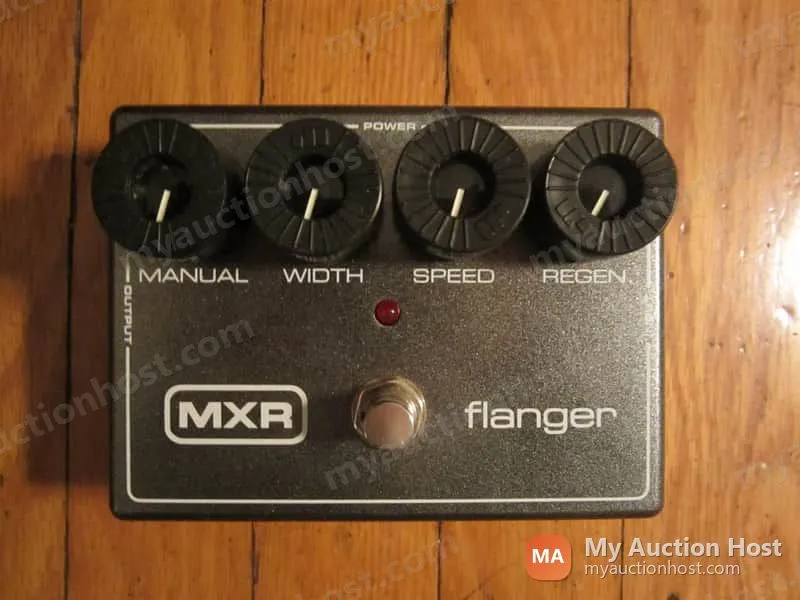
- Manual. Found on flangers, as on our MXR M-117 (Manual, Width, Speed, Regen). In general it sets the centre point of the delay sweep. That is general knowledge, not something we sourced.
- Regen / Resonance / Feedback. How much of the output goes back into the input. Wikipedia says that on a flanger it intensifies the peaks and troughs, and on a phaser it creates a resonant effect that emphasises the frequencies between the notches. Our Boss Super Phaser has a Res knob for this.
- Mix / Level. Dry-to-wet balance. Notches are deepest at an equal mix (Wikipedia). Many classic pedals have no mix knob and use a fixed ratio.
- Mode. Our Super Phaser also has a Mode knob. We have not documented what each position does, so check the manual before relying on one.
Bass and low notes
Several of the pedals we have handled were made for bass, such as the DOD FX72 Bass Stereo Flanger and the Eden Amplification Bass Chorus I-90. What a given circuit does to low notes depends on its filtering, and we have not measured any of ours. A seller of one of our Boss HF-2 flangers wrote in the listing that it sounds great with bass, and noted that many online comments compare it to Andy Summers’ guitar sound. Those are seller opinions. For the rest of the bass signal chain see the bass section of our pedal order guide.
Where they go on a pedalboard
Our pedal order guide covers this with Boss and Sweetwater’s advice: modulation usually goes after the drives, so the effect works on the finished tone, and before delay and reverb, though some players disagree. If you run them from a shared supply, see the pedalboard power guide. Our overdrive, distortion and fuzz post covers the drive pedals that sit before them.
Modulation pedals from our catalogues
Grouped by effect, going by the listing text and category. Bought items show the asking price, sold items the sale price, and a few listings did not sell, as on their own pages.
Phasers
- Boss Super Phaser (bought Jul 2016, asking $45)
- Boss PH-2 Super Phaser (listed, did not sell, asking $55)
- Boss PH-3 Phase Shifter (sold Feb 2018 for $40)
- MXR Phase 90 (sold Mar 2017 for $50)
- MXR Phase 45 Script Reissue (sold May 2017 for $75)
- DOD FX20B (sold Apr 2018 for $30)
- DigiTech Hyper Phase (sold Feb 2018 for $30)
- Belcat PHS-505 (listed, did not sell, asking $28)
- Biyang Phase Pro PH-10 (sold Mar 2017 for $28)
- Joyo Vintage Phase (sold Apr 2017 for $20)
- Donner Pearl Tremor Phaser (sold Mar 2017 for $20)
Flangers
- MXR M-117 Flanger (bought Nov 2017, asking $80)
- 1980s Boss HF-2 Hi Band Flanger (bought Jul 2016, asking $50)
- 1987 - 1996 DOD FX72 Bass Stereo Flanger (bought Apr 2026, asking $45)
- 1980s Boss HF-2 Hi Band Flanger (sold Mar 2017 for $60)
- DOD FX75 (sold Apr 2018 for $35)
- DOD FX75C Flanger (sold Feb 2018 for $30)
- DOD FX75C (listed, did not sell, asking $40)
- DOD FX75C Flanger and FX65B Chorus (sold Jul 2018 for $75)
Chorus and vibrato
- Eden Amplification Bass Chorus I-90 (bought Oct 2018, asking $40)
- MXR M-134 Stereo Chorus (sold Feb 2018 for $99.99)
- DOD FX60 (sold Mar 2018 for $44)
- DOD FX60 Stereo Chorus (sold Feb 2018 for $35)
- DOD FX65B (listed, did not sell, asking $40)
- Danelectro DS-5 and DS 6 (sold Feb 2018 for $30)
- Behringer UV300 Ultra Vibrato (sold Jan 2018 for $19.95)
Several of the DOD pedals above are covered, with dating and model histories, in the DOD FX-series field guide, and the Boss ones in the Boss dating guide. The story behind buying and selling them is in the blog post.
Where to find them on eBay and Reverb
| Looking for | eBay | Reverb | Amazon (similar) |
|---|---|---|---|
| Phaser pedals | eBay | Reverb Sponsored link. We may earn a commission if you buy through it. Details | Amazon |
| MXR Phase 90 and Phase 45 | eBay | Reverb Sponsored link. We may earn a commission if you buy through it. Details | Amazon |
| Flanger pedals | eBay | Reverb Sponsored link. We may earn a commission if you buy through it. Details | Amazon |
| Chorus pedals | eBay | Reverb Sponsored link. We may earn a commission if you buy through it. Details | Amazon |
| Boss CE-2 chorus | eBay | Reverb Sponsored link. We may earn a commission if you buy through it. Details | Amazon |
| Vibrato pedals | eBay | Reverb Sponsored link. We may earn a commission if you buy through it. Details | Amazon |
| Tremolo pedals | eBay | Reverb Sponsored link. We may earn a commission if you buy through it. Details | Amazon |
| Bass chorus and flanger | eBay | Reverb Sponsored link. We may earn a commission if you buy through it. Details | Amazon |
Sources
- Flanging: Wikipedia
- Phaser (effect): Wikipedia
- Chorus (audio effect): Wikipedia
- Tremolo: Wikipedia
- Vibrato: Wikipedia
- Uni-Vibe: Wikipedia
- Leslie speaker: Wikipedia
- Electro-Harmonix: Wikipedia
- MXR Phase 90 analysis: ElectroSmash (read via the Internet Archive)
- Boss CE-2 analysis: ElectroSmash (read via the Internet Archive)
- Bucket brigade devices and the MN3007: ElectroSmash (read via the Internet Archive)