The short version
- Where anyone bothers to make the distinction, distortion is the more extreme version of overdrive, and fuzz is a particular form of extreme distortion. That is Wikipedia’s wording, and it is about as official as this subject gets.
- The useful difference is in the circuit. Overdrive rounds the peaks of the signal off gently (soft clipping). Distortion chops them off abruptly (hard clipping). Fuzz does it with transistors working hard, and the waveform ends up close to square.
- The sound also depends on where the clipping sits, what the filters around it do, and how much gain comes before it. Those details are why a Tube Screamer, a Rat and a Big Muff sound nothing alike, and we go through the actual component values below.
- The names on the pedals do not always agree. Plenty of our own listings say “overdrive distortion” in the same breath, and one Boss pedal has a knob to move between the two.
- This is a catalogue tour, not a shoot-out. The pedals are ones I have bought or sold, grouped by what they are descended from. I am not claiming to have A/B-tested them all, and I say when something is my reading or my arithmetic rather than a source’s.
The one idea you need: clipping
Every one of these pedals makes a louder copy of your guitar signal and then lets the peaks run into a wall. The wall is what you hear. According to Wikipedia’s distortion article, soft clipping “gradually flattens” the peaks and creates higher harmonics related to the original note, while hard clipping flattens them abruptly and puts more power into the higher harmonics. Gentle rounding sounds like an amp getting warm. A flat chop sounds like an amp shouting.
In the pedal world the usual short form (Wikipedia’s list of distortion pedals says it in so many words) is: overdrive is soft clipping, distortion is hard clipping, and fuzz is the one that gets nearly to a square wave using lo-fi transistors. It is a tidy rule. It is also a rule with a lot of exceptions.
Symmetric or asymmetric?
There is a second axis. If the positive and negative peaks are clipped the same amount, the clipping is symmetric. If one side clips harder than the other, it is asymmetric. Per the same Wikipedia article, symmetric hard clipping adds high-amplitude odd harmonics, a “dirty” or “gritty” tone, while asymmetric clipping produces both even and odd harmonics. In the pedals below, ElectroSmash describes the Tube Screamer and Rat as symmetric, and the Fuzz Face as asymmetric, and Wikipedia describes the Boss OD-1 as asymmetric soft clipping. You can see how a simple change shifts things: ElectroSmash notes that removing either of the Tube Screamer’s two clipping diodes would give asymmetric clipping.
Overdrive: the amp that is just starting to break up
The idea behind overdrive is to imitate a tube amp being pushed. Wikipedia notes that by the mid-1970s hard rock had made heavy tones popular, but getting them meant playing very loud, so Boss released the OD-1 in 1977 to give the sound of power-amp distortion at lower volumes. It describes the OD-1’s clipping as asymmetrical and soft, set against the “brash” fuzz pedals of the day.
Inside a Tube Screamer
Wikipedia says Maxon developed the Tube Screamer as a competitor to the OD-1 and that the first one, the TS808, came out in 1979. The ElectroSmash analysis (read through the web archive, because the live site would not load for us) breaks it into an input buffer, a clipping amplifier, a tone and volume section and an output buffer, around a dual op-amp such as the JRC4558. The clipping amplifier is where the character lives:
- Gain. A non-inverting op-amp stage whose gain is set by a 4.7 kΩ resistor to ground and, in the feedback path, a 51 kΩ resistor in series with the 500 kΩ Drive pot. That works out to a gain of about 12 at minimum Drive and 118 (about 41 dB) at maximum. (ElectroSmash quotes the same figures; the arithmetic is 1 + feedback resistance / 4.7 kΩ.)
- Clipping. Two diodes, back to back, sit in that feedback path. When the voltage across them exceeds their forward voltage, they conduct and the stage’s gain falls toward 1, so the peaks are held rather than chopped flat. ElectroSmash’s analysis uses a diode forward voltage of about 1 V for the original part (it lists 1N914 silicon diodes in its bill of materials). It is symmetric.
- It clips earlier than you might think. At minimum Drive, ElectroSmash works out that input signals below roughly 90 mV peak pass without clipping. Its rule of thumb for pickups is 60 to 200 mV for single coils, 200 to 600 mV for humbuckers and hot pickups, and picking transients up to about 2 V peak on hot pickups. So a humbucker will push the diodes even with the Drive turned down.
- Bass is clipped least. A 4.7 kΩ resistor and 0.047 µF capacitor from the inverting input to ground form a high-pass filter in the feedback loop with a corner near 720 Hz (1 / 2πRC). Below it, the stage has progressively less gain, so low notes are clipped less and the distortion is frequency-selective.
- The top is softened twice. A small 51 pF capacitor across the diodes rounds off the corners of the clipped wave, and a passive low-pass filter after the clipper (723 Hz, per ElectroSmash) rolls off the highs. Put those together and you have the famous mid hump.
- Tone control. The Tone knob is an active circuit with a 220 Ω resistor and 0.22 µF capacitor that shunts feedback above about 3.2 kHz, according to ElectroSmash.
ElectroSmash also has a short “Tube Screamer myth” section: it says the circuit is simple and the parts cheap, yet prices of the early 1980s pedals keep rising, partly on the belief that the original JRC4558D chip made by Japan Radio Company has the best sound. That is a claim about the market, not a measurement, and I am passing it on, not endorsing it.
One consequence, and this part is my reading, not ElectroSmash’s: a circuit that deliberately keeps the lows out of the clipper is an awkward fit for a bass. Our catalogue has plainly noticed, with a Tube Screamer Bass and other bass-specific drives, listed below.
Overdrive-family pedals from our catalogues
Grouped by what they are, or are modelled on, going by the listing text. Many are boutique takes on the Tube Screamer, the Klon Centaur, the Timmy and the Zen Drive. I have not opened them up, so none of the component details above are claimed for these specific units.
- 2011 - Present Ibanez TS9B Tube Screamer Bass (bought Mar 2025, asking $75)
- Critter - TS “LEGEND” ! 18 v internally charged w/9v (Tube Screamer Inspired) Ships now. (bought Sep 2021, asking $79)
- Boss SD-1 Overdrive (bought Apr 2017, asking $35)
- Boss BD-2 Blues Driver Overdrive (bought May 2018, asking $55)
- 2018 Fulltone OCD V2 (bought Oct 2021, asking $80)
- 2020 Critter Klone (bought Jun 2021, asking $129)
- 2020 Critter Klone Overdrive (bought Jun 2020, asking $80)
- Paul Cochrane Timmy Overdrive Pedal (bought Apr 2017, asking $129)
- Mad Professor Sweet Honey Overdrive (bought Apr 2017, asking $99)
- Handmade zendrive (bought Nov 2016, asking $58)
- Joyo JF-01 Vintage Overdrive (sold Feb 2018 for $20)
- Slide Meister Slide Meister ODX Overdrive (sold Feb 2018 for $30)
- Boss SD-1 Overdrive (sold Feb 2018 for $30)
- Caline Pure Sky Overdrive CP-12 (sold Jan 2018 for $20)
- Bartek Zendriver (sold Feb 2018 for $50)
- Electro-Harmonix Bass Soul Food (sold Feb 2017 for $55)
Distortion: hitting the wall on purpose
Wikipedia dates the Boss DS-1 to 1978 and says it uses two hard-clipping diodes for an aggressive edge, similar to the Pro Co Rat released the same year. That pairing is why the circuit type became known as “distortion” as opposed to the soft-clipping “overdrive” of Boss’s earlier pedal. (The Rat is dated 1978 in Wikipedia’s infobox, but its article text says full production started in 1979 and that it first appeared in the 1979 catalogue, so call it the late 1970s.) Wikipedia adds a detail about the DS-1: it uses a preamplifier chip, a Toshiba TA7136AP, instead of a conventional op-amp, and when that part became scarce the circuit was redesigned in 1994, with audible differences.
Inside a Pro Co Rat
ElectroSmash on the Rat describes a single LM308 op-amp running as a variable-gain non-inverting amplifier, followed by the clipping diodes, a tone filter and a transistor output stage.
- Gain. The 100 kΩ Distortion pot over a 47 Ω and 560 Ω pair gives a theoretical gain of up to 2305, or 67 dB. ElectroSmash is quick to add that the real figure is limited by the op-amp’s own characteristics and by the clipping, and it compares the nominal maximums: Big Muff 60 dB, MXR Distortion+ 46 dB and Tube Screamer 41 dB.
- Clipping. Two silicon diodes (1N914 in the bill of materials) go from the op-amp’s output to ground, not into the feedback loop. Once the amplified signal exceeds a diode’s forward voltage the diode conducts and the signal is held at that level, positive and negative. That is hard clipping, symmetric. ElectroSmash says the op-amp amplifies the signal up toward the supply limits before the diodes hold it. My reading is that this is why the result is a harder, more complete clip than the Tube Screamer’s.
- Filtering. A 100 pF capacitor across the feedback and the op-amp’s limited bandwidth roll off the top at high gain, and high-pass filters (around 60 Hz and 1.5 kHz, in ElectroSmash’s words) trim the bass, leaving a mid hump around 1 kHz.
- Tone. A single-pole low-pass filter (1.5 kΩ plus the 100 kΩ pot, with a 3.3 nF capacitor), sweeping from about 475 Hz to 32 kHz per ElectroSmash. It is a wide range, and at the fully bright end the clipped wave shows a “shark fin” shape.
- Output. A JFET source follower gives a low output impedance, and the input has a 1 MΩ pull-down resistor, so the Rat does not pop when switched.
So the same two-diode idea gives opposite results depending on where it goes: inside the feedback loop (Tube Screamer: gain falls as the diodes turn on, soft clipping) or after the gain stage, to ground (Rat: the signal is simply held at the diode voltage, hard clipping). This is my simplified summary of ElectroSmash’s two analyses.
Distortion-family pedals from our catalogues
The Rat and DS-1 lineage is well represented, along with some hybrids. Where I call one a Rat clone, I have gone by the listing.
- Boss DS-1 Distortion (bought Aug 2016, asking $35)
- MXR Custom Badass '78 Distortion (bought Aug 2016, asking $38)
- 2023 Critter 1978R (bought Aug 2023, asking $90)
- DOD Gunslinger Mosfet Distortion (bought Nov 2017, asking $76.99)
- 2021 Tacoma Standard Electronics "Bass Commander" (bought Apr 2021, asking $74)
- Boss DS-1 Distortion (sold Mar 2017 for $25)
- MXR Custom Badass '78 Distortion (sold Mar 2017 for $30)
- Mosky Audio Black Rat (sold Jan 2018 for $20)
- Biyang DS-8 Mouse Distortion (sold Feb 2018 for $35)
- MXR Distortion + (sold Mar 2017 for $60)
- Tech 21 Hot-Rod Plexi (sold Apr 2017 for $115)
Fuzz: the happy accident
Wikipedia calls fuzz “a particular form of extreme distortion originally created by guitarists using faulty equipment.” The first commercial fuzz pedal was the Maestro FZ-1 Fuzz-Tone, which Wikipedia says Gibson introduced in 1962 (the circuit came from Glenn Snoddy and Revis Hobbs). In May 1965 Keith Richards used one to record “(I Can’t Get No) Satisfaction,” and the market for them took off.
Inside a Fuzz Face
The Fuzz Face was designed in London by Arbiter Electronics in the autumn of 1966, says ElectroSmash, and it uses just two transistors where some rivals used three. There is no op-amp in the circuit it analyses; two transistors and a feedback resistor do the work.
- Gain. ElectroSmash calculates about 49 dB (a voltage gain near 290) from the input transistor alone, using a 33 kΩ collector resistor and a collector current of about 0.22 mA, and notes that real life will not reach that figure. A feedback resistor takes part of the second transistor’s emitter current back to the first transistor’s base (“shunt-series” negative feedback), which trades gain for stability.
- Clipping. ElectroSmash describes the typical output as an asymmetric waveform with hard clipping when the Fuzz control is maxed, and notes that the clipped tops are slightly tilted rather than flat.
- Input impedance is very low. About 8 kΩ calculated, and about 5 kΩ once the feedback is included (ElectroSmash simulates 5.2 to 8.4 kΩ as the Fuzz control moves). Compare that with the 1 MΩ at the Rat’s input.
- Output impedance is high. About 15 kΩ measured at 1 kHz with a 500 kΩ volume pot, which ElectroSmash calls a bad value that “can carry problems” in a pedal chain.
- Frequency response. Not much shaping: it only loses bass below about 14 Hz and keeps the highs, which ElectroSmash says contributes to the powerful distortion.
- Germanium versus silicon. The classic argument is that germanium transistors sound warmer and creamier while silicon has more gain and a harsher top. ElectroSmash calls it a “mythology” and points out that germanium parts vary a lot, and I pass it on in the same spirit.
This explains why fuzz pedals have a reputation for reacting to what is plugged into them. My inference, not ElectroSmash’s: with an input around 5 kΩ, a passive pickup is heavily loaded and the guitar’s volume and tone controls change that load, which would fit the popular claim that a Fuzz Face cleans up when you turn the guitar down and dislikes a buffer in front of it. I have not tested that claim here.
Inside a Big Muff Pi
The Big Muff Pi was designed in 1969 and mass-produced from 1970, per ElectroSmash, and it takes the Fuzz Face idea and builds a system. The 1976-77 version ElectroSmash analyses has four cascaded common-emitter transistor stages (four NPN transistors) and four silicon diodes:
- Stage by stage. An input booster, then two clipping stages, then a passive tone control, then an output stage. The two clipping stages calculate to about 28 dB and 29 dB, but ElectroSmash says the real circuit gets nearer 23 dB and 25 dB, and the output stage adds about 13 dB to make up for the tone-stack loss.
- Clipping. Each clipping stage has a pair of diodes (D1 and D2 around one transistor, D3 and D4 around the other) in the collector-to-base feedback loop. They conduct once the voltage between collector and base passes about 0.6 V, which limits the swing to roughly ±0.6 V. A 1 µF capacitor in series with each pair keeps the transistor’s DC bias undisturbed, and ElectroSmash says that capacitor sets how much bass gets clipped.
- Narrow band. Small Miller capacitors in three of the stages roll off the highs around 1.2 kHz. With the input stage’s own filtering, ElectroSmash says frequencies below about 90 Hz and above 1.2 kHz are attenuated at about 60 dB per decade. It says the effect accentuates the lows and low mids.
- Tone control. It is not a conventional treble and bass pair. A single 100 kΩ pot blends a low-pass and a high-pass filter, and at its midpoint the two make a scoop at 1 kHz (ElectroSmash: about 7 dB overall loss plus 6.5 dB at the notch, or −13.5 dB in total), exactly where a Tube Screamer or Rat has a hump.
Both circuits are doing “transistor gain plus diode clipping”, but the Big Muff clips twice in cascade, keeps its lows and scoops its mids, while the Tube Screamer clips once, trims its lows and boosts its mids. That is the sort of difference that makes two pedals feel like different instruments.
Fuzz-family pedals from our catalogues
Fuzz Face-style, Big Muff, octave fuzz and a few oddballs. This is also where most of our bass pedals are.
- 2025 Caleb’s Clones 999 Fuzz (bought Jun 2025, asking $85)
- 2022 Critter Octave Fuzz (bought Oct 2022, asking $119)
- 1990's DOD Classic Fuzz FX52 (bought Nov 2016, asking $40)
- 2015 Catalinbread Katzenkonig Fuzz/Distortion (bought Nov 2016, asking $105)
- 2016 Electro-Harmonix Big Muff Pi (sold Feb 2018 for $65)
- BBE Windowpane Silicon Fuzz Like Fuzz Face (sold Apr 2017 for $35)
- MXR Classic 108 Fuzz (sold Feb 2017 for $60)
- 2016 DOD Carcosa Fuzz (sold Mar 2017 for $75)
- MXR Bass Fuzz Deluxe (sold Mar 2017 for $70)
- 2014 Fulltone Octafuzz (sold Feb 2018 for $100)
The numbers side by side
Figures from ElectroSmash’s analyses of the original-style circuits, unless noted. These describe the classic designs, not every clone, and the real-world gain is lower than the nominal maximum in each case.
| Circuit | Gain element | Nominal max gain | Clipping | Bass and treble handling |
|---|---|---|---|---|
| Tube Screamer (TS808) | Op-amp (JRC4558 family) | 118 (about 41 dB) | Two diodes in the op-amp feedback loop, symmetric, soft | High-pass near 720 Hz in the clipper, low-pass near 723 Hz after it: mid hump |
| Pro Co Rat | Op-amp (LM308) | 2305 (67 dB), limited in practice | Two silicon diodes to ground after the gain stage, symmetric, hard | Mid hump near 1 kHz; tone low-pass from about 475 Hz to 32 kHz |
| Big Muff Pi (1976-77) | Four common-emitter transistor stages | About 60 dB (ElectroSmash’s comparison figure) | Two diode pairs in transistor feedback loops, about 0.6 V | Rolls off below about 90 Hz and above 1.2 kHz; 1 kHz scoop at the tone midpoint |
| Fuzz Face | Two transistors | About 49 dB from the first stage (calculated) | Transistor saturation, asymmetric, hard | Little shaping; input impedance about 5 kΩ, output about 15 kΩ |
| Boss OD-1 (Wikipedia) | Not detailed there | Not given | Asymmetric soft clipping | Level and Over Drive controls only |
| Boss DS-1 (Wikipedia) | Toshiba TA7136AP preamp chip | Not given | Two hard-clipping diodes | Not detailed there |
Where the names stop helping
Wikipedia itself says the terms are only distinguished “where a distinction is made,” and our catalogue shows why. The same pedal gets called two or three things:
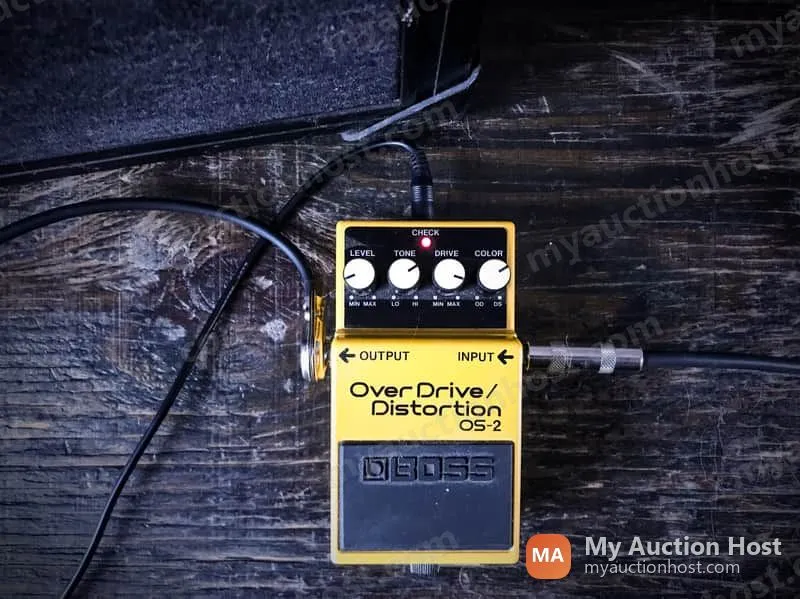
- The Boss OS-2 is literally named OverDrive/Distortion, and its Color knob is marked OD at one end and DS at the other, so you pick the flavour yourself.
- The Red Llama clone was listed as “Distortion Overdrive.”
- The Fulltone Full-Drive 2 Mosfet was listed as “Overdrive Distortion.”
- The Catalinbread Katzenkonig is called “Fuzz/Distortion,” and a second listing for it mentions both a Rat and a Tone Bender.
- The Joyo JF-01 is called an overdrive and a Tube Screamer clone in one title, which is at least consistent.
Those names are the sellers’ and makers’ wording, not a measurement. To know what a particular pedal does, look at where its clipping happens (inside a feedback loop, after the gain stage, or in the transistors themselves), or just plug it in.
Which one when
A rule of thumb, which is general advice and my summary rather than something from a cited source:
| Family | Clipping | Classic examples | Reach for it when |
|---|---|---|---|
| Overdrive | Soft (diodes in an op-amp feedback loop, per ElectroSmash on the Tube Screamer) | Boss OD-1, Tube Screamer | You want an amp that sounds like it is working hard, or want to push an amp that is already near breakup. |
| Distortion | Hard (diodes that hold the signal after the gain stage) | Boss DS-1, Pro Co Rat | The amp stays clean and you want the gain to come from the pedal. |
| Fuzz | Extreme, from transistors, close to a square wave | Maestro FZ-1, Fuzz Face, Big Muff | You want the sound to be an effect in its own right, not an amp imitation. |
Owning a lot of these is mostly curiosity, and I will not pretend otherwise. For the amp end of the chain, our speaker impedance guide covers matching amps and cabinets.
Where to find them on eBay and Reverb
| Looking for | eBay | Reverb | Amazon (similar) |
|---|---|---|---|
| Overdrive pedals | eBay | Reverb Sponsored link. We may earn a commission if you buy through it. Details | Amazon |
| Tube Screamer and clones | eBay | Reverb Sponsored link. We may earn a commission if you buy through it. Details | Amazon |
| Distortion pedals | eBay | Reverb Sponsored link. We may earn a commission if you buy through it. Details | Amazon |
| Rat-style distortion | eBay | Reverb Sponsored link. We may earn a commission if you buy through it. Details | Amazon |
| Fuzz pedals | eBay | Reverb Sponsored link. We may earn a commission if you buy through it. Details | Amazon |
| Big Muff | eBay | Reverb Sponsored link. We may earn a commission if you buy through it. Details | Amazon |
| Bass overdrive, distortion and fuzz | eBay | Reverb Sponsored link. We may earn a commission if you buy through it. Details | Amazon |
The eBay, Reverb and Amazon search links are affiliate links (see our terms).
Sources
- Distortion (music): Wikipedia
- List of distortion pedals: Wikipedia
- Ibanez Tube Screamer: Wikipedia
- Boss DS-1: Wikipedia
- Pro Co RAT: Wikipedia
- Tube Screamer circuit analysis: ElectroSmash (read via the Internet Archive)
- Pro Co Rat analysis: ElectroSmash (read via the Internet Archive)
- Big Muff Pi analysis: ElectroSmash (read via the Internet Archive)
- Fuzz Face analysis: ElectroSmash (read via the Internet Archive)