The short version
- I have bought 5 modulation pedals and sold 17 of them, with 4 more listings that never found a buyer. The sales ran from Mar 2017 to Jul 2018, at prices from $19.95 to $99.99.
- 7 of the 17 sold listings are DOD or DigiTech (the DOD FX series) — the largest single maker in the list.
- The way the pedals work is covered, with the circuit numbers, in the modulation pedals guide. This post is the story that goes with it: what I bought, what I sold, and what the listings said.
- None of the sale prices below is what I paid. Bought pedals show the listing’s asking price only, and sold ones show the price they sold for.
Why a pile of swooshy pedals?
Overdrive, distortion and fuzz are the pedals everyone argues about. Modulation is the pedal family everyone owns one of and nobody argues about, which probably says something. After the drive pedals post, I went through the same catalogues for the other half of the board, and the pattern was not what I expected. The dates tell a tidy story: I bought two of them in July 2016, one in 2017 and one in 2018, every sale happened between Mar 2017 and Jul 2018, and then nothing until a stray flanger turned up in April 2026.
If you want the how-it-works version of anything below, the phaser, flanger and chorus sections of the guide are the place. I will keep the electronics light here.
The phasers
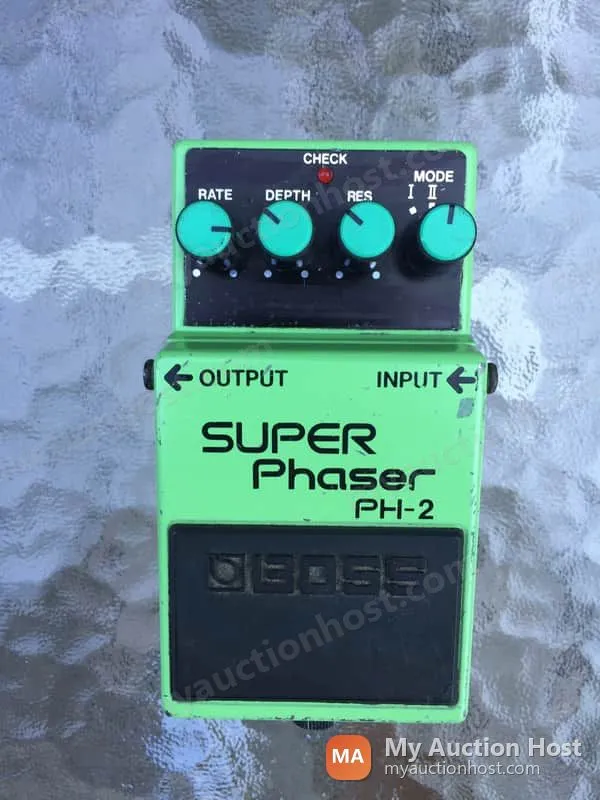
The phaser I bought was a Boss Super Phaser in Jul 2016 (asking $45), which has four knobs (Rate, Depth, Res and Mode) and a green case with the scuffs to prove it. I have not documented what each Mode position does, so I will not pretend to. A second Super Phaser, the PH-2, was listed for sale at $55 and did not sell, which I hold no grudge about.
The best comparison in the catalogue is the price ladder. The MXR Phase 90 sold for $50 in Mar 2017. The Phase 90 lookalikes from Joyo, Donner and Biyang sold for $20, $20 and $28, and a Belcat copy at $28 did not sell at all. That is the clone economy in miniature: the original brought $50 and the copies that sold brought $20 to $28.
The priciest phaser was a MXR Phase 45 Script reissue, unopened, at $75. My own listing said it was “bought for a project that never happened” and that I had too many phasers already, which is the most honest sentence in the catalogue. Per ElectroSmash, the Phase 45 is the one-notch, two-stage cousin of the Phase 90, and the guide explains what that means.
Then there is the DOD FX20B, a six-stage phaser (“phasor” in 1980s DOD spelling) that sold for $30. In the listing I wrote that I had another one in my collection and that none I had tried sounded or behaved quite like it, and that it did not sound like a Boss PH-2 or an MXR Phase 90. Six stages should give three notches by the usual rule of thumb, which may be part of why.
- Boss Super Phaser (bought Jul 2016, asking $45)
- Boss PH-2 Super Phaser (listed, did not sell, asking $55)
- Boss PH-3 Phase Shifter (sold Feb 2018 for $40)
- MXR Phase 90 (sold Mar 2017 for $50)
- MXR Phase 45 Script Reissue (sold May 2017 for $75)
- DOD FX20B (sold Apr 2018 for $30)
- DigiTech Hyper Phase (sold Feb 2018 for $30)
- Belcat PHS-505 (listed, did not sell, asking $28)
- Biyang Phase Pro PH-10 (sold Mar 2017 for $28)
- Joyo Vintage Phase (sold Apr 2017 for $20)
- Donner Pearl Tremor Phaser (sold Mar 2017 for $20)
The flangers
Flangers are where the buying happened. In July 2016 I bought a Boss HF-2 Hi Band Flanger, and our Boss dating guide uses an HF-2 as its example of a pedal that says “Made in Japan” on a green label and carries no serial number. An HF-2 sold for $60 in March 2017. The listing said the pedal had a sound “favored by many” and that I thought it sounded great with bass too, which are my words from the listing and not a measurement.
In Nov 2017 I bought an MXR M-117 Flanger (asking $80), whose knobs read Manual, Width, Speed and Regen. That one is worth a look because the labels are the whole controls lesson in four words, and the guide explains each one.
The newest arrival is a DOD FX72 Bass Stereo Flanger, bought in Apr 2026. The seller’s own listing mentions that it still has its battery cover, which the seller says most are missing, so that is a point for the survivors. On the sales side, the DOD FX75 and FX75C family accounts for most of the flanger listings: an FX75, two FX75Cs (one of which did not sell) and a two-pedal lot with an FX65B chorus. If you ever need to work out which year an FX75 is, the DOD guide does exactly that.
- MXR M-117 Flanger (bought Nov 2017, asking $80)
- 1980s Boss HF-2 Hi Band Flanger (bought Jul 2016, asking $50)
- 1987 - 1996 DOD FX72 Bass Stereo Flanger (bought Apr 2026, asking $45)
- 1980s Boss HF-2 Hi Band Flanger (sold Mar 2017 for $60)
- DOD FX75 (sold Apr 2018 for $35)
- DOD FX75C Flanger (sold Feb 2018 for $30)
- DOD FX75C (listed, did not sell, asking $40)
- DOD FX75C Flanger and FX65B Chorus (sold Jul 2018 for $75)
Chorus and vibrato
The highest sale price in the whole group was a chorus: an MXR M-134 Stereo Chorus went for $99.99 in Feb 2018. Two DOD FX60 choruses sold for $44 and $35, and a DOD FX65B did not sell. The DOD guide describes the FX60 as the site’s “poor man’s” Boss CE-2, and the guide explains what a CE-2 actually is, down to the chips inside.
In October 2018 I bought an Eden Amplification Bass Chorus I-90 (asking $40), a chorus made for bass players. The cheapest pedal on the list was a Behringer UV300 Ultra Vibrato at $19.95, and the guide has a section on why vibrato and tremolo keep getting confused, which is worth reading before you buy the wrong one.
- Eden Amplification Bass Chorus I-90 (bought Oct 2018, asking $40)
- MXR M-134 Stereo Chorus (sold Feb 2018 for $99.99)
- DOD FX60 (sold Mar 2018 for $44)
- DOD FX60 Stereo Chorus (sold Feb 2018 for $35)
- DOD FX65B (listed, did not sell, asking $40)
- Danelectro DS-5 and DS 6 (sold Feb 2018 for $30)
- Behringer UV300 Ultra Vibrato (sold Jan 2018 for $19.95)
What the numbers say
- Boss and MXR commanded a premium over the copies where there were copies: Phase 90 at $50 against $20 to $28 for the lookalikes that sold.
- The two highest sale prices were the unopened Phase 45 reissue at $75 and the MXR M-134 at $99.99. That is a small sample and not a market study.
- Not every pedal sold. Four listings (the Boss PH-2, the Belcat PHS-505, a DOD FX75C and a DOD FX65B) did not, and their pages show them as unsold.
Where to go next
- The modulation pedals guide: the electronics and history, with sources.
- The DOD FX-series field guide for the FX20B, FX60, FX65B, FX72 and FX75 family.
- The Boss dating guide for the PH-2, PH-3, HF-2 and CE-2 families.
- The Joyo clone guide for the Phase 90-style copies.
- The pedal order guide for where to put them on a board.
- The drive pedals post, overdrive, distortion and fuzz, for the other half of the board.
Where to find them on eBay and Reverb
| Looking for | eBay | Reverb | Amazon (similar) |
|---|---|---|---|
| Phaser pedals | eBay | Reverb Sponsored link. We may earn a commission if you buy through it. Details | Amazon |
| MXR Phase 90 | eBay | Reverb Sponsored link. We may earn a commission if you buy through it. Details | Amazon |
| Flanger pedals | eBay | Reverb Sponsored link. We may earn a commission if you buy through it. Details | Amazon |
| Chorus pedals | eBay | Reverb Sponsored link. We may earn a commission if you buy through it. Details | Amazon |
| DOD analog pedals | eBay | Reverb Sponsored link. We may earn a commission if you buy through it. Details | Amazon |
| Bass chorus and flanger | eBay | Reverb Sponsored link. We may earn a commission if you buy through it. Details | Amazon |
The eBay, Reverb and Amazon search links are affiliate links (see our terms).