The short version
- The usual starting order is tuner → wah and filters → compressor → overdrive, distortion and fuzz → modulation → delay → reverb.
- The logic: pedals that need a clean signal go first, pedals that create the tone go in the middle, and pedals that add space go last.
- EQ and volume pedals are genuinely debated; both work early or late, and they do different jobs in each spot.
- Boss and Sweetwater agree on one more rule: experiment. The order is a starting point, not a law.
Why order matters
Every pedal processes whatever reaches it. Put a delay before a distortion and the distortion chews up the echoes; put it after and you get clean repeats of a distorted note. Boss compares pedal order to a recipe: add the ingredients in the right order and each one shines, while the wrong order gives a “muddied, cluttered” tone. Sweetwater’s guide is more relaxed: “there are no hard-and-fast rules, only results.” Both start from the same order, though.

The standard order, step by step
| # | Pedal type | Why it goes here |
|---|---|---|
| 1 | Tuner | It needs the cleanest signal to read the pitch accurately |
| 2 | Wah and filters, compressor, pitch and octave (their order among themselves varies) | They work best on the clean guitar: wah shapes it, a compressor evens it out, and pitch effects track a clean note far better than a distorted one |
| 3 | Overdrive, distortion, fuzz | The core of the tone; stack lightest to heaviest |
| 4 | Noise gate | Right after the gain pedals, which are usually the noisiest |
| 5 | Modulation (chorus, phaser, flanger) | It colors the finished, distorted tone |
| 6 | Delay | Clean, even repeats of the whole sound |
| 7 | Reverb | Like a room, it’s the last thing that happens to the sound |
Skip any category you don’t own. A drive and a delay is still “drive, then delay.”
First: tuner, pitch and the clean-signal pedals
Boss puts the tuner first in “any professional signal chain,” because “the purer and cleaner that signal, the more accurately the tuner can detect the pitch.” Pitch shifters and octave pedals belong early for the same reason: Boss notes it’s “far easier for them to track a tidy signal than one shredded by distortion.” A compressor goes early too, Boss says, so it compresses the clean guitar “rather than the sound of the effects to come.”
Wah and compressor order varies. Sweetwater’s chain runs filters and EQ first, then the compressor; Boss suggests the wah “directly after the tuner and before the drive section,” and its bass guide puts compression before the wah. Either way, both go before the drives. The wah’s position also changes its sound: Sweetwater says wah into overdrive gives “a mellower, more vocal quality,” while overdrive into wah has “a much wider sweep with more dramatic wah sounds.”
Middle: the drive section
Overdrive and distortion are, in Boss’s words, “the core ingredient in tone,” and they amplify the noise of anything before them. With more than one, Boss’s rule is to stack them from the lightest drive to the heaviest distortion, with a noise gate right after.
Boss has a special note for fuzz: put it before the tuner if the tuner isn’t true bypass, and turn the fuzz off when you tune.
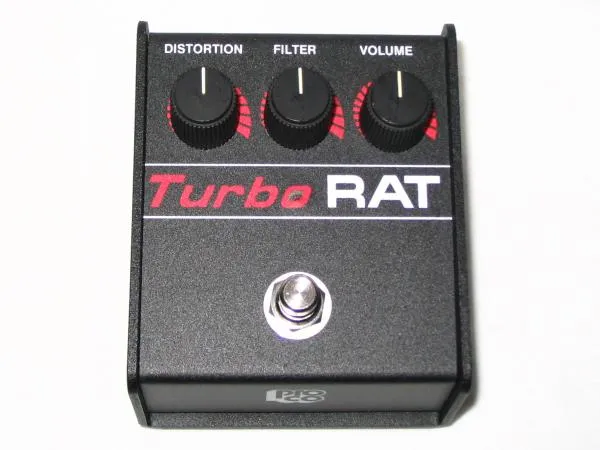
Where does a loud distortion like the archive’s Turbo RAT fit? In the drive section, and under Boss’s lightest-to-heaviest rule, after any milder overdrives. Its seller prized its “very high output, which is ideal for overdriving the input stage of a tube amp.” Our RAT family guide has more on why the Turbo is louder.
Last: modulation, delay and reverb
Boss places modulation after the drive so the phaser or chorus works on the finished tone, though “some players disagree.” Delay comes next: after distortion it gives “cleaner and more even repeats,” while before it the repeats can bleed together. Sweetwater calls delay into distortion “messy, splatty repeats” that might occasionally be just what a song needs. A looper, if you use one, goes before the delay. Reverb goes last because, as Boss puts it, in a real room reverb “is the last thing that happens before it reaches our ears.”

Where does the EQ pedal go?
Boss calls it “open to debate”: one school sculpts the guitar first, the other shapes the finished sound. The archive’s Boss GE-7 shows how differently the two spots behave:
- Before the drives, an EQ changes how the drive distorts. Boss says boosting the mids and the Level there pushes an overdrive harder, and that an EQ in this spot “can add additional gain” and act as “a second drive option.”
- After the drives, it shapes the distorted sound without changing how hard the drive is hit. Boss suggests it for scooped metal tones and for lifting a fuzz that disappears in the band.
- In the amp’s effects loop, Boss says it lets you tailor your tone “without adding gain.”
The seller bought his GE-7 as an “uncolored lead booster” for gigs through a friend’s Marshall that “had a nice distortion tone already.” Our GE-7 settings guide has slider charts for each of these jobs.
And the volume pedal?
Also debated, and again the spot changes the job:
- First in the chain: like a guitar volume knob on the floor. Turning it down cleans up the drives, as Boss notes.
- After the drives, before modulation and delay: Sweetwater’s choice. It changes your level in the band without changing how hard the drives are hit, and lets you swell into delays and reverbs with the tails intact.
- Last: it acts as a master volume.
Using the amp’s effects loop
Many amps have an effects loop: a send and return between the preamp, where the amp’s own distortion is made, and the power section. If you get your distortion from the amp, Sweetwater recommends putting modulation, delay and reverb in the loop, because they “sound cleaner and clearer” after the amp’s distortion. Everything else (tuner, wah, compressor, drives) still goes into the front of the amp.
Buffers and long chains
Sweetwater describes a familiar problem: add pedals and cables and, even with every pedal off, you hear “less high-end” and a lower overall level. A buffer, either a standalone one or a buffered-bypass pedal, keeps the signal strong. Sweetwater’s rough guide:
- three or four pedals: a buffer at the front;
- one of them already buffered (the GE-7, for example, uses buffered bypass): a buffer at the end;
- eight or ten pedals: possibly one at each end.
Boss’s own advice is simply to put the tuner first and use buffered pedals to protect the tone down the line.
Bass players
Bass boards follow much the same order. Boss’s bass guide gives: tuner → compressor → wah and filters → octave → drive → noise gate → EQ → modulation → volume → delay → reverb. The EQ moves after the drive because distortion and fuzz can thin out a bass’s low end, and an EQ there can put it back.

When to break the rules
Boss says “rules are made to be broken, and some of history’s most incredible rigs fly in the face of conventional wisdom,” and Sweetwater ends its guide by stressing experimentation. A delay running into the front of an overdriven amp is a classic sound Boss credits to players from The Edge to Eddie Van Halen; just keep the delay level and repeats down. Start with the standard order, then move one pedal at a time and listen.
Sources
- The Ultimate Guide to Guitar Effects Pedal Order and Signal Chain (Henry Yates) — Boss Articles
- What Is the Best Guitar Pedal Order? — Sweetwater InSync
- Order of Operation: A Guide to Bass Effects Signal Chain — Boss Articles
- Five Creative Ways to Use an EQ Pedal for Guitar — Boss Articles
- Pedal Partners: Combining EQ with Other Effects — Boss Articles
- GE-7 Equalizer: specifications — Boss
Stock photos in this guide (credited in each caption) are provided by Pexels. Every other photo is our own.