The short version
- Find the serial number first. Roland’s own support page says it is on a white sticker on the bottom or back, and on some battery-powered products inside the battery compartment. That is the whole of what Roland says about it.
- Roland publishes where the serial is, not how to turn it into a date. Every date rule below comes from collectors, retailers and fan sites, and none of them names a source. They agree with each other on the big picture, and the arithmetic holds together, but treat the result as “about” a month, not a certificate.
- Three older serial styles run from 1977 to 2010, and a calculator below decodes them. A newer style after 2010 has no published rule that we could find.
- Serials are only one clue. The country on the label, the label colour, the power-adaptor name and the screw narrow it down too, and we use real photos from pedals we sold to show how.
- Other pages claim to do this. We list seven, with an honest note on how far each can be trusted.
Where the serial number is
Roland’s support article on finding a serial number says most serials are seven characters, one or two letters and five or six digits, on a white sticker on the bottom or back of the unit. For battery-powered products the sticker can be in the battery compartment, and it can also be on the box. It also says older serials may be six digits, or start with 0.
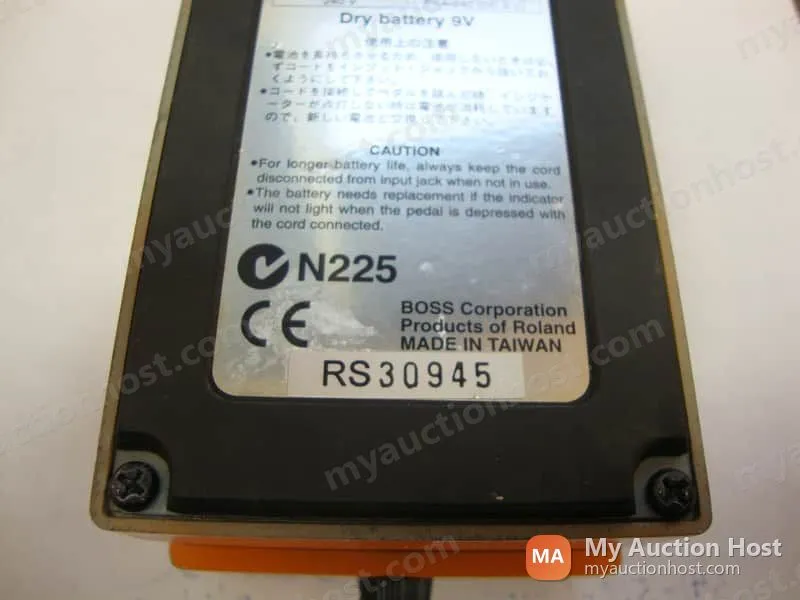
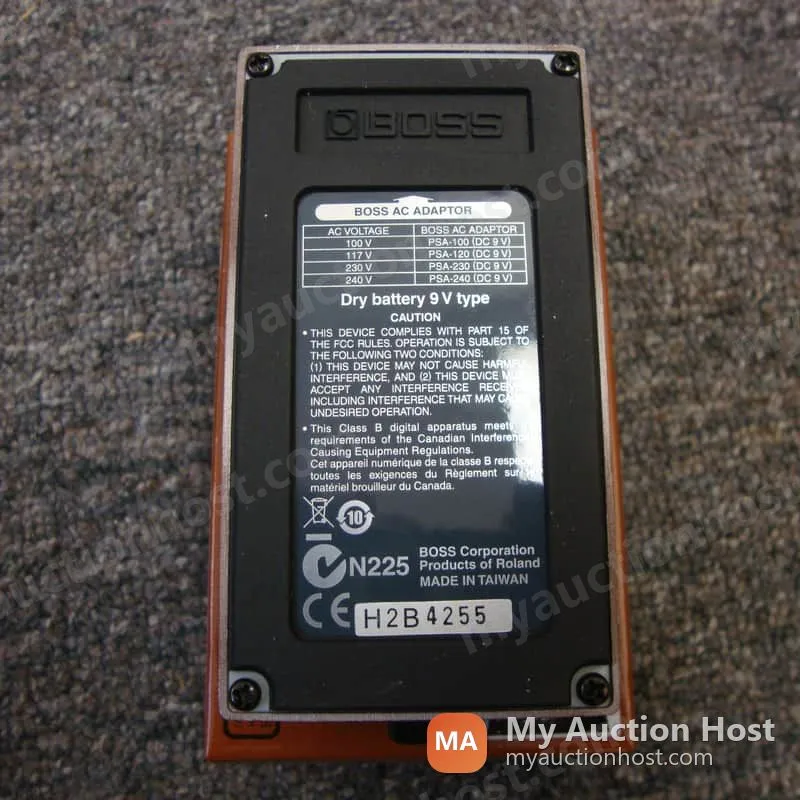
On a compact pedal, that means two places to look. Flip the pedal over and read the label on the bottom plate, where later pedals carry the serial. For an older pedal, open the battery compartment: the collector charts below place the early codes there, stamped on the enclosure or on a sticker under the battery. The two photos below show both sides of the story.
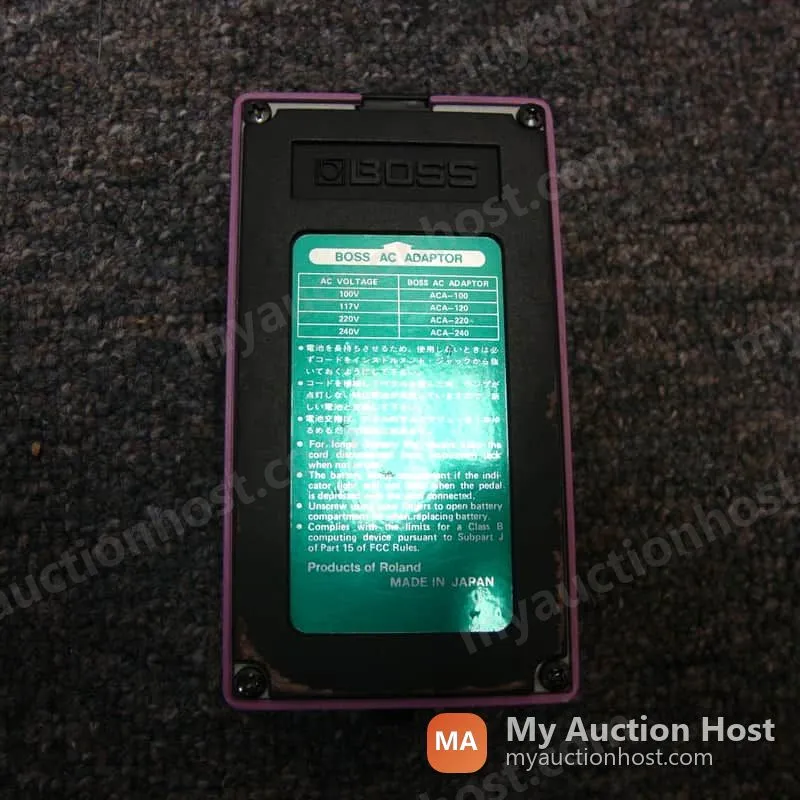
Our Boss HF-2 flanger is the opposite case: the bottom label shows “Made in Japan” and no serial at all (see the photo below). On a pedal like that, the number is in the battery compartment.
Serial number calculator
Type a Boss serial to see what the community rules say. This calculator is ours, built from the Cool Old Guitars chart described in the next section, and it works in your browser only: nothing you type leaves the page.
Reading the answer: the result is a community estimate, and a pedal could have been made a month or so either side of it. Letters I and O may or may not be skipped in the two-letter style; none of the sources says. Test it against a pedal whose date you know before you trust it.
The three serial styles, 1977 to 2010
The clearest chart we found is by Cool Old Guitars, a UK retailer, in its Boss serial number decoder/dating page. It names no source, which is the main weakness. A 2011 post on MatrixSynth describing the Bossarea decoder gives five “types” with dates that match it in outline. Here is the chart, in plain terms:
| Style | What it looks like | Where | How to read it | Years |
|---|---|---|---|---|
| 1. Stamped batch code | 4 or 5 digits, such as 7800 | Stamped in the battery compartment, above the switch | 6300 is October 1977; add 100 for each month after that. Not unique: every pedal from a month can carry the same code. | Oct 1977 to about Apr 1981 (10500) |
| 2. Stickered serial | 6 digits, such as 141100 | Sticker in the battery compartment, under the battery | First two digits count months: 02 is January 1981, 03 is February, and so on (02 to 13 is 1981, 14 to 25 is 1982). Last four digits vary; not unique. | Jan 1981 to Feb 1989 (99) |
| 3. Two letters, five digits | Such as RS30945 | Sticker; later pedals show it on the bottom label | Ignore the first letter. The second letter and the first digit give the month: A0 is March 1989, A9 is December 1989, then B0 is January 1990. Each letter is ten months. | Mar 1989 to Oct 2010 (Z9) |
| After 2010 | Seven characters in a newer layout, such as H2B4255 | Bottom label | No published rule found. | From Nov 2010 (per the Bossarea types) |
We checked the arithmetic, because that is one test we can do without a source. From October 1977, 42 months of 100 each reaches April 1981. From January 1981, 97 months reaches February 1989, the stated end of the six-digit style. And ten months per letter from March 1989 puts Z9 at October 2010, which is where the Bossarea types end the older style and start the new one. The numbers agree with each other. That is evidence the chart is internally sound; it is not proof that it matches the factory records.
The same Cool Old Guitars page notes that Japanese production ended in the mid-1990s, so a second letter past E is unlikely on a Japanese pedal. That is the retailer’s opinion, not a documented cut-off.
Worked examples from pedals we sold
Three pedals in our archive have label photos, so here is what each one tells you.
| Pedal | What the label shows | What it tells us |
|---|---|---|
| Boss DS-1 | Silver label, “Made in Taiwan”, PSA adaptor table, serial RS30945 | Style 3. The second letter S is the 19th letter, counting A as 0, so 18 × 10 + 3 = 183 months after March 1989: about June 2004. Taiwan and PSA both fit that. |
| Boss HF-2 Hi Band Flanger | Green label, “Made in Japan”, ACA adaptor table, no serial on the label | Japan-made with an ACA label points to the older pedals. The listing called it 1980s; the serial in the battery compartment would pin it down. We have not seen it. |
| Boss OC-3 Super Octave | Dark label with FCC and Canadian compliance text, “Made in Taiwan”, PSA table, serial H2B4255 | A newer layout, so none of the three rules above applies. We could not decode it, and we would rather say so than guess. |
Other clues besides the serial
A serial can be missing, unreadable or in a format nobody has documented. These clues stand on their own and can back up a serial or replace it.
Country of manufacture
Per Wikipedia, Boss compact pedals were made in Japan until circa 1990, then in Taiwan, and from around 2019 production moved to Malaysia. The “circa 1990” is vague, and some marketplace sellers say certain pedals went to Taiwan as early as 1988; we could not confirm that. The date a given pedal changed countries is a range, not a line. Guitar World, in an article by Guitarist magazine that was made as a paid partnership with Boss (the page says the opinions are independent), puts the point in market terms: the Japan-made pedals are “more collectible and expensive.”
Label colour and the battery screw
Wikipedia says the bottom labels come in black, silver, green, pink and blue, and that earlier pedals had a metal battery-compartment screw while later ones kept it and added a plastic knob. Guitar World adds that a silver thumbscrew on an early Japan-made pedal is a good sign for collectors. Our HF-2 has a green label; our DS-1 has a silver one. Sellers also say a black label means older, and one retailer ties the silver label to the 1990s, but we found two different years for that and no source for either, so we do not give a date here.
ACA or PSA: the power label
The first line of a Boss bottom label names the adaptor. According to Cool Old Guitars’ power article (2018), the original pedals used the ACA adaptor, an unregulated 12-volt supply that the pedal drops to 9 volts inside, and the PSA adaptor, a regulated 9 volts, arrived with the DD-2 in 1983. Both ran side by side until 1997, when every pedal used PSA. A pedal made before 1997 is therefore most likely ACA, and one with a PSA label could be from 1983 onward. Our HF-2 reads ACA, our DS-1 and OC-3 read PSA. A PSA supply on an ACA pedal can sound weak and the LED may not light. For the wider power story, see our pedalboard power supply guide.
Circuit changes inside
Some pedals changed their circuit over the years, and the part inside can date them if you are willing to open the case. The DS-1 is the usual example. Guitar World says early ones used a Toshiba preamp chip and that in 1994, by then Taiwan-made, it was redesigned around an op-amp. Wikipedia’s DS-1 page gives the original chip as the Toshiba TA7136AP and names later op-amps; we are not repeating its later years because a search snippet gave a different year for the last change. Our RAT guide covers the DS-1 as a hard-clipping pedal. Component date codes, such as those on pots and chips, can also date a pedal, but we did not find a Boss-specific guide, so we do not teach that here.
Where the sources disagree
| Question | What we found |
|---|---|
| When did production move from Japan to Taiwan? | Wikipedia: circa 1990. Some sellers say 1988 for individual pedals. Treat it as a range. |
| When did the stamped batch codes end? | Cool Old Guitars: about April 1981 (10500). The 2011 Bossarea types: early 1981. The six-digit style starts at 02 = January 1981, so the two overlap. |
| When did the silver label start? | Listings say about 1994 and about 1997. No source for either. |
| Did ACA pedals always take 12 V? | The retailer’s article says 12 V. One seller says later ACA-labelled pedals ran on 9 V. Check with the LED and the label. |
| What does a post-2010 serial mean? | No published rule found. |
Other pages that claim to date Boss pedals
You do not have to take our word for any of this. These are the pages we found that say they can date a Boss pedal, with what we could and could not confirm. We checked them in late November 2026.
| Page | Type | What to know |
|---|---|---|
| Roland support: finding your serial number | Official, no dates | Where the serial is and its general format. No date table. The most reliable page here, for what it covers. |
| Cool Old Guitars: Boss serial number decoder | Chart, with a retailer’s tool linked | The clearest chart; the one our calculator is built on. No source named. Written by a shop that sells vintage pedals. |
| MatrixSynth: Boss & Roland serial number decoder (2011) | Blog post about the Bossarea decoder | Five “types” with dates; the formats themselves are in images. Bossarea did not load when we tried it. |
| serial-number-decoder.com: Boss | Interactive tool | Takes a serial and a model. Names no source and shows no ranges. Carries affiliate links. We did not test its output. |
| Sequence15: deciphering Roland serial numbers (2008) | Personal blog | Describes the month code in the 1989-and-later style. Old and unsourced, but it matches the others. |
| StompboxZone: decoder | Interactive tool | Linked from other pages here. It returned a server error when we tried it, so we cannot say what it does. |
| Wikipedia: Boss Corporation | Encyclopedia | Country, label colours and screws; no serial rule. Some statements carry no citation. |
One warning: searching for “Boss pedal serial number” also turns up a swarm of look-alike pages that copy the same year tables with no author and no source. We have not linked them. A good habit with any decoder, ours included, is to run a pedal you already know the date of through it first.
Why bother? What age does to value
The Guitar World article says Japan-made pedals are the more collectible ones, especially early units with a silver thumbscrew, and singles out the DS-1 with a Japan-made, silver-screw, black-label build as the most revered. It also names early classics sought in original form, such as the CE-2 Chorus, DM-2 Delay and DC-2 Dimension C. That is one magazine’s view and the market moves, so check recent sales before paying a premium. If you only want the sound, the article points to Boss’s Waza Craft versions. A $25 Taiwan-made pedal, like the DS-1 we sold, is a sound purchase for the tone, and a date does not change what it does to a signal.
More Boss pedals we have sold
- Boss DS-1 Distortion: Taiwan-made, serial RS30945, sold for $25 in March 2017.
- Boss HF-2 Hi Band Flanger: Japan-made, ACA label, sold for $60 in March 2017.
- Boss OC-3 Super Octave: Taiwan-made, newer serial style, sold for $65 in April 2017.
- Boss SD-1 Super Overdrive, Boss PH-3 Phase Shifter and Boss PH-2 Super Phaser: more photos, with labels you can read for yourself.
- Our Boss GE-7 settings guide covers a pedal that is still in production and has sold for decades.
Where to find them
These searches go straight to listings. Pedals sold as “made in Japan” or “black label” are the older ones; read the photos of the bottom label and ask for the serial.
| Looking for | eBay | Reverb | Amazon |
|---|---|---|---|
| Boss DS-1, Japan-made | eBay | Reverb ad | Amazon |
| Boss black label pedals | eBay | Reverb ad | Amazon |
| Boss CE-2 Chorus, Japan | eBay | Reverb ad | Amazon |
| Boss SD-1 Super Overdrive | eBay | Reverb ad | Amazon |
| Boss HM-2 Heavy Metal | eBay | Reverb ad | Amazon |
| Boss PSA power adaptor | eBay | Reverb ad | Amazon |
| Boss ACA power adaptor | eBay | Reverb ad | Amazon |
| Any Boss compact pedal | eBay | Reverb ad | Amazon |
The eBay, Reverb and Amazon search links are affiliate links (see our terms). Photos of the pedals we sold were taken by the seller.
Sources
- How do I find/enter my Serial Number?: Roland support
- Boss Serial Number Decoder/Dating: Cool Old Guitars
- Correctly powering your old Boss pedal (ACA vs PSA simplified), 2018: Cool Old Guitars
- Boss & Roland Serial Number Decoder, 2011: MatrixSynth
- Deciphering Roland serial numbers, 2008: Sequence15
- Boss Corporation: Wikipedia
- The most valuable BOSS pedals ever made (Guitarist, paid partnership with Boss), Dec 2023: Guitar World
- Boss serial decoder: serial-number-decoder.com