The short version
- DOD Electronics of Salt Lake City, Utah made some of the most affordable American effects pedals of the 1980s and 1990s. Its budget FX series started in 1982 and, by the fan-built reference this guide leans on, ran to some 70 models.
- From the mid-1980s DOD billed its pedals as “America’s Pedal.” By the end of the 1990s, production had moved to China.
- You can tell a DOD’s generation by eye: original series (1982–88), second series (1989–98) or final series (1996 on). The tells are the graphics, the logo, the treadle and the power jack.
- DOD did not put the build date in the serial number. The workable method is reading the date codes on the parts inside.
- This archive has listed eight DODs. The ones we have pages for come with photos, prices and the original write-ups.
DOD and “America’s Pedal”
Most of what follows comes from America’s Pedal, a fan-built DOD reference that ran from 2009 to the mid-2010s and is no longer online. Its authors say they had no connection to DOD, DigiTech or Harman, and the name of the site is the name DOD used on its own ads. We read archived copies. Where the site gives an opinion we say so, and where it says its own dates may be off, we pass that on.
| When | What happened |
|---|---|
| 1974 | DOD Electronics is founded in Salt Lake City by John Johnson and David O. DiFrancesco. |
| 1970s | The first pedals include the 250 Overdrive Preamp and the 201/401 Phasor. America’s Pedal notes that the 250 is very close to the MXR Distortion+ and the Phasor resembles the MXR Phase 90. |
| 1981 | The pro-level Performer 500 series arrives, with silent FET switching and two 9 V batteries. |
| 1982 | The cheaper FX series begins, at about the time the first MXR-inspired line is discontinued. |
| Mid-1980s | DOD starts billing itself as “America’s Pedal.” |
| About 1990 | DOD and DigiTech are sold to Harman. Co-founder DiFrancesco has left by then, and nearly every detail but the housing is redesigned in 1989. |
| 1993 | Grunge makes pedals fashionable again; DOD names a new fuzz the FX69 “Grunge” and later trademarks the name. |
| 1996 | The redesigned “final series” housing debuts at NAMM (FX13, FX22, FX51, FX64, FX84, then FX12, FX63, FX747, FX100, FX101). |
| 1998 | The line is streamlined, with plainer colors and two-tone model names (FX20C, FX25B, FX66, FX69B, FX75C, FX86B, FX91, FX102). “Made in U.S.A.” quietly disappears from the bottom label. |
| Late 1990s on | Production moves to China (the VFX and GFX series). In 2007 the FX69B and FX86B join DigiTech’s lineup and the rest of the FX series is effectively discontinued. |
| 2013 | Per the site’s news pages, Harman’s DigiTech announces DOD’s rebirth as a “boutique brand,” with reissues of the Overdrive Preamp 250 and Phasor 201. |
Three generations, and how to tell them apart
America’s Pedal sorts the FX series into three looks. DOD did not name them, so the site made up its own labels and says it had no insider access to DOD’s design records. The tells are physical and easy to check. DOD’s original foam-rubber treadle wore out so quickly that it had to be redesigned within the first year, which is why the early pedals come in so many cosmetic variants.
| Series | Years | Graphics | DOD logo | Treadle | Also |
|---|---|---|---|---|---|
| Original | 1982–88 | “Bars” at first, then “box” graphics starting with the FX56; the first four-knob pedals (FX57, FX67, FX72, FX75-B) and the one-knob FX87 had plain text. | “Shadowed” logo on the marque plate | Foam rubber (1982), then three screws and a DOD logo (1983–84), then two screws and a DOD logo (1984–88) | Light grey foam inside (to 1986), then white cardboard and a black plastic battery box. Serrated rubber anti-skid plate on the bottom. |
| Transition | Late 1988 | As original | New “outlined” logo | Mostly as original; some with two screws and no logo | Serial numbers roughly 765k to 782k. |
| Second | 1989–98 | Plain text at first, even on two- and three-knob pedals; “ITC Banco” lettering from the FX69 Grunge on | Outlined logo, changing to an italic one around mid-1992 | Redesigned: two screws, no logo | Smoother anti-skid plate. 1/8″ power jack on this and the original series. |
| Final | 1996–VFX | “ITC Banco”, then two-tone box graphics after 1998 | No marque plate | Screwless, with an italic DOD logo | New housing with a better battery cover and a protected footswitch, and a Boss-style power jack. Sold alongside the second series into 1998. |
Two oddballs stayed on the second-series look into 1999: the FX40B equalizer and the black-graphics FX70C Corrosion, possibly to use up older parts. Chinese-built pedals (the VFX and GFX series) say “Made in China” under the DOD logo on the bottom rubber plate, and their serial numbers usually start with a “V.”
How old is my DOD?
Unlike Boss, DOD did not encode a month and year in its serial numbers. A few early pedals carry a sticker with the date of final assembly, but otherwise the method that works is the one the site used on more than 160 pedals of its own: open the pedal, read the date codes on the chips, pots, transistors and electrolytic capacitors, and treat the newest one as the earliest the pedal could have been built. The site reckoned that final assembly trailed the newest part by roughly two to eight weeks, so add a little.
The serial-number landmarks the site found, and the dates it saw on the pedal pages:
- FX-series serial numbers start above 100,000 in 1982 (none below that were seen), and jump to about 200,000 at the start of 1983.
- From 200k in 1983 to about 1,600k in 1996 the numbers run in order, though not evenly, as production sped up and slowed down.
- The change from black to blue lettering on the FX75 came around serial 331k in mid-1985, and the late-1988 transition pedals sit at roughly 765k–782k. The FX20B’s gold-sparkle paint replaced its grey in early 1993, around 1,300k.
- From 1996 the final series stops following the sequence, and the site had not opened enough of those to explain it.
The site also published a chart of serial number against component date, and asked that it not be reposted. We have not copied it; here is the archived page, which is better than our summary anyway.
The FX series, model by model
This is the site’s own index, grouped by what the pedals do. Years are as the site listed them, and it warned that some may be slightly off. “VFX” means the line continued under the Chinese-built VFX name. Pedals we have sold are linked.
Chorus
| Model | Name | Years | In this archive |
|---|---|---|---|
| FX60 | Stereo Chorus | 1982–93 | sold Mar 2018, sold Feb 2018 |
| FX62 | Bass Stereo Chorus | 1987–96 | |
| FX63 | Deep Freeze | 1996–98 | |
| FX64 | Ice Box | 1996–VFX | |
| FX65 | Stereo Chorus | 1985–97 | |
| FX65B | Stereo Chorus | 1997–98 | listed Jun 2018, sold Jul 2018 |
| FX67 | Stereo Turbo Chorus | 1988–90 | |
| FX68 | Super Stereo Chorus | 1990–96 |
Flanger
| Model | Name | Years | In this archive |
|---|---|---|---|
| FX70 | Stereo Flanger | 1982–84 | |
| FX72 | Bass Stereo Flanger | 1987–96 | |
| FX75 | Stereo Flanger | 1984–87 | sold Apr 2018 |
| FX75-B | Stereo Flanger | 1987–97 | |
| FX747 | Supersonic Stereo Flange | 1996–98 | |
| FX75C | Stereo Flanger | 1998–VFX | listed Jun 2018, sold Feb 2018, sold Jul 2018 |
Phaser, filter and other modulation
| Model | Name | Years | In this archive |
|---|---|---|---|
| FX20 | Phasor | 1982–85 | |
| FX20B | Stereo Phasor / Phaser | 1985–98 | sold Apr 2018 |
| FX20C | Stereo Phaser | 1998–VFX | |
| FX25 | Envelope Filter | 1982–98 | |
| FX25B | Envelope Filter | 1998–VFX | |
| FX22 | Vibro Thang | 1996–VFX | |
| FX13 | Gonkulator Modulator | 1996–97 | |
| FX-17 | Wah/Volume | 1987–2000 |
Overdrive, distortion, fuzz and noise
| Model | Name | Years | In this archive |
|---|---|---|---|
| FX50 | Overdrive Preamp | 1982–88 | |
| FX50B | Overdrive Plus | 1986–98 | |
| FX51 | Juice Box | 1996–97 | |
| FX52 | Classic Fuzz | 1989–97 | |
| FX53 | Classic Tube | 1989–97 | |
| FX54 | Attacker | 1991–94 | |
| FX55 | Distortion | 1982–85 | |
| FX55B | Super / Supra Distortion | 1986–98 | |
| FX55C | Supra Distortion | 1998–VFX | |
| FX56 | American Metal | 1984–90 | |
| FX56B | Super American Metal | 1990–94 | |
| FX57 | Hard Rock Distortion | 1987–93 | |
| FX58 | Metal Maniac | 1989–93 | |
| FX59 | Thrash Master | 1989–94 | |
| FX66 | Flashback Fuzz | 1999–VFX | |
| FX69 | Grunge | 1993–97 | |
| FX69B | Grunge | 1998–VFX | |
| FX70 Metal X | (FX70x) | 1993–96 | |
| FX70C | Corrosion | 1997–99 | |
| FX70P | Big Pig Fat Distortion (MF70) | 1999 | |
| FX76 | Punkifier | 1995–97 | |
| FX32 | Meat Box | 1994–97 | |
| FX33 | Buzz Box | 1994–96 | |
| FX86 | Death Metal | 1994–97 | |
| FX86B | Death Metal Distortion | 1998–VFX | |
| FX91 | Bass Overdrive | 1998–VFX | |
| FX92 | Bass Grunge | 1994–98 | |
| FX100 | Integrated Tube Even Harmonic Overdrive | 1996–98 | |
| FX101 | Grind Rectifying Overdrive | 1996–98 | |
| FX102 | Mystic Blues Overdrive | 1998–VFX |
Preamp, EQ, dynamics and octave
| Model | Name | Years | In this archive |
|---|---|---|---|
| FX10 | Bi-FET Preamp | 1982–95 | |
| FX40 | Equalizer | 1982–87 | |
| FX40B | Equalizer | 1987–VFX | |
| FX42 | Bass E.Q. | 1987 | |
| FX42B | Bass E.Q. | 1987–96 | |
| FX30 | Noise Gate | 1982–85 | |
| FX30B | Gate/Loop | 1985–94 | |
| FX80 | Compressor | 1982–85 | |
| FX80B | Compressor Sustainer | 1985–96 | |
| FX82 | Bass Compressor | 1987–96 | |
| FX84 | Milk Box | 1996–VFX | |
| FX85 | Harmonic Enhancer | 1984–87 | |
| FX87 | Psycho Acoustic Processor / Edge | 1987–89 | |
| FX35 | Octoplus | 1986–94 |
Reverb, delay, utility
| Model | Name | Years | In this archive |
|---|---|---|---|
| FX45 | Stereo Reverb | 1985–87 | |
| FX90 | Delay | 1984–93 | |
| FX96 | Echo FX (analog delay) | 1997–VFX | |
| DFX5 | Digital Turbo Distortion | 1989–90 | |
| DFX9 | Digital Delay | 1989–98 | |
| DFX91 | Digital Sampler/Delay | 1989–94 | |
| DFX94 | Digital Sampler/Delay | 1993–98 | |
| FX12 | Tuna (pedal tuner) | 1996–98 | |
| FX15 | Swell Pedal | 1984–86 |
Not in the tables: the DFX digital series (the DFX6, DFX7 and DFX98 were announced but, as far as the site could tell, never made), the Chinese-built GFX and VFX renamings, and the accessories: a cable tester, direct boxes, a footswitch, a pedalboard, a tuner (the T2) and a volume pedal (the VCC1).
A few DODs worth knowing
- FX56 American Metal (1984–90). The 13th pedal in the FX line and, in the site’s words, arguably DOD’s first modern distortion. Its published maximum gain was 1000 and its maximum output 7 V peak-to-peak, which made it DOD’s loudest pedal at the time, and the site says it was voiced to compete with the Boss HM-2 of 1983. A 1986 list price was $79.95.
- FX45 Stereo Reverb (1985–87). DOD’s only reverb pedal, built on two bucket-brigade chips. The site says only DOD and Arion made analog BBD reverb pedals in the 1980s, calls it rather nice but noisy next to digital reverbs, and recommends an AC adapter because it is hard on batteries.
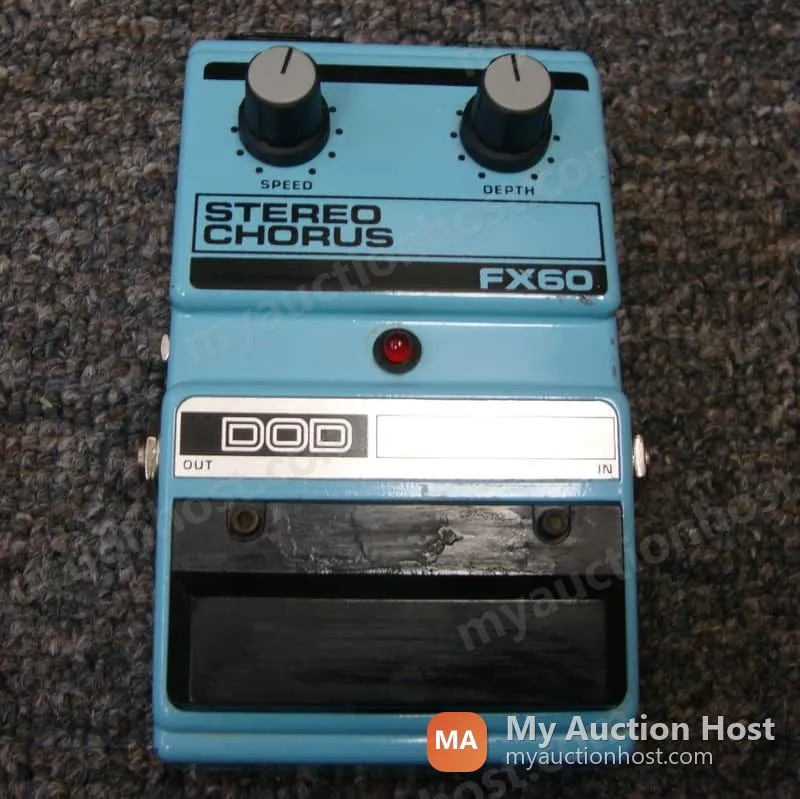
- FX60 Stereo Chorus (1982–93). One of the first ten FX pedals, with just Speed and Depth. The site’s opinion is that it is a “poor man’s” Boss CE-2: similar analog tone, stereo output and a faster maximum speed, usually at a bargain price on the used market.
- FX69 Grunge (1993–97). Controls named Loud, Butt, Face and Grunge. The site says Kurt Cobain used a Grunge pedal only as a joke on MTV in December 1993 and stuck to Boss DS-1 and DS-2 pedals otherwise. An FX69 is displayed at the Experience Music Project in Seattle, according to the same page.
- FX86 Death Metal (1994–97). Three bands of EQ and no distortion knob, with controls called R.I.P., Guts, Pain and Scream. Per the manual it oscillates when R.I.P. is turned up, which is either a flaw or the whole idea.
- FX100 Integrated Tube Even Harmonic Overdrive (1996–98). Introduced at Summer NAMM 1996 with a speaker-emulation output, which the site says was a first for DOD.
The DODs in this archive
The seller kept a small collection of DOD modulation pedals and let a few go in 2018. Each page has the photos, the original write-up and the price, and the pages for these models carry background notes drawn from the same sources as this guide.
- DOD FX60 (sold for $44, March 2018)
- DOD FX60 Stereo Chorus (sold for $35, February 2018)
- DOD FX65B (listed June 2018, not sold)
- DOD FX75 (sold for $35, April 2018)
- DOD FX75C (listed June 2018, not sold)
- DOD FX75C Flanger (sold for $30, February 2018)
- DOD FX75C Flanger and FX65B Chorus (sold for $75, July 2018)
- DOD FX20B (sold for $30, April 2018)
Related family members sold here: the DigiTech Hyper Phase, the DigiTech Drop and a 2016 DOD Carcosa Fuzz, which postdates the 2013 relaunch described above. For the clipping side of DOD’s story, see our guide to the Pro Co RAT and other hard-clipping pedals, and for where a chorus or flanger belongs on a board, pedal order.
Keeping one alive
- Check the battery first. The site notes that a weak 9 V can still power the effect but not flip it back off. DOD even shipped a printed red insert telling owners that a worn-down battery is the usual reason a pedal will not switch back to clean.
- The footswitch wears out. If it is still stiff or unreliable with fresh power, it is probably worn. On the original and second series it sits on a small board, with two wires to unsolder, and the site has an illustrated replacement guide (linked below). It also warns that final-series switches are soldered straight to the main board and call for a delicate touch.
- Parts are metric. Apart from the very first pedals with large CTS pots (marked 137, 1982–83), DOD used metric nuts on the pots and jacks and size 6/32 screws on the bottom plate. The site found replacement nuts hard to source. The part numbers it lists came from DOD’s outlet store as of 2010, so do not count on them.
- Leave the trim pots alone. Where a pedal has internal trim pots, the site’s advice is not to adjust them.
- Scratchy controls are common on old pedals; see our DeoxIT guide for what to spray and when to give up.
What to keep in mind
America’s Pedal was a labor of love by fans, not DOD’s records. It said itself that some years in its index could be slightly off, a few pages were empty in the archive, and the copies we read were captured between 2009 and 2025. For a specific pedal, the date codes inside it beat any chart.
Sources
- America’s Pedal? (DOD history; archived copy, 2010)
- Field guide to DOD’s FX-series pedals — America’s Pedal (archived copy)
- The FX-series index — America’s Pedal (archived copy)
- DOD effects pedal serial number and date of manufacture — America’s Pedal (archived copy, 2010)
- FX technical info — America’s Pedal (archived copy, 2010)
- FX switch repair — America’s Pedal (archived copy, 2010)
- FX45 Stereo Reverb — America’s Pedal (archived copy)
- FX56 American Metal — America’s Pedal (archived copy)
- FX60 Stereo Chorus — America’s Pedal (archived copy, 2010)
- FX69 Grunge — America’s Pedal (archived copy)
- FX86 Death Metal — America’s Pedal (archived copy, 2010)
- FX100 Integrated Tube Even Harmonic Overdrive — America’s Pedal (archived copy)
- Site updates, 2013 (DOD relaunch news) — America’s Pedal (archived copy)