The short version
- The Ibanez Tube Screamer is a green overdrive pedal designed in 1979 by Susumu Tamura at Nisshin Onpa, whose brand was Maxon. It was sold in Japan as the Maxon OD-808 and overseas as the Ibanez TS-808.
- It does not make much gain. What it does is push the mids, trim the low end and nudge an amp that is already working, which is why it is so often used as a boost into a tube amp.
- Players split on it. One well-known pedal reviewer says half of players tell him they hate Tube Screamers and half would never be without one.
- This guide’s author sits closer to the first group, with a twist: the author is not a big fan, but has tried many Tube Screamer clones and still owns a few. We say what that means in our take.
- Below: where it came from, the model timeline, how it works, why some players do not like it, the clones (including three we sold) and how to buy one.
Where it came from
According to Guitar World (2020), the circuit was unveiled in 1979 as a product of Nisshin Onpa, a Japanese firm that was an original-equipment maker of pickups and electronics, and it was the work of its engineer Susumu Tamura. Nisshin sold it under its own Maxon brand in Japan as the OD-808 Overdrive, while its customer Hoshino Gakki, the Ibanez company, took the same circuit overseas as the TS-808 Tube Screamer Overdrive Pro.
It was not designed in a vacuum. Tamura’s stated aim, per Wikipedia, was a pedal to compete with the Boss OD-1 and the MXR Distortion+. Guitar World describes the circuit as closely resembling the OD-1, but with symmetrical clipping and a tone control. Wikipedia adds, citing a 2023 interview with Tamura that we could not open, that Boss held the patent on asymmetrical clipping, so Tamura used symmetrical clipping, and that the “Tube Screamer” name came from a remark by a Sam Ash family member who heard it sounding like a screaming tube amp. We pass that on as Wikipedia’s account, not our own finding. Wikipedia also says two earlier Ibanez-brand overdrives, the “Orange Overdrive” and the OD-855 Overdrive II, came first.
For our own Boss dating guide, the OD-1 is the other half of this story: it coined “overdrive” in 1977, and the Tube Screamer followed two years later.
The models, in order
“Tube Screamer” has meant a number of pedals since 1979. This table pulls together the years we could confirm. Where two sources disagree, we say so.
| Model | Years | What to know | Source |
|---|---|---|---|
| TS-808 (Maxon OD-808 in Japan) | 1979 to 1981 | The original, which Guitar World says many consider the holy grail of overdrive pedals. Small rectangular metal footswitch. Most wide-case units used the JRC4558D chip; some used RC4558P or TL4558P. A rare narrow-case 1979 version used a pair of 1458 chips and was reissued in 2014 as the 35th Anniversary model. | Guitar World (2020) |
| TS9 (Maxon OD-9) | 1982 to 1985 (Wikipedia gives 1981) | Same schematic, with changed output resistor values to cut noise, and a large rectangular switch. Wikipedia says it sounds brighter and less smooth, and that parts varied from batch to batch. | Guitar World (2020); Wikipedia |
| TS10 | from 1986 | Part of Ibanez’s Power Series. Described as cheaper and less sturdy than the earlier ones, yet Stevie Ray Vaughan used them. | Guitar World (2020) |
| TS5 Soundtank | 1991 to 1998 | A Taiwan-built, plastic-case model with a circuit close to the TS9. | Wikipedia |
| TS9 reissue | 1992 | Launched when original TS9s had become costly. | Wikipedia |
| TS9DX Turbo | 1998 | Adds a fourth control with modes labelled TS9, +, Hot and Turbo, for more volume, gain and low end. | Wikipedia |
| TS7 Tone-Lok | 1999 | Aluminium case, knobs that sink in so they cannot be knocked, and a “hot” mode. | Wikipedia |
| TS808HW | 2008 | Limited hand-wired edition of the 808 circuit. Wikipedia calls it the first Tube Screamer with true-bypass switching; we found no second source. | Wikipedia |
| TS9B | 2011 | A bass version with five controls, including a mix control that keeps some clean low end. | Wikipedia |
These years are what the sources say, and some, like the TS5 and TS7 dates, appear in only one place. Ibanez’s current line includes the TS9, the TS808 reissue and a smaller TS Mini; check Ibanez’s own pages for what is in production now.
How it works, in plain terms
Wikipedia’s description of the circuit is the clearest we found. The pedal runs your signal through an op-amp, a small chip, with two silicon diodes wired in opposite directions in its feedback loop. When the signal gets loud enough, the diodes limit it. Because they clip both halves of the wave the same way, the result is called symmetrical and soft. The Drive knob sets how much gain the stage has, a Tone knob adjusts the treble, and Level sets the volume. Transistor buffers sit at the input and output.
Two other points explain the sound. First, the circuit mixes a clipped copy of your signal with the clean one, which is why Wikipedia says it keeps dynamics and clarity that would otherwise be lost. Second, it cuts bass and boosts the mids. Mick Taylor of That Pedal Show, quoted in Guitar World (2020), puts the hump at roughly 500 to 800 Hz. That is one expert’s ear, not a Maxon or Ibanez specification, and we found no official centre frequency.
What about the chip?
Much is made of the JRC4558D op-amp, the chip in most original TS-808s. Wikipedia says the JRC4558D is a licensed version of a common 4558 chip and that the chip type has little to do with the sound, which the diodes dominate. Not everyone agrees: Analog Man founder Mike Piera reports AB tests finding only small differences among chips, but prefers the JRC for a classic sound. We did not find a measured comparison, so this stays opinion on both sides. If you want the exact original sound, the chip is one thing on a list that also includes resistor values, diodes and the build quality of the parts.
How people use it
Mike Piera, in the same Guitar World piece, describes it as a nice boost with a warm midrange that works well with Fender amps, and one that tightens the low end of a loud amp so it sits better in a band. That is the usual case for it: not a standalone high-gain sound, but a way to tighten and push a tube amp that is already close to breaking up. Our pedalboard order guide has where an overdrive like this usually goes in the chain. Our Fulltone guide covers the OCD, a different and fuller-sounding overdrive.
Famous users include Stevie Ray Vaughan, who used TS-808, TS9 and TS10 pedals according to Guitar World. Wikipedia lists many more, such as Gary Moore, but its list is thinly cited, so we leave it there.
Why some players do not like it
Opinions, not measurements, follow. In the Guitar World piece, Taylor says that about half of the guitarists he meets tell him they hate Tube Screamers, and the other half would never be without one. The usual complaints are the ones the circuit is built around:
- The bass is cut. That is by design, and good for a loud amp, but a player who wants a fat, full tone can find it thin. A poster in a Seymour Duncan forum thread says he likes his tone fat; that is one forum post.
- It pushes the mids. Handy to cut through a mix, but some players hear it as boxy or nasal. Mike Piera’s point, above, is that low-volume bedroom playing and loud band playing may want different things.
- Hype. Guitar World’s clone guide calls it the original of a whole family tree of pedals that make up a big part of the pedal market, so there is a lot of noise around it.
- Transparent-overdrive fans want more. A pedal-company blog compares it with Klon-style pedals, which it says keep more low end; that is one opinion, but it matches how the two are usually described.
Our take
The author of this guide is not a big Tube Screamer fan. The author has also tried many Tube Screamer clones and still owns a few. We are not going to explain that; it is the sort of thing that makes sense to someone who owns a lot of pedals. What we will say is that the pedal’s reputation and the pedal’s job are not the same thing. If you want it as a mid-boost in front of a tube amp, it is hard to beat for the money, and the cheap versions do that job. If you want a full-range standalone drive, you may hear what the haters hear. Try one before paying a vintage price.
Three Tube Screamer-style pedals have passed through our archive, and their descriptions give a flavour of the clone world:

- Joyo JF-01 Vintage Overdrive (sold for $20, February 2018): a mint, barely used clone. The listing’s verdict was that it is a Tube Screamer. It also appears in our Joyo guide.
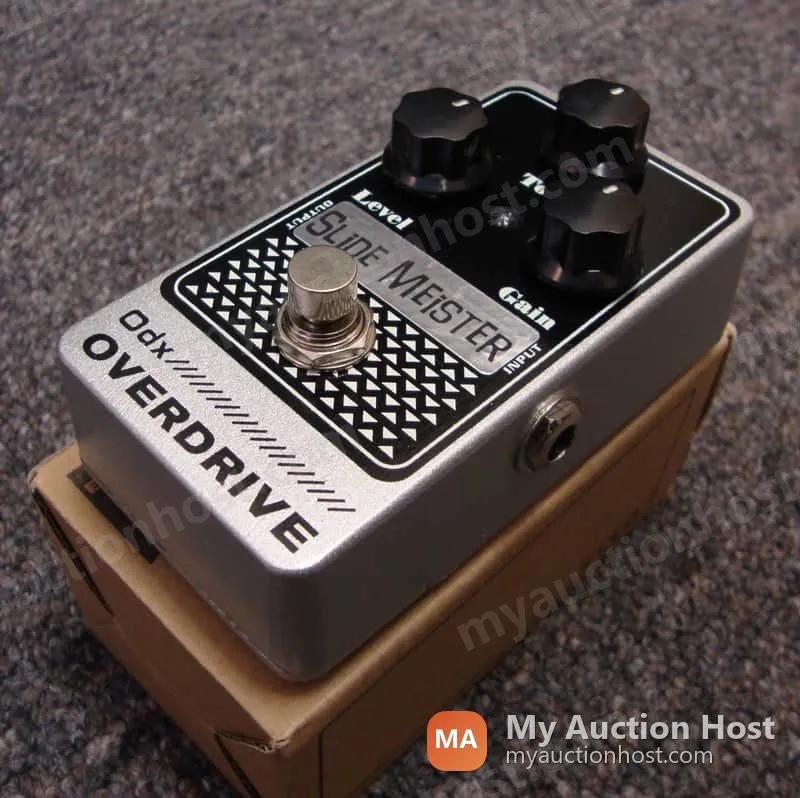
- Slide Meister ODX Overdrive (sold for $30, February 2018): a white-label TS-808 clone that was sold under several brand names. The listing quotes Effects Database copy that says the pedal has a JRC4558D chip, true bypass and hand soldering, and the seller warns to take that with a grain of salt.
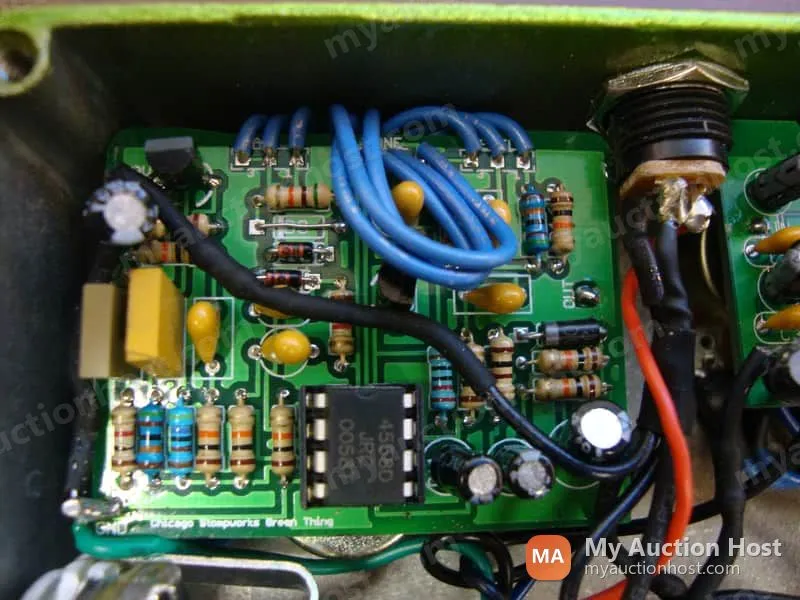
- Chicago Stompworks Fudge Scrambler (sold for $90, July 2019): a two-channel pedal from a boutique builder, with a TS-808 clone on one side and a clone of the Maestro MFZ-1 fuzz on the other.
Clones and cousins
A Tube Screamer “clone” may be a close copy, a modded one or just a pedal in the same spirit. Our Joyo guide explains what “clone” does and does not mean. Here is what the sources say about the main ones. We do not quote prices, because they change.
| Pedal | What the source says | Source |
|---|---|---|
| Maxon OD808 and OD9 | The original maker’s own versions of the TS-808 and TS9. Guitar World’s clone guide lists the OD808 among its picks. | Guitar World’s clone guide; Wikipedia |
| JHS Bonsai | Guitar World’s top pick, a Tube Screamer-style pedal with many modes. | Guitar World’s clone guide |
| EarthQuaker Devices Plumes and Palisades | Both listed as Tube Screamer alternatives. | Guitar World’s clone guide |
| Electro-Harmonix East River Drive | Listed as a Tube Screamer alternative. | Guitar World’s clone guide |
| Way Huge Smalls Green Rhino MKV | Listed as a Tube Screamer alternative. | Guitar World’s clone guide |
| Mooer Green Mile | Listed as a compact, budget Tube Screamer clone. | Guitar World’s clone guide |
| Hudson Sidecar | Listed as a Tube Screamer alternative. | Guitar World’s clone guide |
| Ibanez TS Mini | Ibanez’s own smaller-format Tube Screamer. | Ibanez |
| Joyo JF-01 | A budget Tube Screamer-style pedal; we sold one (above). | Our sale |
| Keeley and Analogman mods | Named by Wikipedia as notable modifiers of Tube Screamers. Analog Man says he began by modifying TS pedals to 808 specs in the 1990s. | Wikipedia; Guitar World (2020) |
| Boss SD-1 | A rival rather than a clone: descended from the OD-1 and the usual comparison. See our Boss dating guide. | Our guide |
Guitar World’s clone guide is the magazine’s opinion, and its pages carry affiliate links. Treat all of these as starting points, not rankings.
Modding
Mods are a large part of the Tube Screamer world. Mike Piera says Analog Man started by changing later TS models to the 808 specification with parts he sourced in Japan. Premier Guitar’s mod guide describes resistor swaps that return later models to 808 values and diode changes that alter the clipping, such as adding a third diode for asymmetry. Wikipedia mentions silicon and germanium diode mixes. If you do not solder, buy a pedal that has been modded by someone who does.
How to buy one
- Decide what you want it for. A boost in front of a tube amp is the classic job; a stand-alone drive is a different job, and not everyone likes it.
- Original or reissue? Guitar World says the 1979 to 1981 TS-808 is the one many players treat as the holy grail, and that vintage ones fetch several hundred pounds. Small rectangular switch means an original 808; a large switch means 1982 or later. Reissues are much cheaper.
- Try a clone first. The Joyo-class pedals are cheap, and several of the bigger names offer extra modes. If you like the idea, you have found out for a low price.
- Read the photos. Ask which chip and whether the pedal has been modded, and look at the switch type.
Where to find them
These searches go straight to listings, with eBay first.
| Looking for | eBay | Reverb | Amazon |
|---|---|---|---|
| Ibanez TS9 | eBay | Reverb ad | Amazon |
| Ibanez TS808 reissue | eBay | Reverb ad | Amazon |
| Ibanez TS Mini | eBay | Reverb ad | Amazon |
| Maxon OD808 | eBay | Reverb ad | Amazon |
| Tube Screamer clones | eBay | Reverb ad | Amazon |
| Joyo JF-01 | eBay | Reverb ad | Amazon |
| Behringer TO800 | eBay | Reverb ad | Amazon |
| Modded Tube Screamers | eBay | Reverb ad | Amazon |
The eBay, Reverb and Amazon search links are affiliate links (see our terms). Photos of the pedals we sold were taken by the seller.
Sources
- Ibanez Tube Screamer: Wikipedia
- Classic gear: Maxon Overdrive and Ibanez Tube Screamer (Rod Brakes, 2020): Guitar World
- Best Tube Screamer clones: top alternatives for all budgets (James Farmer, updated 2023): Guitar World
- Green Giant: History of the Tube Screamer (Lindsay Tucker, 2011): Premier Guitar (article body not readable by us)
- The Ultimate Tube Screamer Mod Guide: Premier Guitar
- Ibanez TS Mini: Ibanez
- Ibanez Tube Screamer history: Analog Man
- The hype of the Tubescreamer (forum thread, opinion): Seymour Duncan forum
- Tube Screamer vs Klon-style overdrive (blog, opinion): Deathcloud