The short version
- Every pedal needs the right voltage, enough current (milliamps) and the right polarity. Most want 9 V DC, center-negative.
- A daisy chain (one adapter, a cable with many plugs) is cheap and often fine for a few analog pedals. Digital pedals sharing it are where the whine and hum start.
- An isolated supply gives each pedal its own electrically separate output, which is the standard cure for that noise. The Voodoo Lab Pedal Power line and the MXR Iso-Brick are examples.
- The famous One Spot is a daisy-chain supply, and a very good one. Its maker, Truetone, also sells isolated 1 SPOT Pro models for bigger boards.
- The author’s favorites are the Truetone 1 SPOT Pro CS6, CS7 and CS12: great value, and they work as well as the Voodoo Lab supplies, sometimes better, with more versatility. Voodoo Lab is historically great and you can never go wrong with it. That is an opinion, not a bench test.
- The MXR Bricks are not battery boxes. They plug into the wall (an 18 V adapter comes in the box). Batteries are a separate, valid option for a few pedals.
What a pedal actually needs
Voodoo Lab, which makes power supplies and so has opinions, sums it up as voltage, current and polarity. Most pedals run on 9 V DC, some on 12 or 18, and using the wrong voltage can mean poor performance or, in extreme cases, damage. Truetone’s help page says the same: a 9 V pedal goes on a 9 V output, and 12 or 18 V only if you have checked with the pedal’s maker. It also warns never to feed a DC pedal from a 9 V AC output unless the pedal specifically asks for AC, as some Line 6 and DigiTech pedals do, because that usually destroys much of the electronics.
- Current. It is measured in milliamps (mA). A pedal draws only what it needs, and Truetone says it is best to have more available than the effect requires. If the output cannot supply enough, and voltage and polarity are right, the pedal simply will not power up properly. Voodoo Lab says vintage stompboxes typically draw just a few mA, while modern DSP pedals are often 250 to 500 mA each. Truetone adds that most makers do not publish the true draw, so check the manual or measure it.
- Polarity. Most pedals are center-negative, but some vintage-style circuits and some modelers are not, and Voodoo Lab calls reversed polarity the silent killer, since it can fry a circuit instantly. Look for the polarity symbol by the jack. Truetone sells a reverse-polarity converter for center-positive barrel jacks.
- Germanium fuzzes. Truetone says old-style fuzz pedals with PNP germanium transistors are electrically opposite to your other pedals, so they should run from their own supply rather than share one.
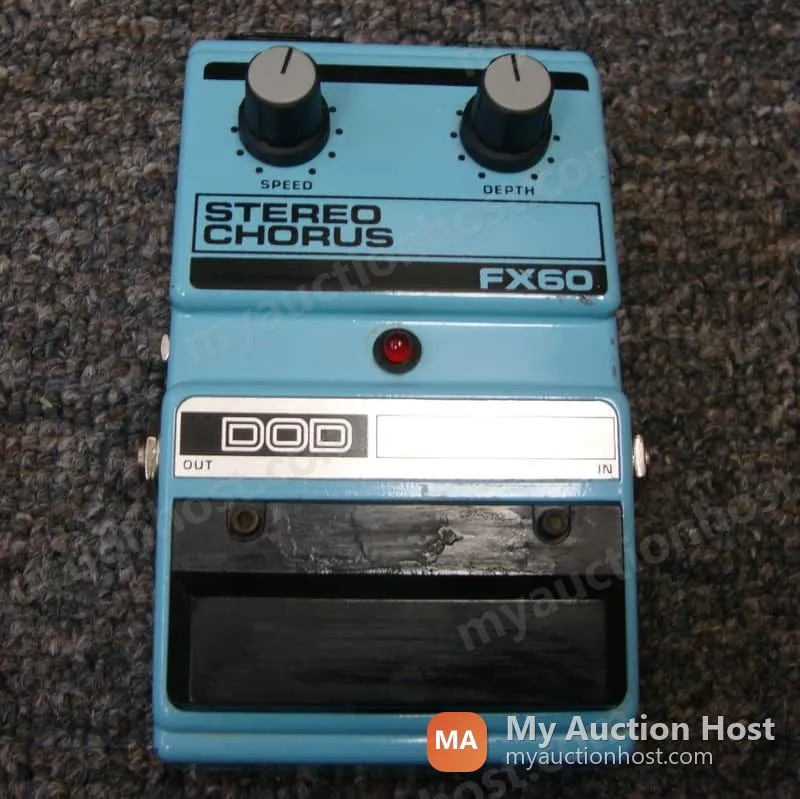
- Vintage DODs. America’s Pedal describes DOD’s original and second-series pedals as using an unusual 1/8″ center-positive power jack, so a standard cord will not do. See our DOD FX-series guide.
The daisy chain: cheap, simple, and sometimes the problem
A daisy chain splits one adapter output to several pedals with a multi-plug cable. All the pedals then share one electrical path, the same ground and the same noise floor. That is the whole appeal (one wall wart, one cable, done) and the whole problem. Voodoo Lab lists the symptoms: a high-pitched whine that changes when you tweak a delay, a tick in time with a tremolo or tap-tempo light, and classic ground-loop hum that grows as you switch on more pedals.
The explanation, as Strymon puts it, is that a digital pedal’s noise is filtered from its own audio output but can leak into the other pedals through a shared, non-isolated power connection. The fixes it suggests are to power the digital pedal from its own supply or to use an isolated, multi-output supply. Rig Doctor, a pedalboard builder, offers a more forgiving rule of thumb: an all-analog board of four or fewer pedals on a daisy chain might be perfectly fine, and the time to upgrade is when you add digital pedals, pass five or six pedals, or start hearing noise. Voodoo Lab agrees that a three-pedal board will probably get through the gig.
What “isolated” means, and how to check
An isolated supply gives each output its own power circuit and ground reference (typically its own transformer winding), so noise from one pedal has no shared power rail to travel along. Voodoo Lab describes it as breaking the unwanted ground path; Rig Doctor calls it the removal of the ground loops behind most pedalboard hum.
One caution from Rig Doctor: some cheap supplies advertise isolation but use one transformer with several taps, which is some separation but not the real thing. You can test it with a multimeter set to continuity. Touch the ground sleeves of two different outputs; a beep means they share a ground and are not isolated from each other.
The usual suspects
The figures below are the makers’ own, from their product pages. Total current is only part of the picture, because each output also has its own limit.
| Supply | What it is | What the maker says |
|---|---|---|
| One Spot / Truetone 1 SPOT | The classic daisy-chain supply | One 9 V DC output rated at 1700 mA, worldwide voltage, switch-mode, plus daisy-chain and cable accessories. Truetone says it changed the game in 2001. It also says analog and single-effect digital pedals work together quietly on a chain, but digital multi-effects and modelers cause noise when sharing power, and recommends its 1 SPOT Pro line for those. |
| 1 SPOT Pro (CS6, CS7, CS12) | Isolated, multi-output | CS6: six isolated outputs, 1600 mA total, very slim. CS7: seven isolated outputs, 1900 mA, four of them switchable 9/12 V. CS12: twelve isolated outputs, 3000 mA total. A CS11 with 3450 mA is the highest current in the lineup. |
| Voodoo Lab Pedal Power 2 PLUS | Isolated, the long-time standard | Eight galvanically isolated 9 V outputs: six switchable to 12 V, two rated 250 mA, and two with a SAG control that imitates a low battery. A 200-watt courtesy outlet on the back can power another device. |
| Pedal Power 3 PLUS | Isolated, lightweight, high current | Every output delivers up to 500 mA; zZounds’ listing counts twelve isolated outputs, with X-Link outputs for expansion. |
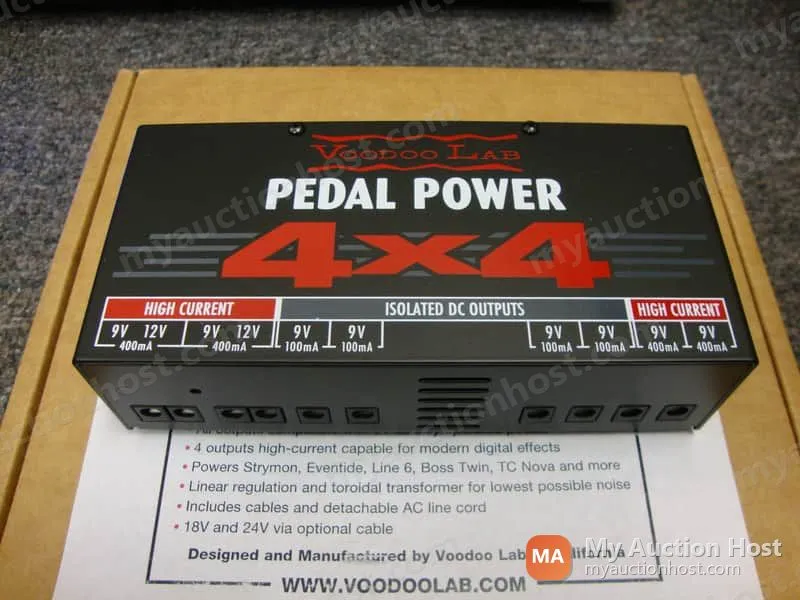
| Voodoo Lab Pedal Power 4x4 | Isolated linear supply with a fan | Eight isolated outputs: four 9 V at 400 mA (two with a 12 V option) and four 9 V at 100 mA, a toroidal transformer, and a temperature-controlled fan. Voodoo Lab says it can properly power up to four power-hungry digital effects plus four ordinary 9 V stompboxes. It’s the one in our archive. |
| Pedal Power ISO-5 | Small isolated supply | Five isolated outputs: three 9 V at 100 mA, one paired 400 mA output for 9 or 12 V, and one 18 V at 100 mA. |
| MXR Iso-Brick (M238) | Isolated, wall-powered | Ten fully isolated outputs: two 9 V at 100 mA, two at 300 mA, two at 450 mA, two 18 V at 250 mA, and two variable 6 to 15 V at 250 mA. The variable pair can mimic the “sag” of a drained battery. It runs from the included 18 V adapter. Dunlop adds: “built like a tank.” Also see the Iso-Brick Pro and Mini Iso-Brick. |
| MXR DC Brick | Wall-powered, 9 V and 18 V outputs | A revamp of the older DCB10: eight 9 V outputs, each with a red LED that lights if there is a short, and two 18 V outputs, with short-circuit and overload protection and the AC adapter and cables included. Dunlop’s page does not call its outputs isolated, unlike the Iso-Brick. |
| Strymon Ojai | Compact isolated supply | Strymon, whose own noise page recommends isolated supplies like it, says it provides isolated power to every pedal. zZounds lists five individually isolated outputs of up to 500 mA each. |
Why the One Spot gets so much love
It is small, it is cheap, it takes any wall voltage in the world, and it powers a board with a single cable. Truetone, formerly Visual Sound, calls it the world’s most popular guitar pedal power supply, which is a maker’s claim, though you can find one on a great many boards. For a handful of analog pedals it is hard to beat on value, and several of the pedals in this archive, like the Turbo RAT, are exactly the kind of 9 V analog box it was built for. Its limits are the ones above: one shared output, so keep the modelers off it. The Pro models are what you buy when the board grows.
The author’s favorites: the 1 SPOT Pro CS6, CS7 and CS12. To be fair to the other side, Voodoo Lab is historically great, its Pedal Power line has earned its reputation over decades, and you can never go wrong with one. But the Truetone Pro supplies are a great deal, and in the author’s experience they work as well as the Voodoo Lab ones or better, with sometimes more versatility. On paper that fits: the CS12 has twelve isolated outputs including dedicated 18 V ones, switchable 9/12 V ones, a variable 4 to 9 V output and a separate 9 V AC output for older Line 6 and DigiTech pedals; the CS7 has seven isolated outputs, four of them switchable 9/12 V; and the CS6 is only 1.2″ tall, so it fits under almost any pedalboard without brackets. That is one player’s preference and the makers’ specs, not a lab comparison.
Batteries, and the MXR Brick mix-up
It is an easy one to mix up, but the Bricks are mains supplies. Dunlop’s own pages say both the Iso-Brick and the DC Brick run from the included ECB009 18 V adapter. What they offer in the battery spirit is the Iso-Brick’s variable outputs, which are meant to imitate the sagging voltage of a drained battery, much as the Voodoo Lab 2 PLUS does with its SAG knob.
Real batteries remain a fine choice for a few pedals: no adapter, no cord, and nothing shared. Voodoo Lab notes that pedalboards used to be rows of battery-powered analog pedals. The catch is that modern digital pedals draw far more current than the few milliamps of a vintage stompbox, so a battery drains much faster.
Adding it up
- List each pedal’s voltage and current from its manual or label. Where the maker does not say, a current meter will.
- Match every pedal to an output that meets its mA, not only the supply’s total. A 450 mA modeler cannot go on a 100 mA output no matter how big the total is.
- Leave some room. Rig Doctor suggests a supply rated about 20 percent above your combined draw. That is one builder’s rule of thumb, not a standard.
- Check polarity and connector size before plugging anything in. A 1/8″ or center-positive pedal needs a converter or its own adapter.
Worked example with the Voodoo Lab 4x4: its eight outputs add up to 2000 mA (our own sum of the maker’s figures), but a 300 mA modeler has to go on one of the four 400 mA outputs, and the four 100 mA ones suit simple analog pedals.
A power supply that never found a board
The archive’s seller has been here. The Voodoo Lab Pedal Power 4x4 (sold for $145 in March 2018) was bought “for a larger board that never materialized,” and the seller noted he already had a Pedal Power 2 and that it was “more than enough.” The Pedaltrain Novo 32 that went with it was bought for the same board that never happened. If you are working out how big a board and supply you really need, our guide to pedal order is the next stop.
Where to find them
Supplies turn up used on eBay and Reverb all the time, and an isolated supply is a part that lasts; Amazon has the new ones. The Voodoo Lab and MXR models above are also at zZounds (the shopping card on this page), but the Truetone Pro supplies are not, so look on eBay, Reverb and Amazon. Searches for each:
| Supply | eBay | Reverb | Amazon |
|---|---|---|---|
| Truetone 1 SPOT Pro CS12 | eBay | Reverb ad | Amazon |
| Truetone 1 SPOT Pro CS7 | eBay | Reverb ad | Amazon |
| Truetone 1 SPOT Pro CS6 | eBay | Reverb ad | Amazon |
| Voodoo Lab Pedal Power 4x4 | eBay | Reverb ad | Amazon |
| Voodoo Lab Pedal Power 2 PLUS | eBay | Reverb ad | Amazon |
| Voodoo Lab Pedal Power ISO-5 | eBay | Reverb ad | Amazon |
| One Spot / Truetone 1 SPOT | eBay | Reverb ad | Amazon |
| Visual Sound One Spot (older) | eBay | Reverb ad | Amazon |
| MXR Iso-Brick | eBay | Reverb ad | Amazon |
| MXR DC Brick | eBay | Reverb ad | Amazon |
These are search links, and some of them earn us a commission (see the note at the bottom of every page).
If it still hums
- Is it the supply? Try the suspect digital pedal on its own adapter or a battery. If the noise vanishes, the shared power was the problem, and Strymon’s suggested remedy is the same.
- Check the isolation with the continuity test above if a supply seems to be isolated in name only.
- Stereo rigs with two grounded amps can hum from a ground loop regardless of the supply, which Strymon’s page also covers.
- Scratchy jacks and pots make noise too; see our DeoxIT guide.
Sources
- Pedalboard Power Supply Complete Guide — Voodoo Lab
- Pedal Power 4x4 — Voodoo Lab
- Pedal Power 2 PLUS — Voodoo Lab
- Pedal Power 3 series — Voodoo Lab
- Pedal Power ISO-5 — Voodoo Lab
- MXR Iso-Brick Power Supply — Dunlop
- MXR DC Brick Power Supply — Dunlop
- 1 SPOT — Truetone
- 1 SPOT Pro comparison — Truetone
- Power help center (FAQ) — Truetone
- Pedalboard Power Supply Guide: Isolated vs Daisy Chain — Rig Doctor
- Noise and ground loops in your signal chain — Strymon
- Strymon Ojai Power Supply (retailer description) — zZounds
- Field guide to DOD’s FX-series pedals — America’s Pedal (archived copy)