The short version
- Ampeg publishes its own rules. Its Knowledgebase item “When was my Ampeg built?” (the old PDF is gone from ampeg.com, but the same text is on the Ampeg Knowledgebase and in a 2021 Wayback Machine copy) describes six serial systems, and our decoder below follows it.
- Only some eras decode. 1953 to 1969, 1985 to 2005 (St. Louis Music) and 2006 on (LOUD, then Yamaha) have a rule. Ampeg itself says the 1970s and the 1981 to 1985 MTI years cannot be dated by serial, and pre-1953 amps had no serial at all.
- Where a serial fits more than one rule, the decoder shows every candidate instead of picking one, with the rule, the source and how far to trust it.
- Ampeg’s own advice is to confirm with the date codes on the speaker, pots and transformers and, for the 1970s, with control-panel, switch and logo features. The decoder handles both.
Ampeg serial number decoder
Fill in whatever you have. Only the serial is needed; the other boxes narrow the answer. Everything runs in your browser and nothing you type leaves the page.
Reading the answer: Ampeg’s page is the manufacturer’s own, but it is a knowledge-base answer, not a factory record, and it says itself that it borrows heavily from Blue Book of Guitar Values and the book Ampeg: The Story Behind the Sound. Treat a result as a good estimate, then check it against the parts and the features.
The serial styles, era by era
| Period | Serial style | What it tells you |
|---|---|---|
| Before 1953 | None | Nothing. Date by EIA codes on speakers and parts. |
| 1953 to mid-1965 | Six digits, YMMNNN | Last digit of the year, month, production number. The decade is not in the serial: 1953 could be 1963. |
| 1965 to 1969 | Six digits, sequential from 000001 to about 092000 | Year only: 000001-020000 is 1965, 020000-049000 1966, 049000-075000 1967, 075000-080000 1968, 080000-092000 1969. |
| 1970 to 1979 | A third system, no usable rule | Ampeg: not enough information; may differ by model or chassis (VT-22 and V-4 are named). |
| 1981 to 1985 (MTI) | No usable rule | Ampeg: cannot be dated by serial. |
| 1985 to 2005 (St. Louis Music) | 10 characters, LLLCYMNNNN | Model, country (U, Y, W, D), year letter (A is 1988 to R is 2005), month (1 to 9, 0 or 10, A is November, B is December), production number. Years before 1988 are “unclear”. |
| 2006 to 2018/19 (LOUD) | 12 characters, XXXXBBYMNNNN | Model, build location, year letter (S is 2006 to L is 2019), two-week period letter, serial. |
| 2018/19 on (Yamaha) | 17 characters, (21)PPPPMYYWWXXXXXC | Product code, manufacturer code, year (68 is 2018), week, weekly serial, check digit. Ampeg’s year chart ends at 73 (2023). |
Worked examples
- AJYDB60626 is the example in Blue Book of Guitar Values for a B-15R: model AJY, country D (U.S.), year letter B (1989), month 6 (June), production number 0626. The decoder returns June 1989. This is the one example we found that comes from a published reference.
- 710201 is the example on a dealer page: year digit 7, month 10, production number 201, so October 1957. The decoder returns that, and it is the only year the rule allows, since a 1960s or 1970s reading of digit 7 would be 1967 or 1977, outside the 1953 to mid-1965 system.
- 404553 reads as April 1954 or April 1964. The dealer page picks 1964 without saying why. The decoder gives both and tells you to check the parts.
- 050412 is one we made up to show the sequential rule: month 50 is impossible, so only the 1965 to 1969 reading applies, and 050412 falls between 049000 and 075000, which is 1967.
- 011234 shows why one answer would be dishonest: it reads as November 1960 (YMMNNN) or as a 1965 sequential number. Ampeg says the two systems overlapped for about six months in 1965, and both readings appear.
1970s features: when the serial cannot help
For the Magnavox years Ampeg gives a table of cosmetic features instead. The decoder above intersects whatever you tick.
| Feature | Years used |
|---|---|
| Blue control panel graphics | 1968 to 1972 |
| Black control panel graphics, square corners | 1972 to 1975 |
| Black panel, horizontally split, rounded corners (solid-state amps) | 1973 to 1979 |
| Black panel, horizontally split, rounded corners (tube amps) | 1976 to 1979 |
| Distortion control knob | 1976 to 1979 |
| White rocker switches (solid-state amps) | 1973 to 1979 |
| White rocker switches (tube amps) | 1976 to 1979 |
| Black rocker switches | 1968 to 1975 |
| Metal “A” logo | 1968 to 1975 |
| Plastic “A” logo | 1973 to 1979 |
Example: a tube amp with a blue panel and a metal logo falls in 1968 to 1972; a black split panel with a plastic logo falls in 1976 to 1979 if it is a tube amp. Features overlap, so you get a window, not a year.
Date codes on the parts
Ampeg points to the EIA codes on speakers, transformers and pots as the way to confirm a date. Our reference for the code layout is the Blue Book of Guitar Values dating tools: a six-digit code is three digits for the maker, one for the year and two for the week (its example is 220022, Jensen, week 22 of 1950 or 1960), and a seven-digit code uses two digits for the year (1377918 is CTS, week 18 of 1979). The decoder reads both. A date code means the part was made then, so the amp was built on or after that date. Parts can sit on a shelf for months, and a replaced part dates the replacement, not the amp.
| Code | Maker | Code | Maker |
|---|---|---|---|
| 220 | Jensen (speakers) | 878 | Acrosound (transformers) |
| 137 | CTS (speakers, pots) | 138 | Stancor (transformers) |
| 067 | Eminence (speakers) | 682 | Electrical Windings (transformers) |
| 270 | Quam (speakers) | 926 | Todd Electric (transformers) |
| 285 | Rola (speakers) | 668 | Standard Electric Products (transformers) |
| 391 | Altec (speakers) | 472 | Pyramid (capacitors) |
| 649 | Electro-Voice (speakers) | 034 | Cornell-Dubilier (capacitors) |
| 304 | Stackpole (pots) | ||
These maker codes come from a dealer page (Found Sound), not from Ampeg, and we could not check each one against a primary list.
Where the sources disagree, and what we did
| Question | What we found | What the decoder does |
|---|---|---|
| When does the 1965 to 1969 sequence end? | Ampeg says 092000. Blue Book’s page, which Ampeg credits, says 090000 for the 1969 range, and is otherwise word for word the same. | Uses 092000 and mentions the other figure for 090001 to 092000. |
| How is October written in the SLM serial? | Ampeg and Blue Book say “10”, but the format has one month character. A dealer page says 0. | Accepts 0 (and an 11-character 10), flags medium confidence. |
| What about 1985 to 1987? | Ampeg’s period starts in 1985 but its year chart starts at A is 1988, and it calls the earlier years “unclear”. | Says nothing for years before 1988. |
| Do the SLM and LOUD year letters clash? | Yes: C to L appear in both (C is 1990 or 2010). A stray copied row (“Q = 2004, H = 1995, M = 2000, R = 2005”) also sits in the 2006 chart on Ampeg’s web page, though not in the PDF, and a dealer page copies it. | Uses the serial length (10 versus 12) to separate the eras and ignores the stray row. |
| Is the 1970s serial really undatable? | Ampeg says so. A forum claim that older SVTs can be dated by serial was blocked to us and is not used. | Says “cannot date by serial” and points to features and parts. |
| What do the LOUD period letters mean exactly? | Ampeg says two-week periods and shows A to C only. | Divides the year into 26 periods and reports a month, good to about two weeks. |
| Where do model-specific serials (SVT, V-4B, Portaflex) stand? | No model-specific rules from Ampeg. It warns that the V-4 and VT-22 may share a system. | Applies the general rules only; the confidence label says so. |
Who owned Ampeg when
Ampeg’s periods follow its owners. According to the Wikipedia article on Ampeg: Michael-Hull Electronic Labs in 1946, the Ampeg Bassamp Company by 1949, a majority stake sold to Unimusic in 1967, Magnavox from 1971, Music Technology Inc. from 1980, St. Louis Music from 1986 (a footnote in the same article says 1985), LOUD Technologies from 2005, and Yamaha Guitar Group from May 2018. Each change roughly lines up with a new serial style.
A bass amp we have sold
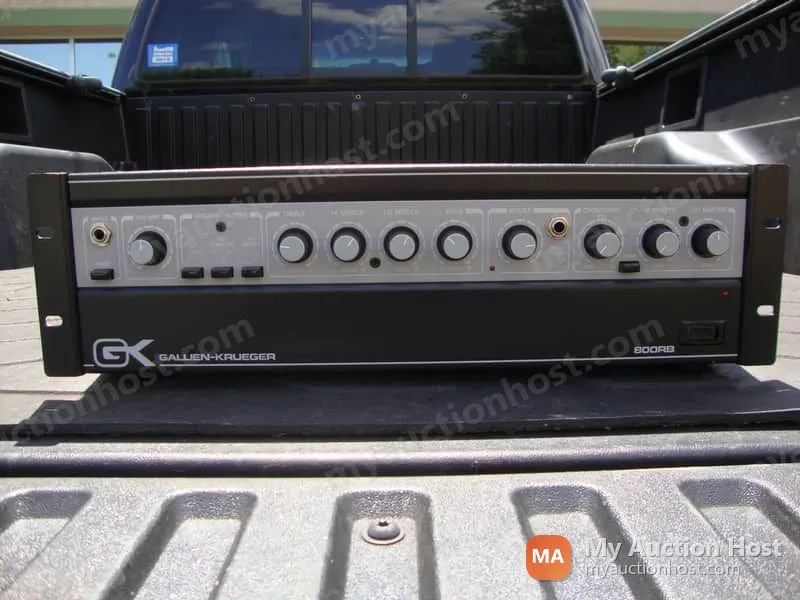
We have not sold an Ampeg amp, but our archive has a close neighbour: the Gallien-Krueger 800RB bass amp head, sold for $500. Photo below, for a sense of what a bass head looks like at auction.
Where to find them
Ask for a clear photo of the serial plate and the control panel, and a close-up of the speaker or transformer codes, so you can run the decoder before you bid.
| Looking for | eBay | Reverb | Amazon |
|---|---|---|---|
| Ampeg SVT head | eBay | Reverb ad | Amazon |
| Ampeg B-15 Portaflex | eBay | Reverb ad | Amazon |
| Ampeg V-4B | eBay | Reverb ad | Amazon |
| Ampeg SVT cabinet (810, 410) | eBay | Reverb ad | Amazon |
| Vintage Ampeg amp (1960s and 1970s) | eBay | Reverb ad | Amazon |
| Ampeg Classic series | eBay | Reverb ad | Amazon |
| Ampeg Portaflex tubes and parts | eBay | Reverb ad | Amazon |
The eBay, Reverb and Amazon search links are affiliate links (see our terms). Ampeg is a trademark of Yamaha Corporation; we are not affiliated with it.
Sources
- When was my Ampeg built? (Dating your Ampeg): Ampeg Knowledgebase
- Dating your Ampeg, PDF, Wayback Machine copy of 2021-05-23: Ampeg
- Dating Ampeg Amplifiers: Blue Book of Guitar Values
- Amp Dating Tools, PDF: Blue Book of Guitar Values
- How to determine the date of your Ampeg: Found Sound
- Ampeg: Wikipedia