The short version
- A jacquard strap has its pattern woven into the fabric on a jacquard loom, not printed or stitched on top. The same idea gave us the 1960s-70s “hippie weave” straps.
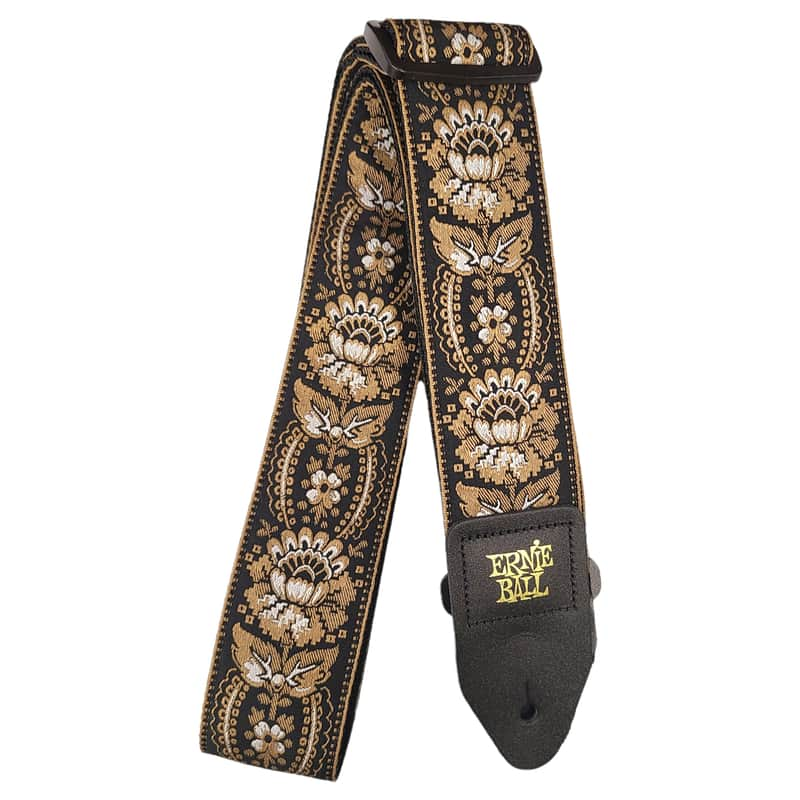
- Ernie Ball’s Classic Jacquard line, which is what I have bought, uses woven polypropylene webbing with embroidered leather ends, by Ernie Ball’s own description.
- I bought six jacquard straps and a plain polypro one on Reverb, in 2020 and 2025.
- The folklore about who wore what at Woodstock is mostly seller talk, and we say so.
What “jacquard” actually means
The name comes from the Jacquard machine, a device fitted to a loom that makes complex woven patterns practical. According to Wikipedia, Joseph Marie Jacquard patented it in 1804, building on earlier French inventions from 1725, 1728 and 1740, and it was run by a chain of punched cards, one card per row of the design. Sources differ slightly on whether the date is 1804 or 1804-05, so treat it as c. 1804. It is a pleasing thought that a guitar strap pattern descends from punched-card computing. It is also entirely true, as far as we can tell.
For a strap, the practical point is that the design is part of the cloth, so it is the same on both sides and cannot peel or flake the way a printed pattern can. That is the manufacturers’ and retailers’ claim, and it is also just how weaving works. We found no independent test of how woven straps wear against printed ones, so we make no claim about that.
What Ernie Ball says about its own
Ernie Ball’s page for the Classic Jacquard strap describes “woven jacquard designs on comfortable polypropylene webbing, finished with embroidered leather ends,” and the line was launched in nine new designs. Current patterns include Black Pleasant Pheasant, Red Rose, Black Checkers, White Blossom, Regal Black and Crimson Royal Bloom. The product page does not state the width or length where we could read it, and retailers disagree: one set of listings says 2 inches and 41 to 72 inches, another says 1.5 inches and 39 to 61. Check the listing for the exact one you are buying, because widths and lengths have probably changed over the years and between acoustic and bass versions.
“Hippie” straps and the 1960s
Retailers say the woven “hippie weave” look was made famous in the 1960s and 70s by companies that no longer exist, and several sellers tie it to Woodstock in 1969. Some sellers also say Jimi Hendrix wore a similar woven strap there. I could not trace any of that to a magazine, a museum or a maker’s history page, so please read it as seller folklore, not established fact. In particular, we found nothing to back the often-repeated story that the pattern came from Guatemalan, Peruvian or Mexican textiles, so we do not repeat it. If you know a solid source, tell us and we will happily update this section.
Practical notes
- Slipperiness. One retailer review we read says polypropylene can slip on a heavy instrument. A heavier bass may be better served by a wider strap or a rubber or leather backing. That is one reviewer’s view.
- Snagging. Woven webbing can catch on rough hardware, which is a fair argument for smooth strap buttons.
- Cleaning. We found no Ernie Ball care instruction. A different maker, 9 Strap, advises a damp cloth and warm water, a mild leather cleaner for the ends, and no machine washing. That is not Ernie Ball’s advice, so check the maker of your own strap.
- Strap locks. Leather ends hold a button well, but a strap lock is cheap insurance for a bass you care about.
Straps I have bought on Reverb
These come from my order history, with the month and the listing’s asking price (not what I paid). Orders I got refunded are left out. It shows the buying habit, not a review of each pattern.
- Ernie Ball Classic Jacquard Guitar Strap/Bass Strap - PLEASANT PHEASANT - #P05360 (Jan 2025, asking $24.99)
- Ernie Ball Classic Jacquard Guitar Bass Strap Black Pleasant Pheasant P05372 (Jan 2025, asking $21.99)
- Ernie Ball Classic Jacquard Guitar Strap Acoustic Electric Bass Woven Weave Hootenanny (Jan 2025, asking $24.99)
- Ernie Ball Classic Jacquard Guitar Strap Acoustic Electric Bass Woven Weave Hootenanny (Jan 2025, asking $24.99)
- Ernie Ball Classic Jacquard Guitar Strap - Royal Bloom (Jan 2020, asking $18.95)
- Ernie Ball Polypro Guitar Strap - Rainbow (Jan 2020, asking $8.99)
- Ernie Ball Classic Jacquard Guitar Strap - Indigo Orchid (Jan 2020, asking $23.16)
Where to find them on eBay and Reverb
| Looking for | eBay | Reverb | Amazon (similar) |
|---|---|---|---|
| Ernie Ball Classic Jacquard straps | eBay | Reverb Sponsored link. We may earn a commission if you buy through it, at no extra cost to you. Details | Amazon |
| Woven or "hippie weave" guitar straps | eBay | Reverb Sponsored link. We may earn a commission if you buy through it, at no extra cost to you. Details | Amazon |
| Levy's jacquard straps | eBay | Reverb Sponsored link. We may earn a commission if you buy through it, at no extra cost to you. Details | Amazon |
| Strap locks | eBay | Reverb Sponsored link. We may earn a commission if you buy through it, at no extra cost to you. Details | Amazon |
The eBay, Reverb and Amazon search links are affiliate links (see our terms).
Sources
- Jacquard machine: Wikipedia
- Classic Jacquard Guitar Strap: Ernie Ball
- Joseph Marie Jacquard: IEEE Computer Society pioneers
- Ernie Ball Classic Jacquard Polypro strap (retailer listing, specs differ): Sweetwater
- Hippie weave guitar strap (seller claim about the 1960s and 70s): Martel Music Store
- Product care instructions (9 Strap, a different maker): 9 Strap