The short version
- A DI box takes a weak, high-impedance, unbalanced instrument signal and turns it into a low-impedance, balanced, mic-level one that can travel a long way down an XLR cable to a mixer without hum or lost top end.
- Passive DIs use a transformer and no power. Active DIs use an amplifier circuit and need a battery or phantom power. Neither is always better: the makers of passive boxes say the transformer decides everything, and the makers of active boxes say the transformer is the weak link.
- The usual advice from the passive camp (Radial, Whirlwind) is passive for loud sources such as active basses, keyboards, pedalboards and amp modelers, and active for weak passive pickups and piezos. We cover the decision and the Jensen question below.
- The sound engineer’s stand-alone DI in front of your amp and the DI output on the back of the amp do different jobs. We found no maker or magazine that declares one the winner, so this guide lays out the trade-offs and flags where it is giving the author’s reading.
- Mic or DI? Shure’s advice, and ours, is often both, with a polarity and timing check before you blend them.
What a DI actually does
Three things happen in a DI. It changes impedance (a magnetic pickup has a high output impedance and wants a high input impedance to deliver its full tone; a mixer’s mic input is low impedance). It balances the signal (two signal lines carrying opposite polarity, so noise picked up along the cable cancels at the far end). And it reduces the level from instrument to mic level, so the mic preamp on the console can do its job. Whirlwind adds a fourth: a DI isolates on-stage electronics from the console and blocks phantom power from reaching the instrument. The name stands for direct injection or direct input; sources use both.
The reason it matters is cable length. Yamaha’s sound-reinforcement writer says to keep an unbalanced instrument run under about 15 to 20 feet, and Radial gives about 15 feet in its FAQ. A balanced XLR run can go to 300 feet or more, which is why the DI sits at the instrument and the long cable goes to the board. Wikipedia explains that a long cable acts as a low-pass filter with a high-impedance source, which dulls the top end, and that converting to low impedance fixes that. Plugging a bass straight into a line input, per Yamaha, can cause noise and loss of low end.
Wikipedia’s article (which itself carries a “needs more citations” flag, so treat the history with care) says passive DIs first appeared in the US in the mid-1960s, mainly in Detroit studios such as Motown and Golden World, often custom built; the engineer Ed Wolfrum’s “Wolfbox” is the one it names. A 48-volt phantom-powered active DI was designed for Leon Russell’s studio, with its circuit published in dB magazine in April 1975. Radial’s JDI, the box every passive DI argument ends up at, arrived in 1996 according to zZounds’ copy for the Radial ProDI.
Passive DIs: a transformer and nothing else
A passive DI is, as Wikipedia puts it, essentially a transformer used as a balun. A typical turns ratio is 10:1 to 20:1, Whirlwind gives about 11.5:1 (an impedance ratio around 133:1), and Wikipedia gives the example of a nominal 50 kilohm pickup source being turned into the 100 to 200 ohm a mic input expects. The transformer also works the other way round: a console input of around 1,500 ohms appears to the instrument as roughly 150,000 ohms. Radial’s own ProDI text quotes a 140 kilohm input impedance.
Radial’s case for passive, repeated across its pages and retailers’ copy, is simple:
- No power. Nothing to run flat, and nothing to starve. Radial notes that phantom power can starve an active box and limit its dynamics.
- Isolation. There is no electrical contact between input and output; the signal crosses as a magnetic field. That is why a transformer DI is the classic cure for ground-loop hum (see hum below), and why Radial says a passive box blocks the DC and 48-volt phantom power that would hurt a pedalboard feed.
- Saturation, not clipping. Driven hard, a transformer saturates and adds even-order harmonics. Radial calls that more natural than the square-wave clipping an overloaded active box can give; zZounds’ copy for the JDI describes it as a vintage-sounding breakup.
- Headroom. Radial says transformers can take large amounts of signal before distorting, which is why it recommends passive boxes for pedalboards and amp modelers.
The catches are in the same sources. Wikipedia says a passive unit cannot add gain, and says active boxes were developed because passive units coloured weak sources such as a Fender Rhodes or single-coil Precision Bass pickups. Radial admits its own JDI is “extremely efficient” but, being passive, can load a pickup on rare occasions; it cites vintage low-output pickups with very long cable runs.
Active DIs: an amplifier, and a power supply
An active DI buffers the instrument with an amplifier, so the input impedance can be huge (Whirlwind’s HotBox quotes about one megohm, and Radial’s own J48 and Pro48 list 220 kilohms) and the box does not load a pickup. It can also add gain, and it needs power: phantom power from the console, a battery, or a wall supply. Whirlwind says the higher input impedance better preserves passive pickups, and Wikipedia says active units pushed input impedance above one megohm.
The weak point, per Radial, is headroom. A modern active bass or acoustic can put out 3 to 6 volts with its preamp turned up and played hard, and a phantom-powered box has to deal with that on a few milliamps. Radial’s answer is the J48, which uses a switching power supply to step the rail up to about 10 volts so it can take 9-volt peaks, and turns off its LED to save current. Its zZounds listing quotes a 10 Hz to 40 kHz response, 220 kilohm input impedance, 600 ohm output and a 130 dB dynamic range, plus a polarity switch, an 80 Hz rumble filter and a -15 dB pad. The cheaper Pro48 uses the same switching supply and lists 20 Hz to 40 kHz, 0.01 percent distortion and a +9 dBu maximum input. Those are the maker’s figures, measured the maker’s way.
Active does not have to mean transformerless. Behringer’s Ultra-DI DI100 is an active box with a transformer on the output (zZounds quotes Behringer’s OT-1), a 10 Hz to 93 kHz response, input impedance above 250 kilohms, a battery or phantom power, and an input attenuator that Behringer says can take speaker-level signals. The Rupert Neve Designs RNDI pairs Neve-designed transformers with class-A discrete FET amplifiers; Neve’s own pitch is that it is built to drive long cable runs from instrument level without the top end rolling off. Both are marketing claims we have not measured.
Our archive also holds a used Countryman Type 85 FET direct box. The seller's write-up says it came from a studio liquidation and calls these units built like tanks; that is the seller's opinion, though it is the usual reputation of the model.
Active or passive: which one for what
This is the conventional wisdom as the makers put it, not a law. Radial’s own FAQ says an active box is the better choice for a weak passive source and a passive box for a hot one, and it sells both, so weigh the incentive.
| Source | Usual advice | Why |
|---|---|---|
| Active bass or active acoustic (onboard preamp) | Passive | High output, so loading is not a problem and headroom is; Radial recommends passive for active pickups |
| Passive bass or guitar pickups, straight in | Active, or a passive with a buffer before it | A passive transformer can load a passive pickup and dull it, and an active input does not; Radial says the JDI can do this “on rare occasions” |
| Piezo pickups | Active with very high input impedance, or a preamp DI | Piezos are weak and want a load of a megohm or more; Radial lists its JDV at up to 3.9 megohms for this |
| Keyboards, drum modules, laptops | Passive | High level, and isolation helps with mains-powered gear |
| End of a pedalboard, amp modelers | Passive | Radial cites headroom, and the transformer blocks DC hum from pedal supplies |
| Phantom power is the only supply available and the source is hot | Passive, or a J48-style design | Starved phantom supplies limit active-box headroom |
On the middle row the sources disagree in tone. Radial’s FAQ says modern bass pickups are powerful and passive is fine, and also that passive boxes may load a vintage pickup; forum posters on bass sites report the JT-DB-E transformer loading a passive bass and dulling the top end, while others report a P-bass into a passive Radial working well enough. Forum opinion is opinion. The author’s reading: if you play a passive pickup, try the box with your bass through your own cable at a bass-friendly length before you buy, or buy from somewhere with a return policy.
Is Jensen all it is cracked up to be?
Short answer, with caveats: the transformer matters more in a passive DI than any other single part, and Jensen is the name makers use to prove theirs is good. But almost every number and claim about it comes from companies that sell the boxes.
Radial’s case. In its ProDI copy, as relayed by zZounds, Radial says a good passive box depends on the transformer, that the Jensen it uses in the JDI is the finest audio transformer for the job, and that such transformers are expensive because they use hand-stacked laminated nickel cores, precise windings and mu-metal Faraday shielding. Cheap transformers, it says, use iron cores that saturate quickly, creating harmonic distortion and phase shift so that groups of frequencies exit the transformer at different times; bottom line, Radial writes, cheap transformers sound bad. Its quick fix for the cheap-transformer problem is an active circuit, which works but, it adds, provides no isolation and so cannot cure ground loops. Sweetwater’s JDI page says the Jensen transformer is the product of decades of experience and offers outstanding linearity at all frequencies with extraordinary level handling.
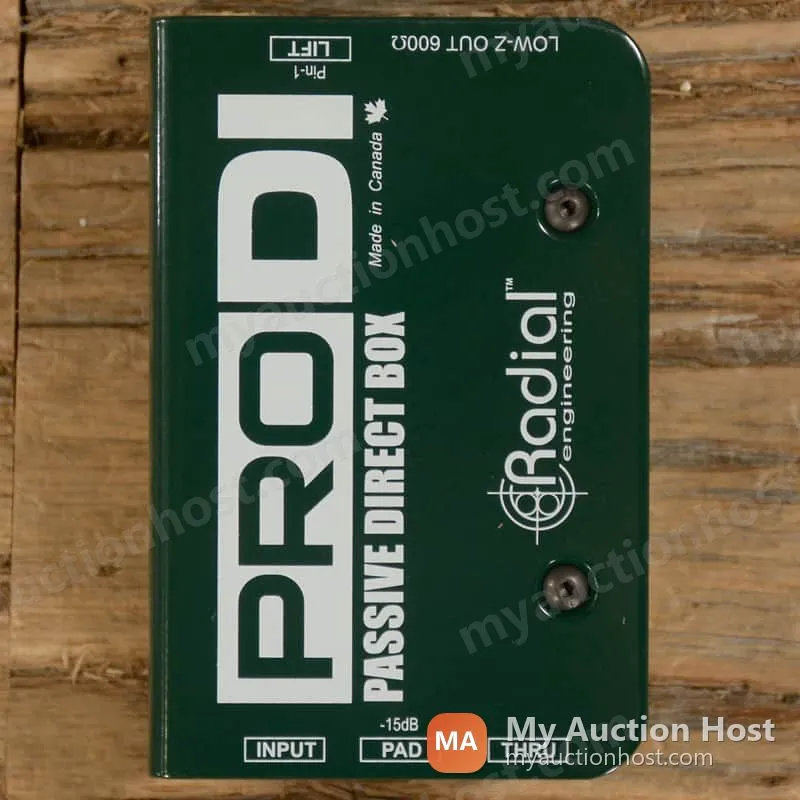
The in-between option. Radial’s own cheaper ProDI uses a custom transformer “fashioned around” the Jensen in the JDI. Radial says plainly that it is not quite as good as the JDI, and says it is about half the price. (Radial’s own comparison page, as quoted in search results, calls the ProDI’s transformer a more economical custom one rather than a Jensen, so the retailer copy and the maker’s page are not worded alike.) That is an unusually frank admission from a maker, and a useful clue about how big the difference is meant to be: a step, not a chasm. Radial’s ProDI text adds an internal mu-metal shield, and says the transformer has a 140 kilohm input impedance chosen to reduce loading. Our own archive has a used Radial ProDI from a 2018 purchase, with the seller’s photos; the face of the box says “Made in Canada”, with LIFT, INPUT, PAD (-15 dB) and THRU legends.
What the “no-name” case looks like. Behringer’s DI100 spec sheet leans on its OT-1 transformer for a linear frequency response and low distortion in the low end, and its active buffer in front. Whirlwind’s passive boxes name their transformers too: its DIRECT-JT uses a Jensen JT-DB-EPC, while its IMP2 uses a TRHL transformer. So the market is not Jensen against nameless iron; it is a ladder of transformer grades with different prices. Where the box does not name a transformer, you are guessing.
What Jensen itself publishes. The transformer in these boxes is usually the JT-DB-E, a 12:1 step-down type. Jensen’s own datasheet page returned an error when we tried to read it, so the figures below come from retailer listings of the part and from search-result excerpts of the datasheet, and are the vendor’s numbers: a 200 kilohm to 1.5 kilohm impedance ratio (about 140 kilohms seen by the instrument when the transformer is loaded by a typical 1 kilohm mic preamp), dual Faraday shields, a maximum input of about +22 dBu at 20 Hz with about 0.036 percent distortion at that frequency, and roughly 100 dB of common-mode rejection at 60 Hz. The naming is messy: Radial’s own site, retailers and Whirlwind variously say JT-DBE, JT-DB-E and JT-DB-EPC for what appear to be close cousins.
What independent measurement exists. Very little, and we want to be straight about that. We found no lab or magazine measurement we could read that puts a Jensen-based DI up against a cheap transformer DI on the same test. Radial’s FAQ points to a Mix magazine comparison called “Seven for the Road”, which we could not find or read. A ProSoundWeb article from 2016 reasons that a passive DI with its switches off is just a transformer and connectors, and credits the JT-DB-E with nearly flat response and low phase shift, but shows no test data. The one measurement we found is a blogger’s test of a single cheap passive box (a Pyle PDC21) with its 20 dB pad engaged, which he reports lost low end badly while the Radial boxes he tested stayed flat. That is one unit, an amateur measurement with some numbers that do not quite agree with each other, and the cause is his interpretation, so it is a warning to check your pad, not proof that all cheap transformers are bad. Equally, the engineering argument (core material, shielding, low-frequency saturation) is sound and widely made, and Radial’s own admission that its ProDI is a notch below its JDI suggests the gap is a step, not a cliff.
The author’s reading, not a finding: Where a DI is likely to show its weakness is the loudest, lowest notes, because that is where a small or cheap transformer core saturates. If you play bass, play loud and are buying one box to live in your gig bag for years, a Jensen-class passive (or a good active) is a reasonable buy. If you want something for a rehearsal room, a cheap box will do the job, and its most likely failure is a rattly switch, not a tonal one. You can also check specs: look for the maker naming the transformer, a published input impedance (the higher the better for a passive pickup), distortion measured at 20 Hz and a stated frequency response. A box that publishes none of these is telling you something.
The DI in the amp, or the DI in front of it?
Two different things share the name. A stand-alone DI sits in the signal chain between your instrument and your amp; a DI output on the amp is a balanced XLR (often transformer-balanced) wired inside the amp.
The stand-alone DI, first in the chain
The classic live arrangement, as Yamaha and Whirlwind describe it, is instrument into the DI, then the DI’s parallel or thru jack to the amp, and the DI’s XLR to the snake. You hear your amp; the front-of-house engineer hears the DI. Almost every DI has the thru jack for exactly this. Reasons an engineer likes it (these are the author’s reading of the sources, not a statement from any maker): the feed does not depend on how you set your amp’s EQ, gain or master; it works if your amp’s own DI is noisy or broken; and the engineer can choose the box, the pad and the ground lift. Reasons you might not: it is one more thing in the chain, you are at the mercy of whichever box the house has, and the engineer’s box is a direct sound, with no amp or cab in it.
Two cautions from the makers. Radial’s FAQ says the thru jack is wired in parallel with the input, so there is a straight-wire connection from the pickups to whatever follows the thru; if an amp is connected there, it can load a passive pickup and change the tone, audible through both the amp and the balanced output. The fixes are a buffered pedal between the thru and the amp, or a DI with a buffered thru. And Whirlwind notes that a second connection to ground at the amp can cause a 60-cycle ground loop, which is why its rule of thumb is to leave the ground lift engaged and use the grounded position only when a passive source needs it.
The DI output on the amp
Many bass amps have a balanced DI out, and many have a pre/post EQ switch. From Ampeg’s SVT-CL quick-start guide, as quoted in search results (check your own manual): with the switch out, the balanced output is pre-EQ, a flat DI for the engineer; with it in, it is post-EQ and carries the amp’s tone to the PA. The same guide describes a ground lift/ground switch on the balanced output. What you get from the amp’s DI is convenience, one fewer box and, post-EQ, your own tone in the PA; some also include a speaker-simulating filter. What you lose is the engineer’s independence, and consistency between amps.
Our reading: for a bass, a pre-EQ amp DI and a stand-alone DI in front of the amp give the engineer a similar signal, so the choice is mostly about whose box and whose ground lift. A post-EQ or speaker-simulated amp DI gives the engineer something nearer to a miked cabinet. Engineers who want that can also put a mic on the cab (see below). None of our sources says one approach is right; Whirlwind, Yamaha and Radial describe the stand-alone arrangement as common, and none of them says engineers prefer it.
Before the pedals, or after?
“Pre” and “post” also describe where in your own chain a DI sits. Before pedals it hears the raw instrument (the engineer gets a clean bass and you drive the pedals into the amp, with the thru). After pedals, such as at the end of a pedalboard, it hears the drive and effects; Radial recommends a passive box there for the headroom and to block DC hum from pedal supplies. For board order, see our pedal order guide and, for the power side, the pedal power guide. A DI pedal with an amp simulator bundles the DI and the amp into a single box at the end of the board.
Speaker-simulating DIs and amp-modeling pedals
A guitar or bass cab rolls off highs and lows, so a straight DI sounds fizzier than a miked cab. Several boxes add a filter to approximate the speaker.
- Radial JDI, speaker setting. Sweetwater’s JDI copy says a second -30 dB pad, used with the -15 dB input pad, lets the JDI be connected in parallel with a speaker so an engineer can tap the sound from a guitar amp speaker after the distortion; it includes a speaker-emulation filter that rolls off highs and lows to approximate a 12-inch driver. Whirlwind’s DIRECTOR and Behringer’s DI100 also list speaker-level inputs through attenuators.
- Radial JDX Direct-Drive. A pedalboard amp simulator that doubles as a direct box: a thru for a stage amp, a buffered tuner out, and then filters that zZounds says are modelled on a Shure SM57 in front of a Marshall 4x12, with two more voicings (vintage Marshall-style and early Fender Twin-style) and a presence switch. It has an XLR out with polarity reverse and ground lift. There is also a phantom-powered JDX 48 that sits across the speaker output.
- Tech 21 SansAmp Bass Driver DI. zZounds calls it a secret weapon among bassists: presence, drive, level, a blend control that mixes the direct signal with the SansAmp tube-amp emulation (particularly useful for piezo-equipped basses, per zZounds), active bass, mid and treble controls, and three outputs (an effected XLR, an effected quarter-inch and an uneffected parallel quarter-inch). With the footswitch off it works as a standard transparent active DI. Our own sold archive has a SansAmp Para Driver DI, and the listing says it was bought to use where a good amp or DI was not handy, and calls the blend feature priceless.
If you use a speaker-level tap of any kind, remember what a tube amp wants: a load. Radial’s FAQ says not to connect a DI between a head and its cabinet (the internal traces are not rated for speaker power), and that using the amp’s parallel speaker jack is fine if a speaker stays connected. Our speaker impedance guide and power tube guide say why an unloaded tube amp is a bad idea, and the speaker connectors guide covers the cables.
Mic or DI, and both
This is the other half of the argument. A DI hears the instrument and nothing else: no amp, no cabinet, no room. A mic on a cab hears all of that, including what is wrong with it. Shure’s bass-recording article lists the options: DI only, mic only, or both, and says a DI on its own can lack the life of a miked cabinet. It also gives a DI two practical virtues: a backup track, and the ability to re-amp later. Blending a DI with a mic can add frequencies the amp does not produce, which links to the low-string arithmetic in our SM57 guide: a dynamic mic that starts at 40 Hz cannot do the whole job on a bass cab. A typical recipe, as Shure describes it, is a DI plus one or more mics, such as a close dynamic and a more distant condenser. For mic choices, see our SM57 vs SM58 guide and the alternatives guide (the Electro-Voice RE20 and Sennheiser MD 421 are the bass-cab names there).
Shure adds mic-placement advice for bass cabs: toward the cone edge for warmth, toward the centre for bite, and about 4 to 18 inches away to manage proximity effect, with a hard floor brighter than carpet. It also says heavier compression is common on a DI’d bass than on a miked one.
Phase, polarity and timing
When you blend two sources of the same note, they can fight. Shure says to check phase relationships between the channels. Two practical tools exist:
- Polarity reverse. Whirlwind says a DI with a phase-reverse switch flips pins 2 and 3, and if the mic and DI sound out of phase you can reverse the mic preamp polarity, use the DI switch, or flip it in the recording software. Many DIs, including some Whirlwind models, have no polarity switch. Radial’s JDI, J48 and JDX do.
- Time alignment. A mic that is a foot from a speaker hears the note later than the DI does. That is our arithmetic, not a quote: sound travels about 343 metres per second, so a foot (0.3 metres) is nearly 0.9 milliseconds, and 6 inches about 0.45 ms. Nudging the DI later in the recording software by about that much brings the two in line, and polarity flipping is the quick test. If you are mixing live, there is usually no way to delay one channel by less than a millisecond, so the polarity switch is what you have.
Some phase trouble never goes away: Sound On Sound’s Hugh Robjohns notes that when two very different tones are blended, the player moves a little while playing so the relationship keeps shifting, and suggests keeping one source lower in the mix or asking whether both are needed. That is a wise question.
Re-amping: the DI in reverse
Record a clean DI, then play it back through an amp later and mic that. A re-amp box reverses the DI’s job: it turns a balanced line-level signal into a high-impedance unbalanced instrument-level one. The Radial Reamp JCR is described by zZounds as the current version of the original Reamp designed and patented by John Cuniberti: passive, transformer-isolated, with XLR and TRS inputs, a level control, a three-position filter and a mute. It lists a 20 Hz to 20 kHz response and an input impedance of 1,800 ohms. Radial’s FAQ says only passive DIs can be used backwards as a re-amp box, and even then the level is not reduced; sources disagree on how well a reversed DI works, so use a dedicated box if you will use it a lot. This is also Shure’s argument for recording a DI in the first place.
Hum, ground loops and the ground-lift switch
Sound On Sound explains the mechanism: mains-powered devices are tied to earth, small voltage differences exist between outlets, and when two devices are joined by a cable whose shield is tied to both earths, noise current flows through the shield and into an unbalanced signal. Its advice is to power interconnected gear from the same outlet, or use isolation transformers, rather than cutting a safety earth.
- Never remove the mains earth pin on an amp or lift it with a cheater plug. The lift switch on a DI lifts only the signal ground on the XLR, and is not a substitute. If hum is bad, see a tech.
- Ground lift disconnects pin 1 on the XLR output (Radial’s description). Yamaha’s advice: try both positions and use the quieter one. Whirlwind’s rule of thumb is to leave it lifted and ground only when a passive source needs it. Radial says a transformer’s isolation is more effective than lifting the ground, so on a passive box the switch is the backup.
- Some active boxes lose phantom power or fall back to battery when the ground is lifted, per Wikipedia and Radial’s overview; Radial says its J48 keeps phantom on. Check the manual before lifting.
- Pad. If the signal distorts at the preamp, hit the pad (Radial lists -15 dB on its JDI, J48 and Pro48 listings; zZounds’ ProDI text says -10 dB while the box face we have shows -15 dB, a retailer inconsistency worth knowing about).
The boxes, one by one
Radial JDI MK3. The reference passive box. zZounds lists a Jensen isolation transformer in a nickel container, a -15 dB pad, a reverse-polarity switch, a speaker pad and a ground lift, a merge switch that turns the thru into a second input for stereo sources, and a steel chassis with protected switches. Sweetwater calls it premium and describes 600 ohm balanced output, pin 2 hot per the AES standard, and a bottom pad that adds some electrical insulation from an amp handle. A stereo JDI Stereo is also sold.
Radial ProDI. The lower-priced passive from the same maker: a custom transformer built around the Jensen design, 14-gauge steel, isolated XLRs and a mil-spec board, with the ProD2 as the stereo version. See above for how Radial positions it against the JDI.
Radial J48 and Pro48. The active alternatives that stretch phantom power for headroom; see active DIs.
Rupert Neve Designs RNDI and Behringer Ultra-DI DI100. The premium and budget active-with-transformer options; the DI100 is also the one of the group that Behringer says accepts speaker-level inputs.
Radial JDX, Tech 21 SansAmp and the rest are the DI-plus-amp-sim pedals in the section above.
The numbers side by side
| Box | Type | Input impedance | Frequency response | Notes |
|---|---|---|---|---|
| Radial JDI MK3 | Passive, Jensen | Not stated in the copy we read | Not stated | -15 dB pad, polarity reverse, speaker pad, ground lift, merge |
| Radial ProDI | Passive, custom transformer | 140 kilohms | Not stated | Pad, ground lift; ProD2 is stereo |
| Radial J48 MK2 | Active, 48 V phantom | 220 kilohms | 10 Hz to 40 kHz | 600 ohm out; 130 dB dynamic range; 80 Hz filter; -15 dB pad |
| Radial Pro48 | Active, 48 V phantom | 220 kilohms | 20 Hz to 40 kHz | 600 ohm out; 0.01 percent THD; max input +9 dBu |
| Behringer Ultra-DI DI100 | Active, battery or phantom, output transformer | Over 250 kilohms | 10 Hz to 93 kHz | Noise -110 dBu; THD+N under 0.005 percent; speaker-level input option |
| Rupert Neve RNDI | Active, transformer plus class-A FET | Not stated in the copy we read | Not stated | Neve-designed transformers |
| Radial Reamp JCR | Passive re-amp box | 1,800 ohms (input); 4.8 kilohms output | 20 Hz to 20 kHz | XLR and TRS in; filter; mute |
Buying used, and the rest of the signal path
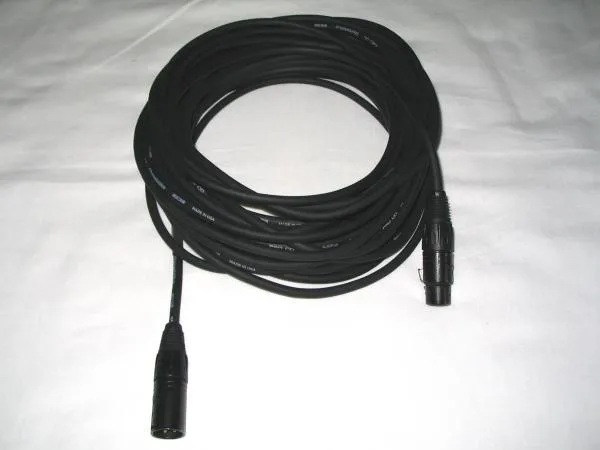
A DI is a good used buy, because a steel box with a transformer in it has little to wear out: look at the XLR connector (does it wobble), the quarter-inch jacks (does the plug crackle), the switches (do they click firmly), and test it with phantom power on and off if it is active. Listings to browse: JDI on eBay, ProDI on eBay, DI100 on eBay, and on Reverb JDI Sponsored link. We may earn a commission if you buy through it. Details, J48 Sponsored link. We may earn a commission if you buy through it. Details and SansAmp Bass Driver DI Sponsored link. We may earn a commission if you buy through it. Details. A DI is useless without cables: an XLR cable from the box to the board, an instrument cable to the box, and a short one from the thru to the amp. Our Pro Co XLR cable listing shows the type, and the gig bag checklist covers the spares. For mics on the same board, see the SM57 vs SM58 guide.
Where to find DIs and re-amp boxes
| Looking for | eBay | Reverb | Amazon (similar) |
|---|---|---|---|
| Radial JDI | eBay | Reverb Sponsored link. We may earn a commission if you buy through it. Details | Amazon |
| Radial ProDI | eBay | Reverb Sponsored link. We may earn a commission if you buy through it. Details | Amazon |
| Radial J48 | eBay | Reverb Sponsored link. We may earn a commission if you buy through it. Details | Amazon |
| Radial Pro48 | eBay | Reverb Sponsored link. We may earn a commission if you buy through it. Details | Amazon |
| Rupert Neve RNDI | eBay | Reverb Sponsored link. We may earn a commission if you buy through it. Details | Amazon |
| Behringer Ultra-DI DI100 | eBay | Reverb Sponsored link. We may earn a commission if you buy through it. Details | Amazon |
| Whirlwind Director | eBay | Reverb Sponsored link. We may earn a commission if you buy through it. Details | Amazon |
| Radial JDX Direct-Drive | eBay | Reverb Sponsored link. We may earn a commission if you buy through it. Details | Amazon |
| Tech 21 SansAmp Bass Driver DI | eBay | Reverb Sponsored link. We may earn a commission if you buy through it. Details | Amazon |
| Tech 21 SansAmp Para Driver DI | eBay | Reverb Sponsored link. We may earn a commission if you buy through it. Details | Amazon |
| Radial Reamp JCR | eBay | Reverb Sponsored link. We may earn a commission if you buy through it. Details | Amazon |
| XLR microphone cables | eBay | Reverb Sponsored link. We may earn a commission if you buy through it. Details | Amazon |
| Instrument cables | eBay | Reverb Sponsored link. We may earn a commission if you buy through it. Details | Amazon |
The zZounds, eBay, Reverb and Amazon links are affiliate links (see our terms). Radial, Whirlwind and the retailers all sell DI boxes, and this guide separates their claims from the published numbers where it can.
Sources
- Radial JDI MK3 Passive Direct Box: zZounds
- Radial JDI Jensen-equipped Passive Instrument Direct Box: Sweetwater
- Radial Pro DI Passive Direct Box: zZounds
- Radial J48 MK2 Active Direct Box: zZounds
- Radial Pro48 Active Direct Box: zZounds
- Rupert Neve Designs RNDI Active Transformer DI Box: zZounds
- Behringer Ultra-DI DI100: zZounds
- Radial JDX Direct-Drive Guitar Amp Simulator: zZounds
- Radial JDX 48 Guitar Speaker Emulator: zZounds
- Tech 21 SansAmp Bass Driver DI V2: zZounds
- Radial Reamp JCR Studio Reamper: zZounds
- Radial JDI MK3 and Stereo: zZounds
- D.I. FAQs: Radial Engineering
- JDI FAQ: Radial Engineering
- A Direct Box Can Be In-DI-spensible: Whirlwind
- The Direct Path: Yamaha Hub
- Recording and Mixing Bass Guitar: Shure
- Understanding and Solving Ground Loops: Sound On Sound
- DI unit: Wikipedia