The short version
- There are four common ways to finish a speaker wire: bare wire, pin connectors, banana plugs and spade lugs.
- Speakers and amps have two common kinds of terminal. Spring clips take only bare wire and pins; binding posts take all four.
- That makes pins the most universal termination, which is exactly what the Monster Cable connectors in the archive are.
- Wire gauge and getting the polarity right matter far more than gold plating.
- Guitarists: never use an instrument cable between an amp and a speaker cabinet, and never run a tube amp with no speaker connected.
Two kinds of terminal
According to Crutchfield, speakers use one of two terminal types, and most amps and receivers use the same two.
- Spring clips (push terminals): press the tab, poke the wire into the hole, let go. Quick and easy, but they only grip something thin and straight.
- Binding posts: a threaded post with a screw-down collar. Many are “five-way” or “universal” posts, with a hole through the shaft for bare wire or a pin, a socket in the end for a banana plug, and room under the collar for a spade. By convention, red is positive and black is negative.
Four ways to finish a wire
| Termination | Spring clip | Binding post | Best for |
|---|---|---|---|
| Bare wire | Yes | Yes (through the hole) | Cheap, permanent installs |
| Pin | Yes | Yes (through the hole) | Fitting anything, tight spaces |
| Banana plug | No | Yes (end socket) | Quick plug-and-unplug |
| Spade lug | No | Yes (under the collar) | A tight, clamped connection |
Bare wire
Free and universal. Crutchfield’s method is to strip about 3/8 inch of insulation and twist the strands tightly so none stick out, because a stray strand touching the other lead can short the amplifier’s output. The downside is that exposed copper oxidizes over time. Roger Russell, formerly McIntosh Laboratory’s director of acoustic research, notes that simply cleaning an old wire and its terminals and reconnecting them can make an audible difference.
Pin connectors
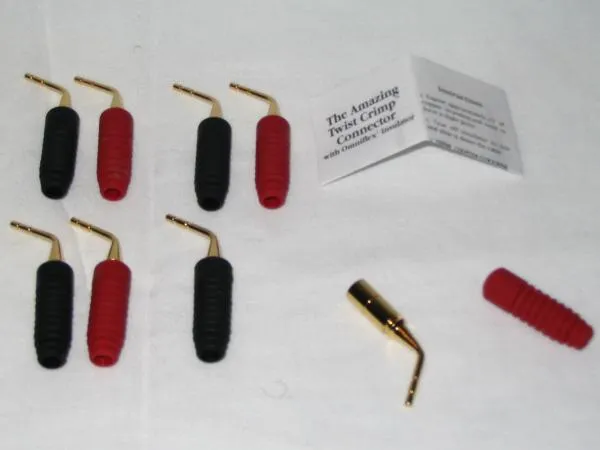
A pin is a short, solid metal probe on the end of the wire. It goes anywhere bare wire goes, spring clips included, but it’s neat, stiff and won’t fray. The Monster pins in the archive add two twists: they screw onto the stripped wire by hand, so there’s no crimping or soldering, and they’re angled at 60° to take the strain off the wire in cramped spaces. Crutchfield’s old listing for them gives 24k gold contacts, a fit for wire up to 12/14 gauge, and compatibility with “push terminals and 5-way binding posts.” (Monster’s founder, Noel Lee, named his first 12-gauge speaker cable “Monster” because of its size.)
The seller’s own installation notes are worth passing on:
- “Basically, you ‘screw’ the connector onto the cable. The interior of the terminating connector is threaded inside.”
- If the wire has a slick inner insulation, “you will have to pinch the cable tightly with your fingers so that the cable will not rotate inside its jacket.”
- “The best thing about a crimpless design is if you mess it up, you can always try again!”
Banana plugs
A banana plug is a springy 4 mm pin that pushes into the socket in the end of a binding post. It’s the fastest way to connect and disconnect speakers, which is why Crutchfield recommends them for anyone tired of feeding bare wire into terminals. New plugs and posts can be stiff, so the first insertion may take some force. Dual bananas join two plugs on a fixed spacing (usually 3/4 inch) so a positive and negative pair goes in at once. Bananas won’t work in spring clips, which is why the seller warned that the Monster pins “are not banana connectors.”
Banana socket blocked? Some amps and speakers, especially those sold in Europe, come with plastic caps in the binding posts’ banana sockets. The usual explanation is that a banana plug can fit some European mains sockets. The caps can be removed by the owner, and Crutchfield has a short video showing how.
Spade lugs
A spade, or fork, is a flat U-shaped tab that slides around the shaft of a binding post, under the collar. Screw the collar down and it’s clamped firmly in place, which is why spades are popular for permanent setups. They only work with binding posts, and the fork has to be the right size for the post.
Should you tin the wire first?
Tinning (flowing solder into the twisted strands) gives a neat, fray-proof end, and it’s fine where nothing will squeeze it, such as inside a soldered connector. But many technicians advise against putting tinned wire under a screw clamp or into a crimp. Solder is soft and slowly flattens under constant pressure, a problem called solder creep, so the joint can work loose or turn intermittent. For binding posts, clean, tightly twisted bare strands are the safer choice. Roger Russell also quotes connector maker AMP warning that tin against gold plating can corrode in wet or humid conditions.
Wire gauge, briefly
Speaker wire is sized in AWG (American Wire Gauge), where a smaller number means a thicker wire. Thicker wire has less resistance, which matters most on long runs, at high power and with low-impedance (4 or 6 ohm) speakers. Crutchfield’s rule of thumb: 16 gauge is all you need for runs of 50 feet or less to ordinary 8-ohm speakers; step up to 14 gauge beyond that, or for a high-current amp or low-impedance speakers.
Roger Russell’s classic table, which keeps the wire’s resistance under 5% of the speaker’s impedance, gives these maximum lengths:
| Wire | 4-ohm speaker | 8-ohm speaker |
|---|---|---|
| 16 AWG | 24 ft | 48 ft |
| 14 AWG | 40 ft | 80 ft |
| 12 AWG | 60 ft | 120 ft |
Russell calls the 5% limit conservative; some speakers tolerate double that with no audible change. Lengths are for the run from amp to speaker. The Monster pins in the archive, built for 12–14 gauge, sit at the heavy end of home-stereo wire.
Getting the polarity right
Each speaker needs positive to positive and negative to negative at both ends. Wire with connectors fitted usually marks positive in red. Plain “zip cord” speaker wire marks one conductor with a stripe, a ridge or a different-colored metal instead; pick one to be positive and use it the same way at every terminal.
Swap the wires on just one speaker and the pair ends up out of phase: one cone moves out while the other moves in. The bass partly cancels and the stereo image goes vague. If a system suddenly sounds thin, check this first.
What gold plating actually does
Gold doesn’t conduct electricity better than copper; copper and silver are both better conductors. What gold does is resist tarnish, so the contact surface stays clean for years. That’s why Crutchfield’s listing for the Monster pins pairs “signal transfer” with “corrosion resistance”. Gold plating is a longevity feature, not a tone upgrade.
For musicians: amp-to-cabinet cables
Guitar and bass rigs use the same physics with different plugs, usually 1/4″ jacks. That leads to the most common cable mistake in music:
- An instrument cable is not a speaker cable. Fender explains that an instrument cable has a single thin conductor (usually 24 gauge) inside a shield, built for a weak signal. Used between an amp and a cabinet, much of the amp’s power turns into heat instead of sound, and “in extreme situations” the cable or its plugs can fail.
- It doesn’t work the other way either. A speaker cable has two heavy conductors and no shield, so used as a guitar cable it picks up hum and buzz. Sweetwater calls it “a magnet for electrical interference noise.”
- Label them. Both often use the same 1/4″ plugs and can look alike, so mark your speaker cables.
- Speakon is the pro answer. Neutrik’s Speakon connector locks in place, and it was designed so it can only be used for speakers: you can’t accidentally swap in a shielded instrument or mic cable.
Never run a tube amp with no speaker connected. Sweetwater’s advice is blunt: “Never, never, never run the amp with no speaker plugged in. This can cause major damage.” A mismatched speaker load is far less risky than no load at all. Plug in the cabinet before you switch the amp on.
Quick tips
- Work with the amplifier switched off.
- Strip about 3/8 inch, twist tightly, and check for stray strands before you power up.
- Tighten binding posts by hand. Pliers can strip threads or crack the post.
- Keep the polarity consistent at both ends of every run.
- Every few years, unplug, clean and reconnect bare-wire connections to clear oxidation.
- For gear that moves around (stage rigs, rearranged rooms), pins or bananas save wear on the wire ends.
Sources
- How to connect speaker wire: gauge, terminals and connectors — Crutchfield (archived)
- Monster Cable Twist-on Angled Gold Pins — Crutchfield listing (archived 2015)
- Blocked Banana? Remove your binding post caps! — Crutchfield (video)
- Speaker Wire: A History (wire-length table) — Roger Russell
- Solder Creep — AVCSS Tech World
- Why Instrument Cables Aren’t the Same As Speaker Cables — Fender
- What is the Difference Between Speaker and Guitar Cables? — Sweetwater InSync
- What things will damage my tube amp? — Sweetwater SweetCare
- Speakon connector — Wikipedia
- Banana connector — Wikipedia
- Binding post — Wikipedia
- Electrical resistivity and conductivity — Wikipedia
- Noel Lee (executive) — Wikipedia