The short version
- 12AX7: the high-gain tube. It does the voltage gain in nearly every guitar amp preamp.
- 12AT7: medium gain but much more current. Classic Fender amps use it to drive the reverb tank and as the phase inverter.
- 12AU7: low gain, low noise. More common in hi-fi and as a driver than as a guitar gain stage.
- All three share the same 9-pin base, pinout and heater wiring, so they physically fit the same sockets. That does not mean every swap is a good idea.
Side by side
Each is a dual triode: two small amplifying tubes in one glass envelope. The datasheet figures below are the classic published values for each type.
| 12AX7 | 12AT7 | 12AU7 | |
|---|---|---|---|
| European name | ECC83 | ECC81 | ECC82 |
| Amplification factor (μ) | 100 | 60 | 17 (often rounded to ~20) |
| Plate resistance | ≈ 62.5 kΩ | ≈ 10.9 kΩ | ≈ 7.7 kΩ |
| Transconductance | ≈ 1.6 mA/V | ≈ 5.5 mA/V | ≈ 2.2 mA/V |
| Typical plate current | ≈ 1.2 mA | ≈ 10 mA | ≈ 10.5 mA |
| Heater | Center-tapped: 12.6 V at 150 mA (series) or 6.3 V at 300 mA (parallel) | ||
| Base | 9-pin miniature (noval), identical pinout | ||
What the numbers actually mean
Amplification factor (μ) is the tube’s theoretical maximum voltage gain. A 12AX7 can multiply a small guitar signal far more than a 12AT7 or 12AU7, which is why it sits in the gain stages that turn a pickup’s output into something worth distorting.
Plate resistance and transconductance describe how much current a tube can move and how “stiff” it is when driving a load. Here the 12AT7 is the opposite of the 12AX7: much lower plate resistance and more than three times the transconductance. It gives up voltage gain in exchange for the muscle to drive a demanding load, such as a reverb tank’s transformer or the grids of a pair of power tubes. That trade is why amp designers reach for it in those jobs.
The 12AU7 has the lowest gain of the three and a similarly low plate resistance. That makes it a natural fit for low-noise line stages, tone-stack drivers and phase inverters, especially in hi-fi gear.
Where each tube sits in a classic Fender
The blackface Fender Deluxe Reverb and Twin Reverb are a textbook example of all of this. Both use the same preamp tube layout:
| Position | Tube | Job |
|---|---|---|
| V1, V2 | 12AX7 | Preamp gain stages for the two channels |
| V3 | 12AT7 | Reverb driver (sends the signal to the tank) |
| V4 | 12AX7 | Reverb recovery and mixing |
| V5 | 12AX7 | Vibrato (tremolo) oscillator |
| V6 | 12AT7 | Phase inverter (drives the power tubes) |
Notice the pattern: 12AX7s where the job is gain, 12AT7s where the job is drive. If you open the back of an amp and find a 12AT7 among a row of 12AX7s, it’s almost always doing one of those two jobs on purpose.
Names, numbers and variants
- ECC83, ECC81, ECC82 are the European (Mullard-Philips) designations for the 12AX7, 12AT7 and 12AU7 respectively. Same tubes, different naming system.
- 7025 is a specially selected low-noise, low-microphonic 12AX7. It’s electrically the same and a direct substitute. Fender historically specified it for sensitive gain stages.
- 12AX7A is generally grouped with the low-noise variants of the 12AX7 and works anywhere a 12AX7 does.
- 5751 is a lower-gain (μ about 70) military-spec cousin of the 12AX7 that drops into the same socket. It’s a popular way to tame a preamp that breaks up too early.
- 6201 is an equivalent designation for the 12AT7, and you’ll also see 5814 and 5963 listed as equivalents for the 12AU7.
Swapping tubes: what to expect
Because the pinouts match, players often “down-swap” a lower-gain tube into a 12AX7 position, usually V1, to get more clean headroom. On paper a 12AT7 has 40% less amplification factor than a 12AX7, and a 12AU7 far less again. Real-world gain depends on the circuit, but the direction is predictable: less preamp gain, a cleaner sound at the same volume setting, and later breakup. Even the milder 5751 cuts gain by roughly 30%.
A few cautions:
- Down-swaps are safer than up-swaps. Putting a higher-gain tube where the circuit expects a 12AT7, such as a reverb driver, can push stages beyond what the design expects.
- Phase inverters are biased for a specific tube. Changing the tube type there changes how hard the power tubes are driven and can unbalance the push-pull pair.
- Heater current is similar but not always identical across the family; the 5751, for example, draws 175 mA at 12.6 V versus 150 mA for a 12AX7. That’s rarely a problem in stock amps, but it’s worth knowing for amps with marginal heater supplies.
About the tubes in the archived lot
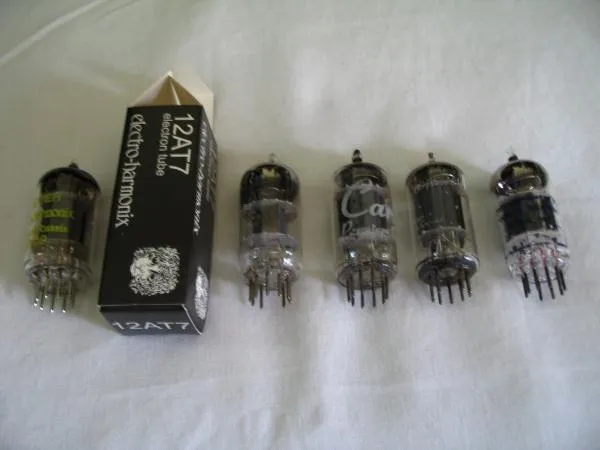
The 2005 tube lot that inspired this guide is a neat cross-section of the family: a new Electro-Harmonix 12AT7EH, a used CBS-branded 12AT7, a Carvin 12AX7A, a Tube Works 12AX7 and a West German 12AU7.
- Electro-Harmonix 12AT7EH: a current-production 12AT7 made in Russia under the Electro-Harmonix brand. The seller bought it by mistake when he meant to order a 12AU7, an easy error given how similar the part numbers look.
- “CBS” 12AT7: CBS branding on a tube most likely points to CBS-Hytron, the tube maker formed when CBS acquired Hytron in 1951. That’s a separate matter from “CBS-era” Fender, the 1965–1985 period when CBS owned the Fender company. The seller wasn’t sure whether this one came out of an old Fender or a Wollensak tape recorder, and either is plausible.
- Carvin 12AX7A and Tube Works 12AX7: both are brand labels. The name printed on the glass doesn’t tell you which factory built the tube.
A word on safety
Tube amps run at lethal voltages, sometimes over 700 V AC and 500 V DC inside the chassis, and their filter capacitors can hold a dangerous charge for days after the amp is unplugged. Don’t reach into a chassis unless you know how to drain the capacitors safely. If in doubt, let a qualified amp tech do it.
Sources
- 12AX7 — Wikipedia
- 12AT7 — Wikipedia
- 12AU7 — Wikipedia
- 12AX7 vs 12AT7 comparison (citing RCA and Mullard datasheets) — Ampera Tubes
- ECC82 / 12AU7 tube data — Ampera Tubes
- Preamp tube gain factor chart — The Tube Store
- 5751 vs 12AX7 — TC Guitar
- Fender Deluxe Reverb tube chart — Fender Guru
- Fender Twin Reverb tube chart — Fender Guru
- CBS-Hytron — Old Tube Radio
- Tube amplifier safety — Rob Robinette