The short version
- RAT (production from 1979): an op-amp gain stage into two silicon clipping diodes, then a passive Filter. Since 1981 the Filter has worked “backwards”: clockwise is darker.
- RAT2 (1988): the same circuit as the 1981-on RAT, plus an on/off LED and glow-in-the-dark graphics.
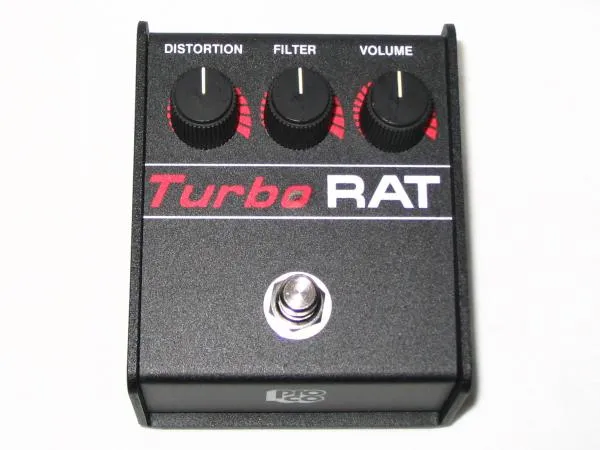
- Turbo RAT (1989): the silicon diodes are swapped for LEDs, which clip later. The result is more output and headroom and a less compressed sound. It works as a big boost as well as a distortion.
A short history of the RAT
| Year | What happened |
|---|---|
| 1974 | Pro Co Sound is founded in Kalamazoo, Michigan, by Charlie Wicks. It starts out making speaker cabinets and cables. |
| Mid-1970s | Engineer Scott Burnham (with Steve Kiraly) develops the circuit. A reported “happy accident”, a 47 Ω resistor where a 470 Ω one was intended, gives it unusually high gain. |
| 1977–78 | About a dozen hand-built “Bud Box” RATs are made to order in off-the-shelf enclosures. |
| 1979 | Full production begins in the large “Big Box” enclosure (made until 1983). Pro Co also launches the Juggernaut, a bass-oriented RAT. |
| 1981 | The Tone control’s wiring is reversed and the knob is renamed Filter. |
| 1984 / 1986 | The smaller enclosure arrives (“White Face”), followed by the “Black Face” look. Both are cosmetic changes; the circuit is the same as 1981. |
| 1988 | RAT2: adds an LED and glow-in-the-dark overlay graphics. |
| 1989 | Turbo RAT, designed by Pro Co employee Gerry “Grape” Carpenter, with LED clipping. |
| 1991 | Vintage “Big Box” reissue. |
| Mid-1990s | The LM308 op-amp is discontinued, and RAT2 and Turbo RAT production switches to the OP07. |
| 2002 / 2004 | Deucetone RAT (dual channel), then the You Dirty RAT (germanium clipping). |
| 2008 | RAT2 production moves to a factory in China. |
| 2010s | White Face reissue (2010), Lil’ RAT (2011), FATRAT (2014). |
| Today | ACT Entertainment makes and distributes the RAT line, and showed a new “Sterling Vermin” model at NAMM 2026. |
Sources differ slightly on the very first production year: Wikipedia and Guitar World say 1978, while others say early 1979. Everyone agrees the prototypes came first and catalog production followed in 1979.
How the RAT circuit works
- Gain stage. An op-amp amplifies the guitar signal, originally the LM308. Its relatively slow slew rate is often credited with the RAT’s smoother top end compared with “fizzier” high-gain pedals. At higher Distortion settings the op-amp itself runs out of headroom and clips before the signal reaches the diodes.
- Hard clipping. Two silicon diodes (1N914/1N4148 types) connected to ground clip the waveform at roughly ±0.65 V. That’s the classic, aggressive RAT edge.
- Filter. A simple passive low-pass filter after the clipping stage. Fully counter-clockwise it lets nearly everything through; turning it clockwise rolls off more and more treble, down to a corner frequency around 500 Hz at maximum. That’s why it feels “backwards” compared with a normal tone knob.
- Volume. Sets the output level.
What makes the Turbo RAT different
The Turbo RAT’s one big change is in step 2: the two silicon diodes are replaced with red LEDs. LEDs need a much higher voltage before they conduct, so they clip later and less hard. In practice that means:
- More output and headroom. With the Distortion low and the Volume high, it works as a powerful boost, which a RAT2 can’t really do.
- A less compressed sound at similar gain settings.
According to JHS Pedals’ history of the RAT, Gerry Carpenter designed it because the standard RAT added too much gain and clutter in front of an amp that was already overdriven. With LEDs he could turn the volume up and the gain down. The archived listing describes the same strength: “a very high output, which is ideal for overdriving the input stage of a tube amp,” or as the seller put it, “a RAT on steroids.”
The RAT and bass
Pro Co thought about bass players early. The 1979 Juggernaut was a bass-oriented RAT with an effects loop, a master volume and a blend control to bring back clean low end, and it was reissued in 2003. The 2014 FATRAT added a bass-boosting “Fat” switch.
The archived Turbo RAT listing says Pro Co’s literature called the Turbo RAT the “RAT of choice” among bass players. We couldn’t find a Pro Co document with that wording, so treat it as the seller’s recollection. His own experience matches it: he used his Turbo RAT on bass as a lead boost “with a little bit of dirt,” without losing the low end.
Identifying your RAT
- Enclosure and graphics: the large “Big Box” (1979–83), then the smaller White Face and Black Face boxes, then the RAT2 with its LED and glow-in-the-dark overlay. The Turbo RAT has a sloped-front enclosure, a style the China-made RAT2 later adopted.
- Serial label: US-built units carry a label with an “RT-” serial and “Made in U.S.A.”, like the one on the underside of the archived Turbo RAT. RAT2s built in China from 2008 don’t say Made in U.S.A.
- Op-amp: earlier units use the LM308 and later ones the OP07. One builder who owns transitional RAT2s puts the switch at around the end of 1995, between serial numbers 235390 and 243304. That’s a collector’s estimate, not an official Pro Co chart.
- Pot date codes inside the pedal can help narrow down when it was built.
Who played one
The RAT family has an unusually long list of users. Wikipedia’s sourced list includes Jeff Beck, Kurt Cobain, Nuno Bettencourt, Frank Black, Graham Coxon, Bill Frisell and Nels Cline. Guitar World’s history adds names such as David Gilmour, Joe Perry, Andy Summers, Thurston Moore and Dave Grohl. Most of these are guitarists; we didn’t find a well-documented list of bass players who used one.
Sources
- Pro Co RAT — Wikipedia
- ProCo RAT pedal myths, history and timeline — JHS Pedals
- The history of the ProCo RAT — Guitar World
- Classic review: Pro Co RAT 2 — Guitar.com
- Affordable boutique RAT pedals explained — Guitar.com
- Feature: 1988 Pro Co RAT — Crave Guitars
- Let’s talk about RATs — Tym Guitars
- LTspice simulation of the ProCo RAT — cushychicken
- RAT distortion — ACT Entertainment
- NAMM 2026: ACT Entertainment showcases RAT Sterling Vermin — Mike’s Gig