The short version
- TBX stands for Treble Bass Expander. It’s a passive Fender tone control with no battery and a click-stop (detent) in the middle of its travel.
- From 0 to 5 it works like an ordinary tone knob, rolling off treble.
- At 5, the detent, the tone circuit is effectively out of the way and the pickups run “flat”.
- From 5 to 10 it reduces the load on the pickups, letting a little more treble, bass and output through: a subtle boost rather than a cut.
- Fender fitted it to American Standard Strats and Teles from the late ’80s, replaced it with the “no-load” Delta Tone system in 1997–98, and still sells it as a retrofit kit.
What Fender says it does
Fender’s own description of the part, as quoted by Premier Guitar and by owners of early examples:
“This detented, stacked 250k/1 Meg control enhances your tonal palette without the use of a battery. From 0 to 5, the TBX is your standard tone control, but once you pass 5 you start to decrease the resistance, which allows more bass, treble, presence and output to flow to your amp.”
How the circuit works
A TBX looks like one knob, but under the pickguard it’s a stacked pot: two potentiometers on one shaft. Premier Guitar’s “Mod Garage” column breaks it down:
- The lower section is a 250k audio pot wired as a normal tone control through a 0.022 µF capacitor. Between 0 and 5 it bleeds treble to ground exactly like a stock Strat or Tele tone knob.
- The upper section is a 1 Meg linear pot wired in series with an 82k resistor. From 0 to 5 it sits at maximum resistance and does essentially nothing. Past 5 it comes into play.
- The detent is the clever part. Fender prints the resistive track so the 250k section drops out of the circuit at exactly half rotation, where the click is. At that point neither section is loading the pickups, so the signal passes through essentially unfiltered.
Turning past the detent lowers the 1 Meg section’s resistance. Because it starts so high, the extra load it adds to the passive circuit is very small, which is why the effect above 5 is gentle: more presence and output than a normal tone knob at 10, not a dramatic boost.
Why you can’t build one from a generic stacked pot: the TBX’s resistive tracks are custom-made, half conductive and half not, so each section only works over its half of the rotation. An off-the-shelf dual pot won’t behave the same way.
Using it on a gig
Think of the detent as “neutral”, then go either way:
- Below 5: darker, smoother, the usual tone-knob roll-off for jazzier rhythm or taming a bright bridge pickup.
- At 5: the guitar’s natural, unfiltered sound. A good default.
- Above 5: a touch more sparkle and output to cut through.
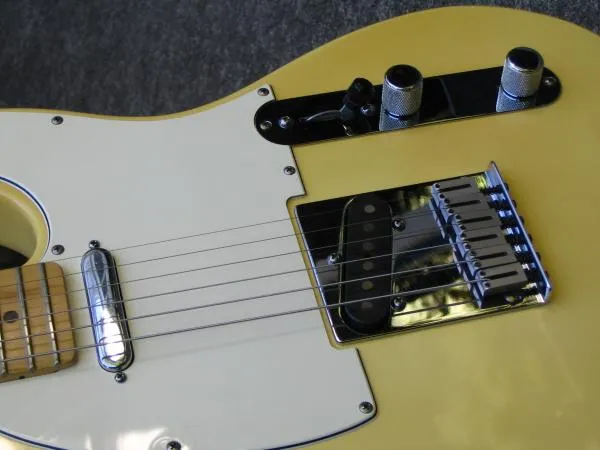
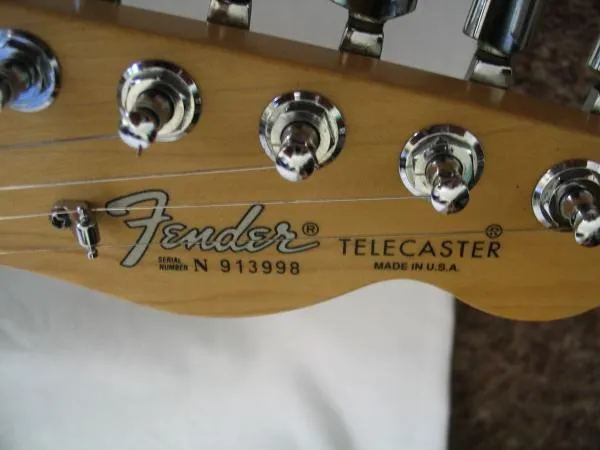
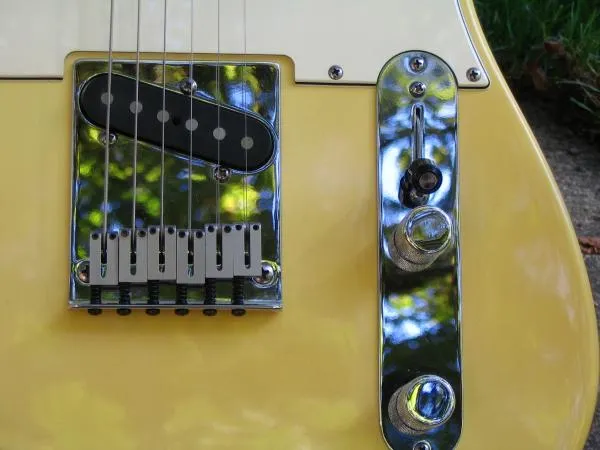
That last move is exactly how the seller of the 1990 Telecaster in the archive used it. He said it was most useful on leads, “bumping the pot over the center notch to enhance the treble response so as to stand out over the rest of the band.”
Which Fenders have one
| Model | TBX use |
|---|---|
| Elite Stratocaster (1983) | Listed by Wikipedia as the first TBX, alongside an active mid boost (see the note below) |
| American Standard Stratocaster | Second tone knob (middle and bridge pickups) from 1987 until 1997 |
| American Standard Telecaster | Tone control from its 1988 introduction until about 1998 |
| Eric Clapton Stratocaster | From 1988; Fender describes its retrofit kit as “the same circuit as used on the Eric Clapton Strat” |
| Buddy Guy Stratocaster | Also fitted with TBX, along with some Artist Series and Custom Shop models |
When did it first appear? Sources disagree. Wikipedia credits the 1983 Elite Stratocaster. Premier Guitar’s columnist, after asking Fender Germany, wrote that “no one seems to remember exactly when it was introduced” and linked it to the 1988 Clapton Strat, and a repair shop’s write-up gives 1988 too. The safe answer is “the 1980s”.
Some sources also list the Strat Plus and Richie Sambora signature Strat. We couldn’t confirm those, so check the control itself (below) rather than relying on the model name.
How to tell if a guitar has TBX
- Feel for the click in the middle. A standard tone pot turns smoothly with no detent. A Fender no-load pot clicks at 10, the end of its travel. A TBX clicks at 5.
- Look under the pickguard for a taller, two-deck stacked pot instead of a single one.
- Fender’s retrofit kit comes with a white tone knob, though knobs are easily swapped, so the detent is the reliable test.
What replaced it: Delta Tone and the no-load pot
In 1997 (Strat) and about 1998 (Tele), Fender replaced TBX on its American series with the Delta Tone system, built around a 250k “no-load” pot. In Fender’s words, it “functions as a normal tone control from 1 to 9. At 10, the tone control is removed from the circuit for increased output and overall tonal response.”
The idea is the same as TBX’s detent: get the tone circuit completely out of the signal path when you don’t need it, because even a standard tone pot at 10 still bleeds away a little treble. The no-load pot does it at the end of the travel, while TBX does it in the middle and adds the gentle “expander” range above.
Adding a TBX to another guitar
Fender still sells the TBX as a genuine replacement part (kit 099-2052-000) containing the stacked 250k/1 Meg pot, the 0.022 µF capacitor, the 82k resistor, a knob and instructions. Fender markets it as able to replace any standard tone control on a guitar with passive pickups, so it works in Strat and Tele wiring. As with any wiring job, if you’re not comfortable soldering inside a guitar, have a tech fit it.
Sources
- Mod Garage: The Fender TBX Tone Control, Part 1 — Premier Guitar
- Fender TBX control — Infinity Guitar Works
- Fender TBX tone control kit, part 099-2052-000 — Strat Cat
- 250K No Load Solid Shaft Potentiometer — Fender
- Feature: 1988 Fender Telecaster American Standard — Crave Guitars
- Fender Elite Stratocaster — Wikipedia
- Fender Eric Clapton Stratocaster — Wikipedia
- US Standard Stratocaster timeline and specifications — Alston family collector site
- US Standard Telecaster timeline and specifications — Alston family collector site