The short version
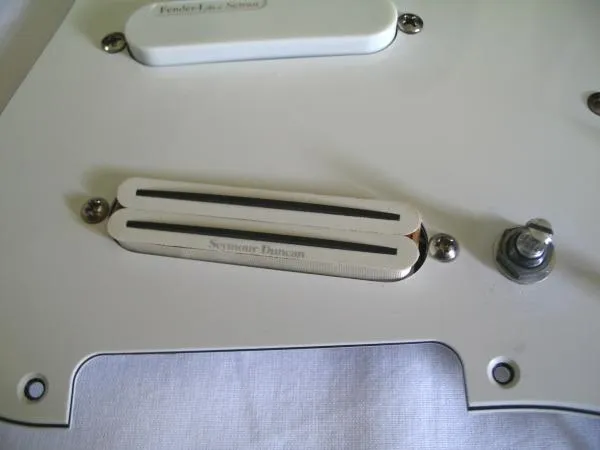
- A Seymour Duncan Hot Rails is a high-output humbucker squeezed into a Strat single-coil footprint: two thin blade “rails” instead of six pole pieces.
- It has a four-conductor lead, so you can reach both ends of both coils and wire it three ways: series (the normal, full humbucker), split (one coil only), or parallel (both coils side by side).
- A push-pull pot lets you switch between two of those modes with no new holes in the guitar.
- Don’t overlook parallel. A split gets you closer to a true single coil but brings the hum back. Parallel gives a cleaner, brighter, slightly quieter voice and stays hum-cancelling.
The Hot Rails in a nutshell
Seymour Duncan describes the Hot Rails for Strat as “the feel and tone of a high-output humbucker in a single-coil sized format.” It comes in bridge and neck/middle versions, uses ceramic magnets, and has the four-conductor shielded lead that makes all of the wiring below possible.
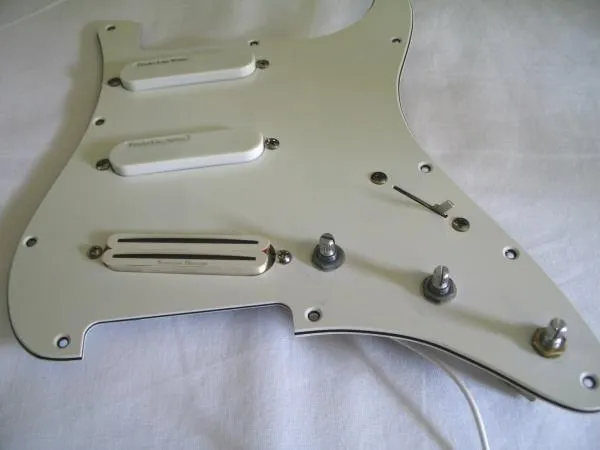
The pickguard in the archive has one in the bridge. Its seller described it this way: “Though it’s in a tiny package, you can definitely peel the paint off the walls with this thing.”
The four wires (Seymour Duncan color code)
Every four-conductor Seymour Duncan humbucker uses the same colors. Each colored wire is the start or the finish of one coil, and the bare wire is the shield.
| Wire | Series (normal) | Parallel |
|---|---|---|
| Black | Hot output | Hot, joined with red |
| Red | Joined to white and taped off (the “series link”) | Hot, joined with black |
| White | Joined to red and taped off | Ground, with green and bare |
| Green | Ground | Ground, with white and bare |
| Bare | Ground (always) | Ground (always) |
Other brands use other colors. DiMarzio and Jackson, for example, assign them differently, so check the maker’s own diagram before you solder.
Three ways to wire two coils
| Mode | Coils working | Hum-cancelling? | Sound |
|---|---|---|---|
| Series | Both, one after the other | Yes | Highest output, thickest and darkest |
| Parallel | Both, side by side | Yes | About 20% less output; brighter, cleaner, scooped |
| Split | One | No | Lowest output; closest to a true single coil, but hums |
Series: the stock humbucker
Almost every humbucker leaves the factory wired in series: the signal runs through one coil and then the other. That stacks the two coils’ output, which is why it’s the loudest and thickest setting. The two coils have opposite magnetic polarity and are connected in opposite directions, so the strings’ signal adds up while hum picked up from outside cancels out.
Split: one coil, single-coil character, hum included
To split, you leave the red and white series link joined, but instead of taping it off you run it to a switch that can ground it. Grounding that junction shorts out one coil, so only the other one is heard. Seymour Duncan’s standard split leaves the “slug” (north) coil active. Which physical coil that is depends on the wiring, and on the pickguard in the archive the seller described it as “the coil furthest from the bridge.”
The catch: with only one coil working there’s nothing left to cancel the hum. A split coil also has less output and can sound thin, because a humbucker coil on its own wasn’t designed to be a Strat pickup.
Parallel: the underrated one
Players talk about splitting humbuckers all the time and rarely mention parallel, which is a shame. In parallel, both coils still work together, but the signal doesn’t pass from one coil into the other. Each feeds the output at the same time. The result:
- Still hum-cancelling, because both coils are active.
- Lower output. Premier Guitar puts the drop at about 20 percent compared with series, which cleans up an amp’s front end.
- Brighter and cleaner, with scooped mids and tighter lows, often compared to the glassy “in-between” positions on a Strat.
It won’t turn a Hot Rails into a vintage Strat pickup, but it lands in single-coil territory without the buzz. If what you really want from a split is “a cleaner, brighter option from my humbucker”, parallel often delivers it with less compromise.
For a Seymour Duncan pickup, the parallel connections are: black and red together as hot; white and green together with the bare wire to ground. That joins the start of one coil to the finish of the other at each end.
Adding a push-pull pot
A push-pull pot is two parts on one shaft: an ordinary potentiometer you turn, and a DPDT (double-pole, double-throw) switch you pull up or push down. The two are electrically independent unless you wire them together, so the knob keeps working as a normal volume or tone control.
- For a split: wire the red/white junction to the switch so that one position grounds it. Seymour Duncan’s official wiring-diagram library includes several push-pull split layouts.
- For series/parallel: use the switch to change how the four colored wires connect, with series in one position and parallel in the other.
- Check the depth. Common CTS push-pull pots need about 1″ of cavity depth, more than a standard pot, which matters in shallow pickguard routes.
- Pot value matters too. 500k pots are the usual choice for humbuckers and 250k for single coils. A 250k pot gives a slightly warmer tone by bleeding off a bit more treble.
The archived pickguard does exactly this with its second tone knob, a 250k push-pull: “UP on the tone knob is single-coil, DOWN is humbucker.”
Split, tap, same thing? Not quite
The archived listing calls its switch a “coil tap”. That’s a very common mix-up, and Fender points out that the two terms “have been used interchangeably in the past, but they are definitely not the same thing”:
- Coil split: breaks the connection between a humbucker’s two coils, turning one off and leaving a single coil working. That’s what the archived pickguard does.
- Coil tap: takes the signal from partway through a single coil’s winding, using fewer turns of wire for lower output. Fender notes that some high-output single-coil pickups use a tap to get closer to a vintage single coil’s output.
Before you solder: work with the guitar unplugged, label wires before you disconnect anything, and follow the pickup maker’s diagram. If you’re not comfortable with a soldering iron, a push-pull pot is a quick job for a guitar tech, and since it drops into the existing pot hole it’s fully reversible.
Sources
- Hot Rails for Strat — Seymour Duncan
- Guitar Wiring Explored: Humbucker Internals — Seymour Duncan
- How do you split a humbucker? — Seymour Duncan
- Pickup wiring diagrams — Seymour Duncan
- Guitar Shop 101: Wiring Humbuckers in Parallel on an HH Strat — Premier Guitar
- Series vs. Parallel Humbucker Wiring, Explained — Aeonic Frets
- Coil Tapping vs. Coil Splitting — Fender
- Understanding guitar wiring, part 6: mini toggle switch and push-pull pot basics — StewMac
- CTS push-pull pots (DPDT) — StewMac
- Humbucker — Wikipedia