The short version
Lace Sensors are low-noise single-coil pickups, and the color names a voice. In order of output, from vintage-bright to humbucker-hot, the four classics are:
- Gold: classic ’50s Strat sparkle. The one that started it all, and the factory choice on Fender’s Strat Plus and the Clapton, Beck and Buddy Guy signature Strats.
- Silver: a fatter ’70s single coil with more midrange. Lace calls it “the ultimate middle position pickup.”
- Blue: much hotter and warmer, like a ’50s humbucker in single-coil form. Works in the neck or bridge.
- Red: the hottest standard Sensor, meant for the bridge when you want humbucker punch.
The color chart
Lace publishes a voicing and a DC resistance for each model. Higher resistance generally means more turns of wire and more output, though it’s only a rough guide to how a pickup will sound.
| Sensor | DC resistance | Voice (per Lace) | Suggested position |
|---|---|---|---|
| Emerald | ≈ 5.7 kΩ | Texas-style twang for country | Neck |
| Gold | ≈ 5.8 kΩ | Classic ’50s single coil with a bell-like tone | Any |
| Hot Gold | ≈ 6.0 / 13.2 kΩ | Modern take on ’60s vintage; separate neck/middle and hot bridge versions | Any / bridge |
| Silver | ≈ 7.1 kΩ | Fat ’70s single coil, more midrange than Gold | Middle |
| Light Blue | ≈ 8.0 kΩ | Warm and punchy, jazz and blues | Neck |
| Burgundy | ≈ 8.9 kΩ | Slightly fatter than the regular Sensors | Bridge |
| Purple | ≈ 10.5 kΩ | Hot, overwound; between Burgundy and Blue, P-90-like in the neck | Bridge |
| Blue | ≈ 12.8 kΩ | Warmer ’50s humbucking sound in a single coil | Neck or bridge |
| Red | ≈ 14.5 kΩ | Hottest Sensor; fat, punchy humbucking output | Bridge |
Lace’s product pages also list “think of” artists for each color: Clapton and Beck for Gold, Radiohead and the Smashing Pumpkins for Blue and Red. Treat those as tone references rather than gear history. The Purple page name-checks Jimi Hendrix, who died fifteen years before the Sensor existed.
How a Lace Sensor differs from a regular single coil
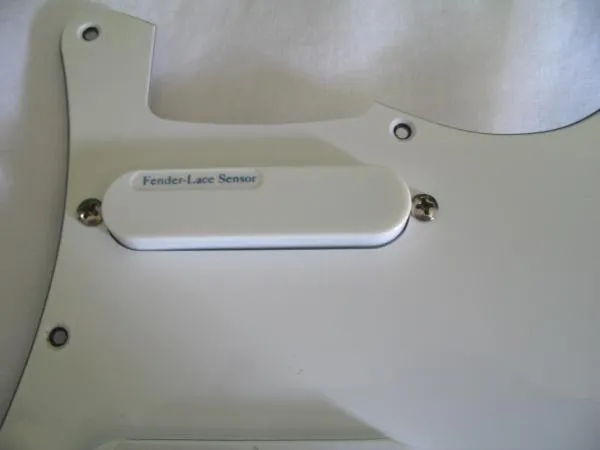
Look at the archived pickguard and the first thing you notice is what’s missing: there are no six exposed pole pieces, just a smooth cover. According to Lace, the design works like this:
- A “Radiant Field Barrier” of metal surrounds the coil and magnets. It’s meant to shield against outside hum and concentrate the magnetic field, an idea Wikipedia compares to the metal shrouds on a Fender Jaguar pickup.
- “Micro combs” replace the traditional bobbin and, Lace says, create 36 separate sensing fields along the strings instead of six. That’s claimed to give better string-to-string balance.
- Weaker magnets are possible because the field is concentrated. Lace says this means less magnetic pull on the strings, for more sustain and truer pitch.
Those are the manufacturer’s claims, but the practical upshot matches what players have reported for decades, including the seller of the archived pickguard: these are very quiet single coils. He called them “about as close to noiseless as you can get,” which was exactly their appeal for recording and electrically noisy stages.
From Actodyne to Fender and back
- 1979: Don Lace Sr. founds Actodyne General International (AGI) in the family garage with his sons Don Jr. and Jeff. He had consulted for Fender on amplifier and speaker problems in the late 1960s.
- 1985: the Lace Sensor pickup is introduced.
- 1987: Fender’s new Strat Plus becomes the first production Fender with Lace Sensors, three Golds as standard.
- From 1988: Gold Sensors become the pickup of choice for years on the Eric Clapton and Buddy Guy signature Stratocasters. The Jeff Beck signature Strat (introduced 1991) pairs Gold single coils with a Gold-based “Dually” humbucker in the bridge. Sensors also appear on the Telecaster Plus and several other models.
- Late 1990s: Fender moves to its own in-house Noiseless pickups. The Vintage Noiseless arrives in 1998, and the Beck model switches to Fender’s Hot Noiseless pickups in 2001.
Sources disagree on the exact years of the Fender arrangement, quoting 1985–1996, 1987–1996 and 1987–1998, so the safe summary is “from the late ’80s to the late ’90s.” Don Lace Sr. died in 1992 and his sons carried on the company. Lace Music still makes and sells Sensors today, in more colors than Fender ever offered.
Dating tip: Sensors from the Fender era are labeled “Fender Lace Sensor,” while later, post-Fender units just say “Lace Sensor.” The neck pickup in the archived pickguard, bought in 1999, reads “Fender-Lace Sensor” in blue lettering.
The Dually: two Sensors in a humbucker
A Lace “Dually” puts two Sensor single coils side by side in a humbucker-sized housing, with each coil’s leads brought out separately for coil-splitting. Because each Sensor is already quiet on its own, a Dually can pair two different colors and still cancel hum. A conventional humbucker normally needs matched coils.
Choosing and combining colors
- One color everywhere is the classic factory approach: three Golds on the original Strat Plus, all Golds plus a Gold Dually on the Beck Strat.
- Graduated output from neck to bridge balances a Strat. Lace’s own position notes point the same way, and retailers sell Blue/Silver/Red sets for neck, middle and bridge.
- Mix freely. As the archived listing’s seller put it, Lace Sensors “will work in any position.” His pickguard puts a Blue in the neck and a Gold in the middle, paired with a Seymour Duncan Hot Rails in the bridge for a much hotter lead voice. He said one of the more interesting sounds was the Hot Rails together with the Gold: “hard to describe — sort of like describing what the color orange looks like.”
Sources
- Lace Sensor Gold single coil pickup — Lace Music
- Lace Sensor Silver single coil pickup — Lace Music
- Lace Sensor Blue single coil pickup — Lace Music
- Lace Sensor Red single coil pickup — Lace Music
- Lace Sensor Purple single coil pickup — Lace Music
- Lace Sensor — Wikipedia
- Fender Noiseless Pickups — Wikipedia
- Fender Jeff Beck Stratocaster — Wikipedia
- The history of Lace pickups — Mixdown Magazine
- Lace Sensor Blue-Silver-Red pickup set (retail listing) — Guitar Center