The short version
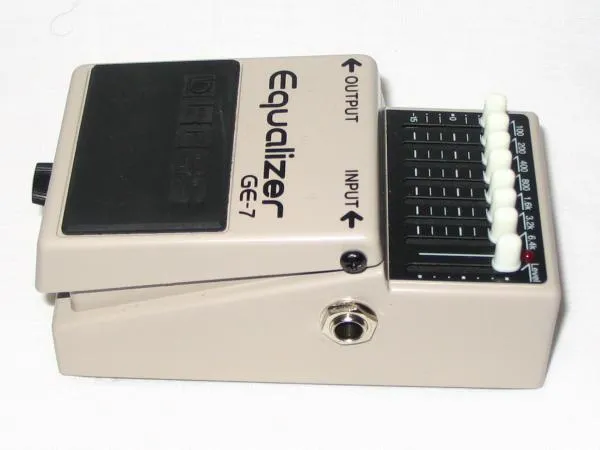
- The Boss GE-7 is a seven-band graphic equalizer in a compact pedal. Each slider boosts or cuts one slice of the frequency range by up to 15 dB, and a separate Level slider raises or lowers the whole signal by up to 15 dB.
- It does far more than fix tone. It can be a clean solo boost, a preamp that pushes your amp or drive pedal, a mid-scooped metal shaper, a fixed “cocked wah” and a feedback fixer.
- Where it sits matters. Before a drive, it changes how that drive distorts. After a drive, or in an effects loop, it shapes the finished sound without adding gain.
- Start with every slider at 0, make small moves, and use the Level slider so the pedal doesn’t jump in volume when you switch it on.
What the GE-7 is
A normal amp gives you three tone controls, and each one covers a wide stretch of the spectrum. A graphic EQ splits that spectrum into more, narrower bands, so you can lift or trim one area without dragging its neighbors along. The GE-7’s seven bands sit at 100 Hz, 200 Hz, 400 Hz, 800 Hz, 1.6 kHz, 3.2 kHz and 6.4 kHz. Each is double the one before it, so the sliders are an octave apart, and their positions draw a picture of the curve you’ve dialed in.
Boss’s compact pedal has been around a long time. Reverb notes it’s been in continuous production since 1981, and Boss still sells it today. The one in the archive was bought in 2003 and listed, boxed with its manual, in 2005.
Specs at a glance
| Spec | GE-7 |
|---|---|
| Bands | 100, 200, 400, 800 Hz; 1.6, 3.2, 6.4 kHz |
| Range per band | ±15 dB |
| Level slider | ±15 dB |
| Filter types | Peaking on the six bands up to 3.2 kHz; shelving at 6.4 kHz |
| Bypass | Buffered |
| Input / output impedance | 1 MΩ / 1 kΩ |
| Power | 9 V battery or Boss PSA-series adaptor; 30 mA |
| Size and weight | 73 × 129 × 59 mm; 400 g with battery |
Figures are from Boss’s current published specifications.
Reading the sliders
Boss sums up the GE-7’s range as everything from “reducing rumble, adding low-end warmth, boosting midrange to cut through the mix, or bringing sparkle to the highs.” In guitar terms:
| Slider | Region | What you’ll hear |
|---|---|---|
| 100 Hz | Lows | Thump and boom. The low E string’s fundamental is about 82 Hz, just below it. |
| 200 Hz | Upper lows | Body and warmth; too much sounds muddy. |
| 400 Hz | Low mids | Thickness and “wood”; too much sounds boxy. |
| 800 Hz | Mids | Where a guitar lives in a band mix: punch and presence. |
| 1.6 kHz | Upper mids | Bite and attack; helps leads cut through. |
| 3.2 kHz | Presence | Edge and clarity; too much is harsh or fizzy. |
| 6.4 kHz | Highs (shelf) | Air and sparkle across the whole top end. |
The top slider behaves a little differently from the rest. The first six are peaking filters: each one boosts or cuts a hump centered on its frequency. The 6.4 kHz slider is a shelving filter, which raises or lowers everything above it, like a treble knob. That’s why it’s the smoothest way to brighten or darken the overall sound.
Starting-point settings
The charts below are starting points built from the techniques Boss describes in its own EQ articles (linked in the sources). Every guitar, amp and room is different: treat the numbers as a place to begin, then trust your ears.
Start here: flat
With every slider on its center line the pedal should sound almost the same on and off. The seller found exactly that: “With all sliders in the 0 dB positions, the guitar signal (tone, level, etc.) remains almost unchanged between switching the pedal on and off.” Set your curve from here, then use Level to match the bypassed volume, or to deliberately make it louder.
Clean solo boost
The simplest boost is all bands flat with the Level slider up. Boss points out that a solo usually doesn’t need the whole range louder, though: “a simple kick to the upper mids and treble frequencies is sufficient” and sits better in the mix than a blanket volume jump. That’s close to how the archived pedal was used, as an “unobtrusive” lead booster in front of a Marshall that was already distorting.
Mid push into an amp or overdrive
Placed in front of a high-gain amp, Boss suggests boosting “a relatively broad range of the upper mid frequencies (roughly the 400 Hz–1.6 kHz sliders on a BOSS GE-7),” then pulling 100 Hz down slightly, and 200 Hz too if it needs more, for a tight, articulate drive. The same move in front of an overdrive pedal, with a moderate Level boost, pushes the pedal harder for a thicker drive that keeps its clarity in the mids.
Clean “second channel” for a one-channel amp
Running into the front of a single-channel tube amp set for crunch, you can do the reverse: pull the Level slider down to hit the amp’s preamp more gently and clean it up. On its own that can sound flat, so Boss suggests cutting some mids, which “will often expose and add a little sparkle to the high frequencies.”
Metal mid scoop
This is the classic “V” the seller mentioned: “put the sliders in a ‘V’ shape for an instant metal tone.” Boss’s version goes after a distortion pedal: lower the mids around 400 Hz–1.6 kHz, then add a gentle bump around 3.2 kHz and at 100–200 Hz for a “thick, modern, weighty distortion tone.”
Don’t scoop yourself out of the band. A deep V sounds huge on its own, but the mids are where a guitar cuts through. Boss makes the same point about classic fuzz tones, whose scooped midrange means they “can quickly disappear in a mix alongside a drummer and bass player.” If you vanish at rehearsal, bring 800 Hz back up.
Fuzz rescue
That’s also the fix for a fuzz that disappears in the band. Put the GE-7 after the fuzz and boost roughly 800 Hz–1.5 kHz (the 800 and 1.6k sliders). Boss says this lifts the fuzz above the bass and drums while keeping its character.
Cocked wah
A wah pedal parked halfway gives that nasal, vocal tone heard on Dire Straits’ “Money for Nothing.” The GE-7 can freeze it in place. Boss’s method: pull every other band to its minimum first, then boost 400 Hz–1.6 kHz. Cutting that much drops the volume, so raise Level to taste.
Clearer reverb into the front of the amp
If your amp has no effects loop, a reverb pedal in front of it can come out muddy. Boss suggests a GE-7 after the reverb with “a light boost in treble frequencies and a slight cut in the bass frequencies” to clean up the tails.
Notching out feedback
The seller listed “notching out feedback for acoustic or electric guitars” among the GE-7’s uses, and Boss describes it as a compact preamp for acoustic-electrics that can cut “frequencies that can trigger feedback on stage.” Feedback rings at one pitch, so the trick is to find the slider nearest that pitch and cut only that one:
- Set up at performance volume with the GE-7 on and flat.
- When the ring starts, listen to its pitch. A low boom points to the 100–200 Hz sliders, a honk to the mids, and a whistle to the top.
- Pull the most likely slider down a few dB. If the ring doesn’t change, put it back and try its neighbor.
- Once it stops, cut only as far as you need, usually a few dB, and leave the rest flat so the guitar keeps its tone.
- Use Level to make up any lost volume.
The GE-7’s bands are fixed, so you can only cut at the nearest of its seven frequencies. A dedicated acoustic preamp with a sweepable notch filter can target a feedback frequency more precisely.
Where to put it
Boss itself calls EQ placement “open to debate”: some players shape their basic tone first, others shape the finished sound last. Both work; they just do different jobs.
| Position | What it does | Good for |
|---|---|---|
| Before drive pedals | Changes what the drive “sees”; boosted bands distort more, and a Level boost adds gain | Mid push, reshaping a drive’s voice |
| After drive pedals | Shapes the finished distorted sound | Metal scoop, fuzz rescue |
| Front of a clean or edge-of-breakup amp | Acts as a preamp or a switchable boost | Solo boost, clean “second channel” |
| Amp effects loop | Shapes the amp’s own distortion without adding gain | Final tone tweaks, solo volume lift |
Because the GE-7 has buffered bypass, its circuit keeps driving the cable even when the pedal is off. Boss notes that buffered pedals help “protect the quality of the tone all down the line” in a long chain, which is part of why the seller found it “definitely is not a ‘tone sucker’.”
Tips for better results
- Cut before you boost. Removing what you don’t want often sounds more natural than piling on what you do. Boss notes that boosting frequencies “raises the noise floor and can create some amp hiss,” so heavy boosts on several bands can get noisy.
- Small moves first. A few dB on one slider is often enough. The full ±15 dB is there for special effects like the cocked wah.
- Match the Level. Louder almost always sounds “better” for a moment. Match the on/off volume before judging a curve, unless the point is a boost.
- Check it with the band. A setting that sounds great alone may vanish, or poke out too much, at band volume.
- Mark your settings. Slider positions are easy to bump. A photo on your phone saves a favorite curve.
Can you use a GE-7 on bass?
You can, and it works for midrange and treble shaping, but it isn’t built for it. The GE-7’s lowest slider is 100 Hz, while a four-string bass’s open E sits around 41 Hz, so the very bottom of a bass is below anything the pedal can directly boost or cut. Boss makes a bass version, the GEB-7, with bands at 50, 120, 400, 500 and 800 Hz and 4.5 and 10 kHz, which it describes as covering a range “specifically designed for bass.” A bass like the 2010 Precision Bass in our spotlights is the kind of instrument it’s meant for.
Sources
- GE-7 Equalizer: features and specifications — Boss
- GE-7 Owner’s Manual (PDF) — Boss
- Five Creative Ways to Use an EQ Pedal for Guitar — Boss Articles
- Pedal Partners: Combining EQ with Other Effects — Boss Articles
- The Ultimate Guide to Guitar Effects Pedal Order and Signal Chain — Boss Articles
- The Complete Guide to Acoustic Guitar Effects Pedals and Signal Chain — Boss Articles
- GEB-7 Bass Equalizer: specifications — Boss
- Boss GE-7 Graphic EQ — Reverb
- Piano key frequencies (E1 and E2) — Wikipedia