The short version
- Fender started using “N” serial prefixes for the 1990s in 1990, and the second character usually tracks the year: N0 for 1990, N1 for 1991, and so on.
- The serial decals were printed well in advance, and some “N9” decals meant for 1999 ended up on guitars built in 1990. Fender says so in its own dating guide.
- So an American-made (MIA) Fender with an N9 serial and early-’90s features may well be a 1990 guitar, not a 1999.
- A serial is only a starting point. Confirm the date with the guitar’s features, the neck date and the pot codes.
What Fender says
Fender’s own guide to dating American-made instruments addresses the N9 puzzle directly:
“The numbers and decals were produced far in advance, and some N9 decals (denoting 1999) were inadvertently affixed to some instruments in 1990. Consequently, some 1990 guitars bear 1999 ‘N9’ serial numbers.”
Fender’s year-by-year chart lists E9, N9 and N0 serials all under 1990. Collector research on the American Standard Telecaster adds a plausible explanation of how it happened: by autumn 1990 the factory had run out of E9 decals. The prefix letter-and-digit and the six-digit number were separate decals, and N9 prefixes were used by mistake until N0 decals took over late in the year.
Fender also cautions that serials are never a precise birth certificate. Its production is modular, and its serial numbering has historically overlapped by two to four years.
US Fender serial prefixes at a glance
A simplified version of Fender’s chart for American-made instruments, with the overlapping years shown:
| Years | Typical prefixes | Notes |
|---|---|---|
| 1976–1978 | S6–S9 | “S” for the ’70s |
| 1979–1981 | S9, E0, E1 | “E” (’80s) begins overlapping |
| 1982–1984 | E1, E2, E3 | US Vintage reissues used a separate “V” prefix |
| 1985–1987 | E3, E4 | |
| 1988 | E4, E8 | |
| 1989 | E8, E9 | |
| 1990 | E9, N9, N0 | The N9 mix-up year |
| 1991 | N0, N1 | |
| 1992–1999 | N2 … N9 | “N” for the ’90s, continuing in sequence |
| 2000 | N9, Z0, DZ0 | “Z” for the 2000s; “DZ” on American Deluxe models |
| 2010 onward | US + 2-digit year | e.g. US10… for 2010 |
Fender’s guide also lists less common prefixes from the same era, including EE (US-made guitars for European export in the mid-to-late ’80s), a limited H/I/K-prefix export run made in 1989–1990, and DN on 1998–1999 American Deluxe models.
A worked example: the archived 1990 Telecaster
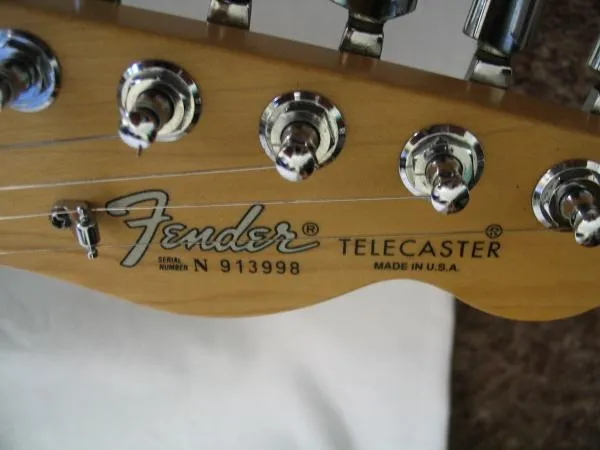
The yellow American Standard Telecaster in the archive is a textbook case. Its headstock decal reads “SERIAL NUMBER N9…” with “MADE IN U.S.A.” (see the photo above). The shop that sold it in 1999 identified it as a 1990, and the seller quoted Fender’s explanation in his 2005 listing.
There’s a second twist. The 1999 purchase receipt lists the guitar as a “’91.” The seller’s theory was that whoever typed the invoice read the “N91…” at the start of the serial as 1991. Under Fender’s scheme, a 1991 serial would start with N0 or N1, not N91, so the receipt is wrong too.
The guitar’s features fit 1990 rather than 1999:
- Serial on the front of the headstock. American Standard Teles carried the serial decal on the headstock face from launch until 1995, when it moved to the back.
- Neck plate with only the Fender logo. The serial wasn’t on the neck plate in this era, matching the listing’s photos.
- A TBX tone control, which Fender replaced with its Delta Tone system around 1998 (see below).
Other ways to date a US Fender
- Neck date. Fender has penciled or stamped production dates on the butt end of the neck heel of most guitars and basses (inconsistently in some eras). You have to remove the neck to see it, and it dates the neck, not the finished guitar, since necks could sit in stock before being paired with a body. If you’re not comfortable removing a neck, have a tech do it.
- Potentiometer codes. Most pots carry an EIA source-date code: a three-digit maker code, then a
two-digit year and a two-digit week. For example,
1377624is CTS (137), 1976, week 24. Other common makers: Stackpole (304), Centralab (134), Allen-Bradley (106). A pot date only gives the earliest possible build date, because Fender bought pots in bulk, and it only helps if the pots are original. - Era-specific features. Decal position, control types (TBX vs. Delta Tone), neck plate style and hardware changed over time. Features that agree with the serial make the date more convincing.
- Paperwork. Receipts and dealer descriptions help, but as the archived Telecaster shows, they can be wrong too.
About that TBX tone control
The seller listed a TBX tone control on his 1990 Tele. That’s factory-correct: the American Standard Telecaster used a TBX tone control from its introduction until about 1998, when the No-Load Delta Tone system replaced it. An owner of an original 1988 example quotes Fender’s description of the part:
“This detented, stacked 250k/1 Meg control enhances your tonal palette without the use of a battery. From 0 to 5, the TBX is your standard tone control, but once you pass 5 you start to decrease the resistance, which allows more bass, treble, presence and output to flow to your amp.”
TBX stands for “Treble Bass Expander.” It first appeared on the Elite Stratocaster in 1983, became the second tone control on the American Standard Stratocaster from 1987 (until Delta Tone arrived there in 1997), and carried over to models such as the Eric Clapton signature Strat. The archived listing describes using it exactly as intended: “bumping the pot over the center notch to enhance the treble response” to cut through the band on leads.
The American Standard Telecaster in brief
Fender relaunched its core US models as the “American Standard” line in the late ’80s. The Stratocaster came first, officially introduced at the January 1987 NAMM show. The Telecaster first appears on Fender’s January 1988 price list, although some casual sources give 1987 for both. It stayed in production until 2000. Typical specifications of the early models:
- Alder body (ash came later) with a polyurethane finish
- Bolt-on maple neck with Micro-Tilt adjustment, a slim “C” profile and a satin finish
- 22 medium-jumbo frets on a 9.5″ radius fingerboard, maple or rosewood; 1-11/16″ nut
- Fender-branded sealed Schaller-made tuners
- Two single-coil pickups (chrome-covered neck pickup), 3-way selector, volume and TBX tone
- Six-saddle bridge with through-body stringing
Quick dating checklist
- Read the serial prefix and find it in the chart above. Treat the result as a range, not a single year.
- Prefixes that span two years need extra care: E9 points to 1989–1990, N0 to 1990–1991, and N9 to 1990 or 1999.
- Check that the features match the era: decal position, controls, neck plate, hardware.
- Check the pot codes if the pots look original.
- If it matters, for example for a sale or insurance, check the neck heel date or ask a qualified tech.
Sources
- How can I find out when my American-made instrument was manufactured? — Fender Support
- US Standard Telecaster timeline and specifications — Alston family collector site
- US Standard Stratocaster timeline and specifications — Alston family collector site
- Feature: 1988 Fender Telecaster American Standard — Crave Guitars
- Fender Elite Stratocaster — Wikipedia
- Fender neck dates — Joe’s Vintage Guitars
- Pot codes can help date your guitar — Still Kickin Music
- Pot code reader — Guitar Dater Project