The short version
- Fulltone was founded in California in 1991 by Michael “Mike” Fuller and is widely counted among the first “boutique” pedal companies. It became best known for overdrives: the Full-Drive line in the 1990s and the OCD from 2004.
- The Culver City, California shop closed in 2022. In 2024 the brand returned as Fulltone USA, with Fuller designing and Jackson Audio building and distributing.
- This archive has sold four Fulltones: the Fulltone Plimsoul, the 2012 Fulltone Secret Freq, the 2014 Fulltone Octafuzz and the 2014 Fulltone Full Drive 2 Mosfet. All four are on this page with prices, photos and the seller’s original words.
- Used Fulltones got more expensive after the 2022 closure, so shop with a plan. We explain which version of a pedal to look for, and what we could and could not confirm.
Mike Fuller and Fulltone
Most of the company story here comes from three places: the Wikipedia article (which cites trade press such as Guitar World, MusicRadar and Guitar.com), the 2024 launch coverage by Guitar World and MusicRadar, and a long Sweetwater video interview with Fuller and Brad Jackson. The Sweetwater page lists the chapters of that interview, which is how we know what they talked about, but it has no transcript, so we do not quote it.
| When | What happened |
|---|---|
| 1991 | Michael Fuller founds Fulltone in California (Wikipedia). The Sweetwater interview starts its story in the 1980s, before the company existed. |
| 1990s | The brand finds success largely through print marketing, on the strength of the Full-Drive overdrives. The lineup grows to include the Plimsoul and the Clyde wah, among others. |
| 2004 | The Obsessive Compulsive Drive (OCD) arrives and becomes the company’s signature pedal. MusicRadar later calls it “one of the most legendary overdrives ever made.” |
| 2011 and 2012 | Reviews of the Plimsoul (Bonedo, March 2011) and the Secret Freq (Premier Guitar, November 2012) show the lineup still going strong. |
| June 2020 | After social media comments by Fuller during that month’s protests, Guitar Center stops selling Fulltone and Reverb suspends sales of new and B-stock Fulltone pedals. Fuller apologizes. More on this below. |
| 2022 | The Culver City shop closes after about 30 years. Fuller says that building everything in the United States is no longer profitable, and says he will keep making pedals in small numbers to protect his trademarks and patents. Used prices climb, by as much as 500% according to one report. |
| January 2024 | Fulltone returns as Fulltone USA in partnership with Jackson Audio, announced around NAMM 2024. Fuller moves to Nashville and becomes Chief Design Officer with approval over the products; Brad Jackson leads the business, and Jackson Audio makes and ships the pedals in the United States. |
A note on the 2022 closure: Josh Scott of JHS Pedals called it the end of the boutique-pedal era (“There’s really nothing left,” as Wikipedia quotes him, from an interview with Guitar magazine). That is one opinion from a fellow pedal maker, but it shows how the industry saw Fulltone: a benchmark, not a niche name.
The pedals, in plain terms
Fulltone made a long list of pedals, and the notes here only cover what we could confirm from the pages we read. Years are given only where a source gave them.
| Pedal | What it is | What to know |
|---|---|---|
| Full-Drive (1, 2 and 3) | The 1990s overdrive line that built the brand. | Fuller and Jackson devote separate chapters of the Sweetwater interview to “Full-Drive vs. Full-Drive 2” and to the Full-Drive 3. Exactly how the versions differ is covered below, with caveats. |
| OCD (Obsessive Compulsive Drive) | An open-sounding overdrive with headroom, meant to act like a driven tube amp. | Seven versions with different circuit-board layouts, then a V2. See the OCD section. |
| Plimsoul | A distortion/overdrive that blends two clipping styles. | One of ours. See below. |
| Secret Freq | An overdrive with a midrange boost control. | One of ours. See below. |
| Octafuzz | An octave-up fuzz. | One of ours. See below. |
| Soul-Bender, ’69 MkII, ’70-BC | Germanium and silicon fuzzes in the Tone Bender and Fuzz Face traditions. | GuitarPedalX’s 2020 roundup of Fuller’s best pedals picks these as favorites; the Soul-Bender is its Tone Bender MkII-style entry, and the ’69 MkII and ’70-BC its Fuzz Face-style ones. |
| DejaVibe, Supa-Trem2, Wahfull and others | Uni-Vibe-style modulation, a tremolo and a fixed wah. | Not in the archive, so we do not cover them here. The Sweetwater interview has chapters on the Supa-Trem2, the HiMu and the “ultimate wah.” |
Fulltone Plimsoul
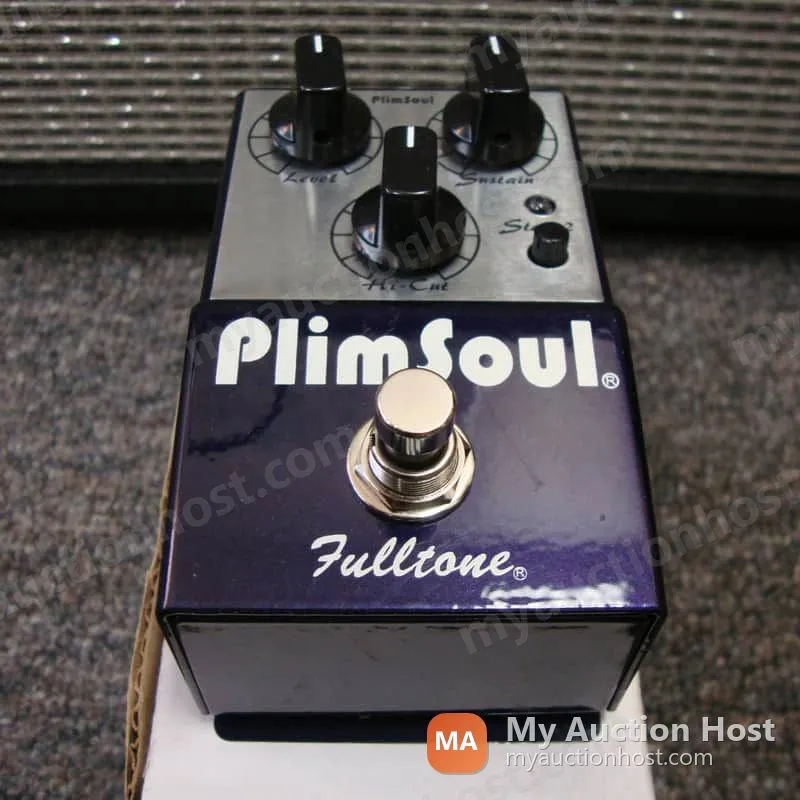
Of the four, the Plimsoul is the one the seller liked best. The archived sale reads: “one of my favorite Fulltone pedals,” with “a lot of sweet harmonic content,” and a description of the circuit as combining “the hard clipping of a RAT-like circuit with the softer clipping of a Tubescreamer-like circuit.” It sold for $75, April 12, 2018, with the box and paperwork. The Fulltone Plimsoul page has nine photos.
That description agrees with the independent review we found. Robby Mildenberger’s Bonedo review (in German, March 2011) says the pedal blends a soft clip of the Tube Screamer kind with a harder clip like the Distortion+, the RAT or the DS-1, and that a “Stage 2” trim control sets the blend, with an LED that brightens as you turn it up. The other controls are Gain, High-Cut and Level. It is hand-built, true bypass and runs on 9 or 18 volts, with a slight difference in sound between the two. Mildenberger hears it as a mix of overdrive and fuzz: sweet and a little fuzzy past noon on the gain knob, clear at full gain, responsive to picking dynamics, and not a high-gain machine for fast legato leads.
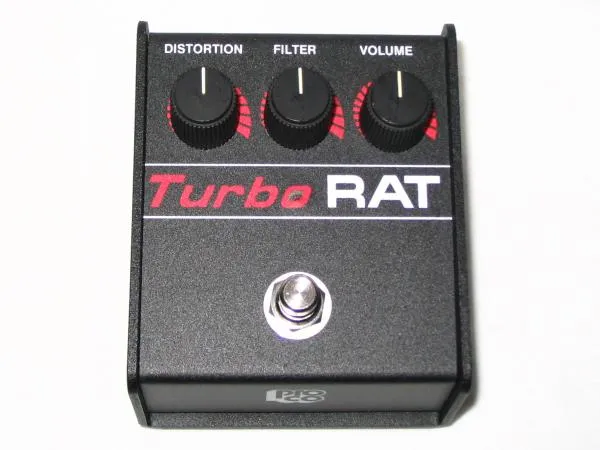
Bonedo adds that Fulltone itself describes the pedal as a mix of overdrive and distortion. If you want to see what “hard clipping” means and how it differs from the soft kind, our Pro Co RAT guide explains it, along with the RAT clones we have sold.
Fulltone Secret Freq
The 2012 Fulltone Secret Freq (a 2012 model) sold for $80, May 8, 2017. The seller called it “flexible, harmonically-rich and beefy,” noted that it does the “cocked-wah midrange thing” described in reviews but excels as a distortion, and wrote that it seems “a bit more tweakable and versatile than the PlimSoul.” The seller also quoted Fuller: it is not an OCD and not a Plimsoul. It has its own thing going.
Premier Guitar’s review by James Volpe Rotondi (November 5, 2012) fits that picture: a pedal built around a midrange boost of up to about 20 dB, good at the mid-heavy tones that define a lot of classic rock. The review is partly paywalled, so we lean on its summary and leave out its price and star ratings. Our seller’s tip, from the archive, is to turn the mids up and the highs down a little to get “a brown sound going.” Treat that as one player’s taste.
Fulltone Octafuzz
The 2014 Fulltone Octafuzz was bought new in 2014, and the seller says it “never left my office.” It sold for $100, February 4, 2018, shipped with a sealed carbon battery. The seller was clear that it had no mods, repairs or velcro and still had its original clear feet.
The Octafuzz is Fulltone’s take on the Tycobrahe Octavia, the octave-up fuzz that has long been tied to Jimi Hendrix. Fulltone’s own marketing calls its circuit an exact copy of the Tycobrahe Octavia, wording that retailers repeat; see, for example, the “From Fulltone” description on a Reverb listing. We found no independent source confirming that claim, and the history of the original is argued over by forum posters, so read it as Fulltone’s own statement. The later OF-2 has three controls: volume, boost and a switch between Octa and Fuzz, according to GuitarPedalX.
Where a fuzz like this belongs in your signal path is covered in our pedal-order guide.
Fulltone Full-Drive 2 Mosfet
The Full-Drive line is what put Fulltone on the map, and the 2014 Fulltone Full Drive 2 Mosfet in the archive is from the later, Mosfet generation. It was bought in 2014, was “basically unused” and sold for $75, February 1, 2018, shipped with a sealed carbon battery.
Here is where we have to be careful. The nine pages we read for this guide do not lay out what separates the Full-Drive from the Full-Drive 2 and 3, or what the “Mosfet” in the name changes. The Sweetwater interview chapters show the topic was discussed, and the name itself points to a MOSFET-based design, but we will not guess at the circuit. What we do have is a forum thread, which is opinion and anecdote only: on the Seymour Duncan forum, posters say that the earliest orange Full-Drive II units had no mini switches or pull-up knobs, that a pull-up volume for flat mids came a few months later, and that the color changed to blue about a year after that. One poster dates his own pedal to January 1996. Take it as a lead, not a chart.
If the exact version matters to you, ask the seller for photos of the controls and compare them with the maker’s own pages or ask Fulltone USA. The model list is long, and a listing title is not always right.
The OCD: the one everyone asks about
The archive has not sold an OCD, but any guide to Fulltone has to cover it. MusicRadar’s FX Files piece by Alex Lynham is a good starting point, and so is Guitar World’s review of the V2 by Paul Riario. Between them:
- The idea. Fuller designed it as an open-sounding drive with headroom, intended to act like a driven tube amp. It runs on 9 to 18 volts, and the higher voltage sounds noticeably less compressed.
- The family tree. MusicRadar says it is essentially a Voodoo Labs Overdrive, similar to a cascaded MXR Distortion+, and partly related to the Tube Screamer. It also notes that Fuller has never confirmed the Tube Screamer link.
- The versions. There are seven V1 versions, told apart by circuit-board layout and the size of the logo on the front panel. The first has an epoxied (“gooped”) board. Versions 1.1 to 1.7 mostly change component values that shape the EQ; the 1.3 raised the drive pot to 1 megohm; a germanium clipping diode was added around version 1.4. MusicRadar says builders often prefer the versions from before the germanium diode.
- The V2. It adds an output buffer, a JFET input stage that raises the input impedance from 330 kilohms to 1 megohm, and an “Enhanced Bypass” option beside true bypass. Riario calls it the best version to date.
- The switch. The HP/LP switch does not select a high-pass or low-pass filter; MusicRadar says it sets the shelving frequency of the Tone control.
In 2024 Fulltone also offered a Custom Shop OCD v1.4 described as a part-for-part recreation (MusicRadar reported it at $249 or £199 at the time). Prices move; check the current ones.
Buying a used Fulltone
These are general notes from us, and where a claim comes from a source we have said so.
- Prices. Guitar.com reported used Fulltone prices rising sharply after the 2022 closure, and Wikipedia cites a figure of up to 500%. Our four sold for $75 to $100 in 2017–18, before any of that. Do not expect those numbers now; compare completed sales, not asking prices.
- Know the exact model and version. “Fulltone OCD” can mean many things (see above). Ask for photos of the front panel, the board and the serial or date information.
- Power. The OCD and Plimsoul take 9 or 18 volts, so check which your supply is giving them; see our pedalboard power guide.
- Clean the controls. Old pots crackle; our DeoxIT guide has the details.
- Fakes and clones. We found no source on counterfeit Fulltones, so we cannot say how common they are. The sensible rules apply: buy from a seller who shows the actual pedal with the inside and the bottom plate, and be careful with prices that look too good.
- Reverb and eBay. Reverb’s 2020 suspension was described as covering new and B-stock Fulltone pedals, and Guitar World wrote in 2024 that it was unclear whether it would resume. Used pedals do turn up on both sites.
Searches for each model we cover:
| Pedal | eBay | Reverb | Amazon |
|---|---|---|---|
| Fulltone OCD | eBay | Reverb ad | Amazon |
| Fulltone Plimsoul | eBay | Reverb ad | Amazon |
| Fulltone Secret Freq | eBay | Reverb ad | Amazon |
| Fulltone Octafuzz | eBay | Reverb ad | Amazon |
| Fulltone Full-Drive 2 | eBay | Reverb ad | Amazon |
| Any Fulltone pedal | eBay | Reverb ad | Amazon |
The Fulltones in this archive
All four were sold by the same seller between 2017 and 2018, each with photos and a full write-up. These pages are history, and the prices were what they fetched.
- Fulltone Plimsoul (sold for $75, April 12, 2018)
- 2012 Fulltone Secret Freq (sold for $80, May 8, 2017)
- 2014 Fulltone Octafuzz (sold for $100, February 4, 2018)
- 2014 Fulltone Full Drive 2 Mosfet (sold for $75, February 1, 2018)
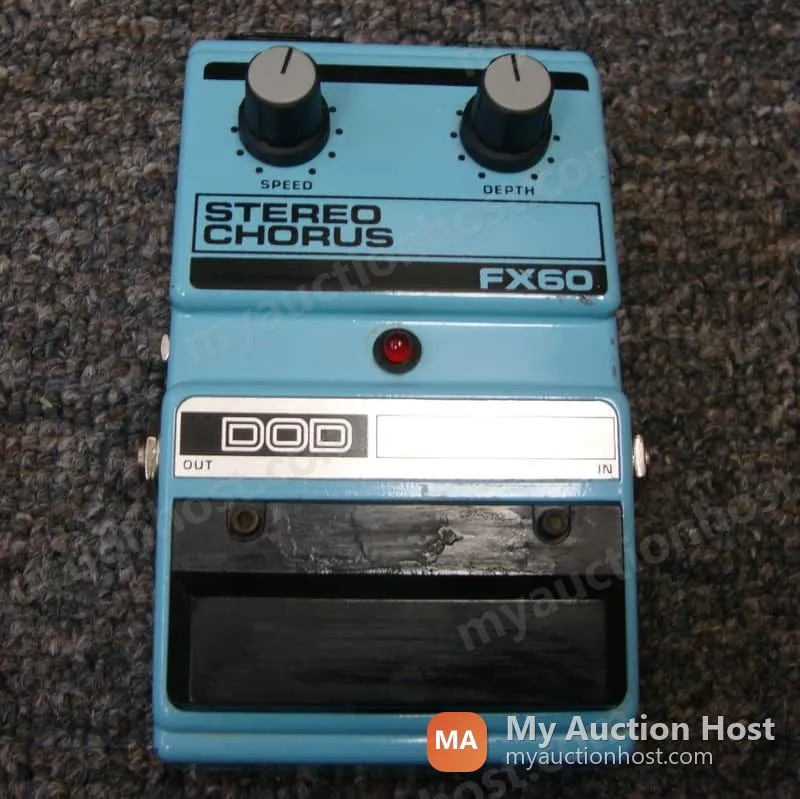
Other pedals on the archive that sit nearby: the RAT and other hard-clipping pedals, and the DOD FX-series pedals that were America’s budget answer to the same era of boutique gear.
The 2020 controversy, briefly
It would be an odd history of the company that left this out. In early June 2020, Fuller posted comments on social media during the protests that followed the death of George Floyd, and in an email reply to a customer. The comments were widely condemned. According to Wikipedia’s summary of the trade press, Guitar Center said it would stop selling Fulltone in stores and online, Reverb suspended sales of new and B-stock Fulltone pedals, and some artists said they would sell their Fulltones. Fuller apologized, saying people were rightfully upset, and later deleted the apology. We are not reproducing the posts here; they are described in the Wikipedia article and in the Guitar World coverage it cites. We mention it because it affected where Fulltones were sold, and because some buyers care. How you weigh it is up to you.
What to keep in mind
- Most details come from reviews and press, not from Fulltone. Where a claim is Fulltone’s own marketing, as with the Octafuzz, we say so. Forum posts are opinion.
- Some sources were only partly readable. The Premier Guitar review is partly behind a paywall, and the Guitar.com stories are known to us through Wikipedia’s citations and search summaries, not read in full.
- No Full-Drive facts beyond the anecdotes. We did not find a source that spells out the Full-Drive versions. If you know of a good one, we would like to hear about it.
- Prices and availability change. Past sales show what these sold for; they are not a quote.
Sources
- Fulltone — Wikipedia
- Fulltone Pedals: Preserving a Legacy of Tone & Partnering with Jackson Audio — Sweetwater InSync (March 11, 2024)
- Fulltone relaunches as Fulltone USA — Guitar World (Phil Weller, January 24, 2024)
- Fulltone effects is back in partnership with Jackson Audio — MusicRadar (Jonathan Horsley, January 24, 2024)
- The FX Files: Fulltone OCD — MusicRadar (Alex Lynham, 2019)
- Review: Fulltone OCD V2 Overdrive Pedal — Guitar World (Paul Riario, 2017)
- Fulltone Secret Freq Pedal Review — Premier Guitar (James Volpe Rotondi, November 5, 2012)
- Fulltone Plimsoul review — Bonedo (Robby Mildenberger, March 21, 2011; in German)
- 9 of Mike Fuller’s best Fulltone pedals — GuitarPedalX (Stefan Karlsson, 2020)
- Fulltone’s Octafuzz OF-2 description (“From Fulltone”) — Reverb listing
- Old Fulltone Full-Drive 2 (forum thread, opinion) — Seymour Duncan forum